



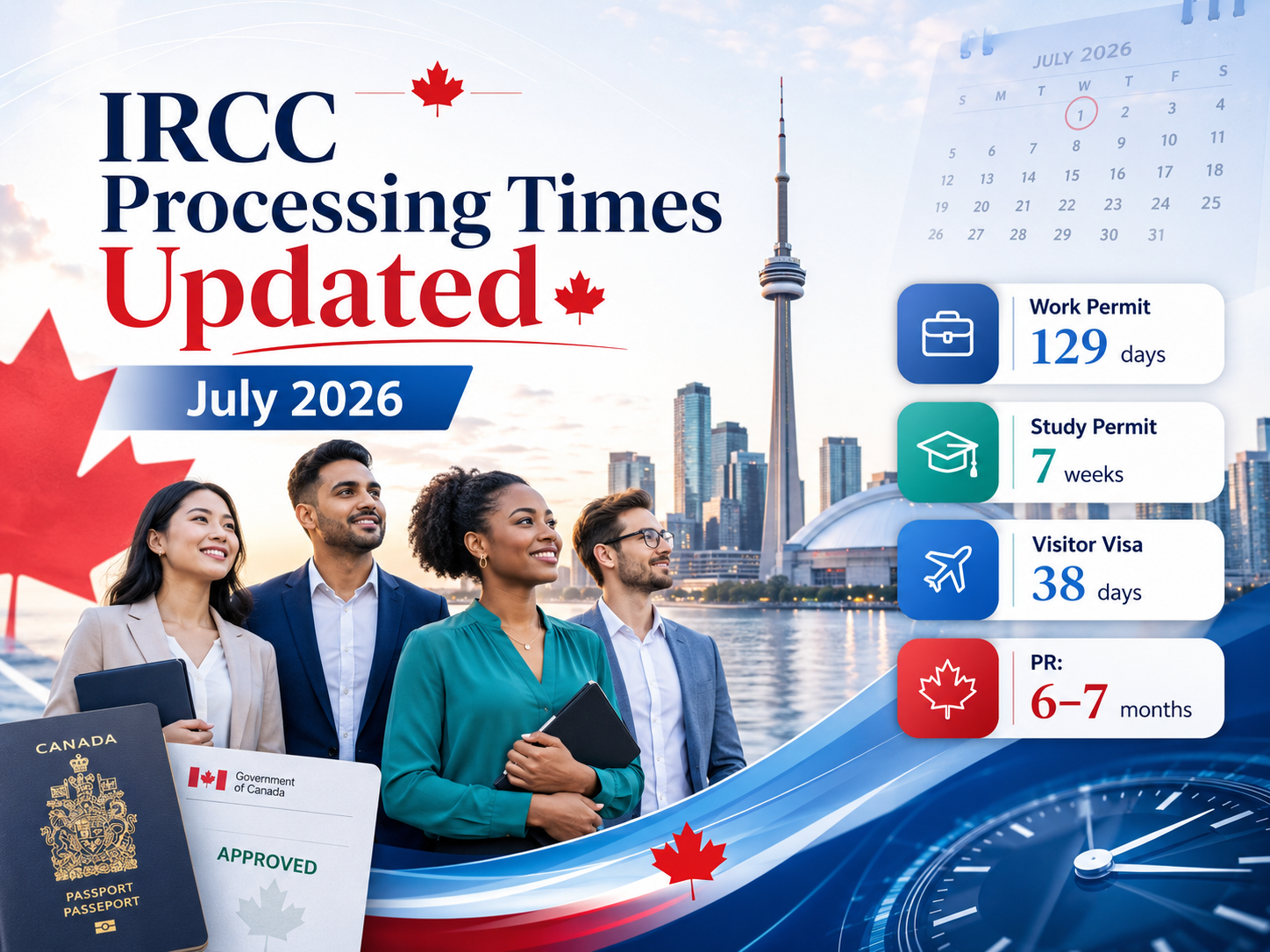
Canada’s newest immigration figures reveal quicker visitor visa decisions in several countries, with India seeing the biggest improvement, while people applying for work permits face longer waiting periods across many parts of the world.
Immigration, Refugees and Citizenship Canada released fresh processing timelines for temporary resident applications. The update covers visitor visas, work permits, study permits, and super visas. The new figures show a clear pattern. Visitor visas now move faster for some applicants, while work permits take longer in several regions.
Visitor visa applicants from India saw the biggest improvement. Processing time dropped by more than two weeks, offering quicker decisions for travellers and families. Applicants from Pakistan and the United States experienced little change, with wait times holding steady.
Applicants inside Canada faced a slightly longer wait than before. Nigerian applicants also saw a small rise in processing time. Even with these changes, visitor visas remained the most consistent category overall. Applications from outside Canada still move closer to the department’s service goal, while no fixed target exists for those applying within the country.
Work permit processing showed the most uneven results. Applicants from Pakistan and the United States now wait much longer than they did in mid-January. Processing times for people applying inside Canada also increased, adding weeks to already long waits.
Indian applicants saw a slight improvement, with timelines shortening by about a week. Nigerian applicants experienced a small drop as well. Despite these few gains, work permits remain the slowest and least predictable option among temporary resident applications.
Study permits showed the least movement. Most regions reported the same timelines as before, with only small increases of about one week in a few countries. This stability suggests that student applications continue to move at a steady pace without major delays or speedups.
Applicants from Canada, Pakistan, and the United States saw no change. India and Nigeria recorded minor increases, but overall processing stayed within a narrow range. For students planning their studies, this consistency provides some certainty.
Super visa processing brought mixed news. Applicants from Pakistan and Nigeria saw modest improvements, with slightly shorter waits. Indian applicants experienced a small increase.
The biggest shift affected applicants from the United States. Their processing time doubled in just two weeks. The sharp rise likely reflects a sudden increase in applications, which added pressure to processing queues.
Processing times reflect estimates for new applications submitted today. The clock starts when officials receive an application and ends with a final decision. Many factors influence the timeline, including case details and how quickly applicants respond to requests.
Service standards act as internal targets for most cases, but some files take longer due to added checks. Not every application type includes a set standard, and officials do not update those targets as often as processing estimates.











Having an ‘Identity Verified’ badge or being ‘Identity Verified’ simply indicates that an individual has submitted information to complete our identity verification process or we have conducted internal verification using various authorized websites. While this process includes safeguards, it does not guarantee that the person is who they claim to be.
If you encounter any issues with this profile, please report them here. While all consultants who are verified have RCIC ID, we may not have the latest data in terms of their renewal/cancellation/discontinuation of their RCIC ID.
╳The “Verified Consultants” profiles on Immiperts.com are independently compiled using publicly available information from multiple sources, including the official CICC Public Register, consultants’ own websites, other public directories, and social media.
Immiperts.com is a completely independent platform and is not affiliated with, endorsed by, or connected to the College of Immigration and Citizenship Consultants (CICC), IRCC, or any immigration consultant.
All information is collected manually and is for educational and informational purposes only. Consultants may claim, update, or request removal of their profile by contacting us at hello@immiperts.com.
Users are strongly advised to always verify the latest authorization status directly on the official CICC Public Register at college-ic.ca.