

You Have the Skills. So Why Does Every Door Feel Closed?
You have years of work experience, a solid educational background, and a genuine desire to build a life in a new country. Yet every immigration pathway you look into seems either out of reach, oversubscribed, or buried in paperwork that leads nowhere.
Thousands of skilled workers miss out on immigration opportunities every year — not because they do not qualify, but simply because they did not know those options existed. The most talked-about visa categories attract the most competition, while quieter, less crowded programs sit largely unused.
Most people start their immigration research in the same place: a quick online search, a forum post, or advice from someone who immigrated years ago under completely different rules. That leads them toward the same handful of programs that everyone else is chasing.
The problem is that immigration policy changes regularly. Programs that were hard to get into five years ago may have opened up. New pathways get created specifically to fill labor gaps in industries and regions that are struggling to attract workers. If you are only looking at the most popular options, you are competing in the most crowded lanes.
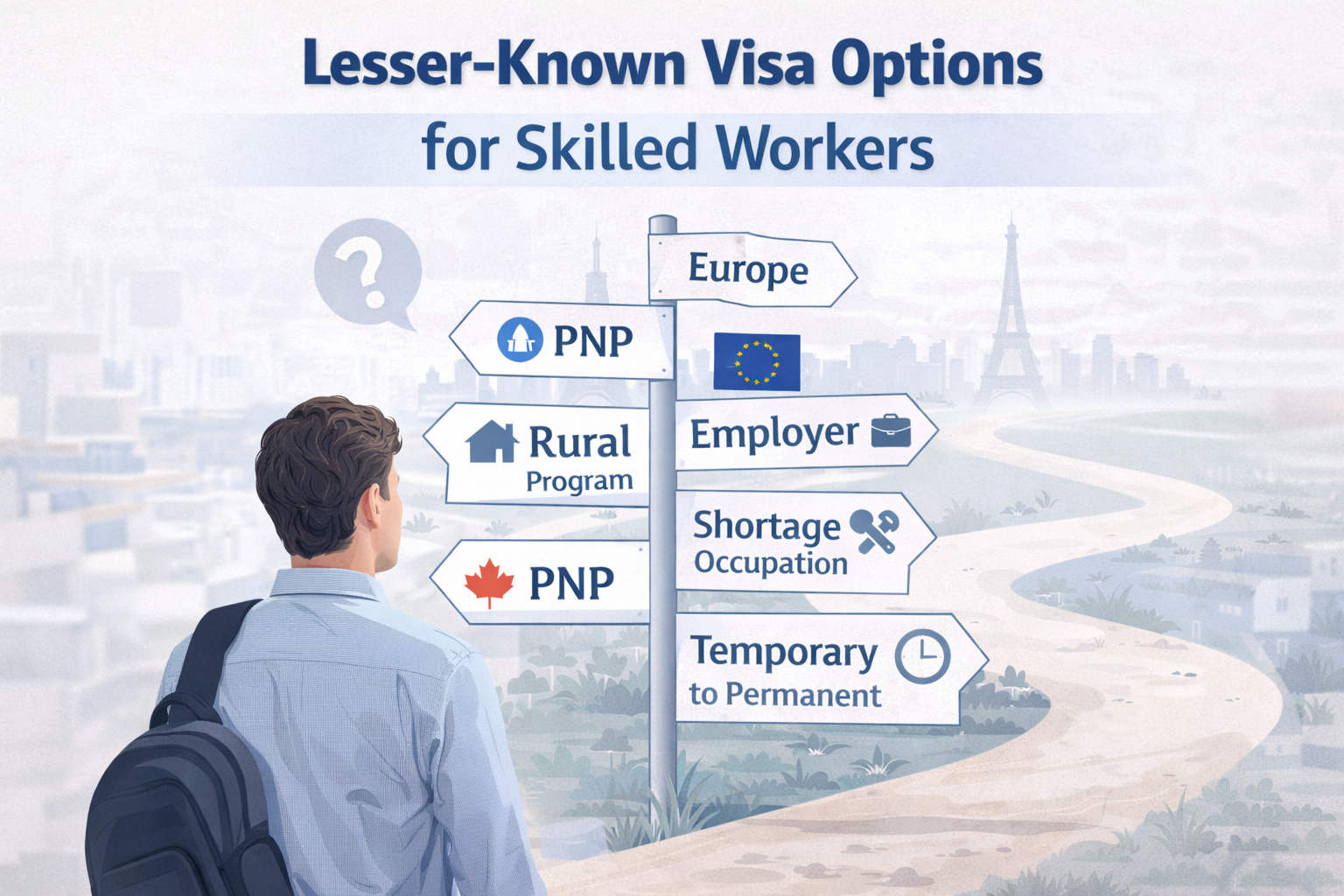
Several countries, including Canada and Australia, have created specific immigration streams designed to bring skilled workers into smaller cities, towns, and rural areas rather than major metros. These programs often have lower point thresholds, faster processing times, and less competition compared to national programs.
Canada's Rural and Northern Immigration Pilot, for example, allows participating smaller communities to directly recommend applicants. Australia has similar state and territory nomination schemes that give preference to workers willing to live outside Sydney, Melbourne, and Brisbane.
If you are flexible about where you settle, at least initially, these programs can be a realistic path in when the national programs feel impossible.
Most countries publish occupation shortage lists, but not many applicants actually use them strategically. These lists change frequently, and a trade or technical occupation that was not on the list two years ago may now be in high demand.
New Zealand, the UK, and Canada all maintain shortage occupation lists that come with advantages such as lower salary thresholds, additional points, or faster processing. Skilled tradespeople, healthcare workers outside of doctors and nurses, and certain technical roles often appear on these lists without attracting the same attention as software engineers or finance professionals.
It is worth checking the current lists in your target countries, not the ones from a blog post written three years ago.
This is one of the most underused pathways in Canada. The Atlantic Immigration Program targets the four Atlantic provinces — Nova Scotia, New Brunswick, Prince Edward Island, and Newfoundland and Labrador.
Employers in these provinces are designated to hire internationally without a Labour Market Impact Assessment in many cases. If you receive a job offer from a designated employer in one of these provinces, you can apply for permanent residence through this stream. The region genuinely needs workers across healthcare, construction, food processing, and several other sectors. It is less competitive than the main Express Entry pool and often gets overlooked simply because people are focused on Toronto, Vancouver, or Calgary.
Most people know that Canada's Provincial Nominee Programs exist, but far fewer explore the entrepreneur and business immigration streams within them. These are not just for wealthy investors. Several provinces have streams designed for people with mid-level business experience who are willing to start or buy a business in that province.
British Columbia, Manitoba, and Saskatchewan have streams with manageable net worth requirements that are well below what federal investor programs demand. If you have run a business before, managed a team, or have experience in a relevant sector, you may meet the criteria without realizing it.
Canada, Australia, the UK, and the US get most of the attention, but several other countries have well-structured immigration programs for skilled workers that are far less competitive.
Portugal's job seeker visa allows you to live in the country while searching for employment, with a path to residency once you find work. Germany has actively opened its skilled immigration program to non-EU workers in recent years, particularly for vocational training holders — not just university graduates. The Netherlands and Ireland both have critical skills permits with relatively clear criteria and reasonable processing times.
These destinations are not backup options. They are fully developed countries with strong labor markets and quality of life. They just get less search traffic.
Many skilled workers arrive in a country on a temporary work visa and give up on immigration entirely because permanent residence seems out of reach. What they miss is that many countries have specific programs that give preference to people already working on the ground.
Canada's Canadian Experience Class, for instance, exists specifically for people who have already been working or studying in Canada. Australia has similar provisions for people on certain temporary work visas. The UK's Skilled Worker visa has a clear route to indefinite leave to remain after five years.
Getting your foot in the door temporarily, and then pivoting to a permanent pathway from within the country, is often more achievable than trying to land permanent residence from abroad on the first attempt.
The biggest mistake is treating immigration research as a one-time task. Programs open, close, change their criteria, and respond to labor market shifts constantly. What someone in an online forum experienced two years ago may not reflect what is available today.
Going directly to official government immigration websites, checking current processing times, and speaking with a registered immigration consultant or lawyer are all things worth doing before making any major decisions. No blog post, including this one, is a substitute for current official information.
If you are feeling stuck, here is a simple approach. Pick two or three countries you are genuinely open to living in. Go to their official immigration websites and look specifically for occupation shortage lists, regional or rural programs, and employer-sponsored pathways. Compare what you find against your own work history, education, and qualifications. You may find that you are closer to qualifying for something than you thought.
The immigration programs that do not get talked about are often the ones with the shortest queues.
1. I don't have a university degree. Can I still qualify for skilled immigration programs?
Yes, in many cases. Several countries, including Germany, Canada through certain provincial streams, and Australia through trade occupation lists, have pathways specifically for people with vocational training or skilled trade experience. A degree is not always a requirement. What matters more is whether your occupation appears on a shortage list and whether you can demonstrate relevant experience.
2. Do I need a job offer before I can apply for most skilled worker programs?
Not always. Programs like Canada's Express Entry Federal Skilled Worker stream, Portugal's job seeker visa, and Germany's job seeker visa allow you to apply without a prior job offer. However, having a job offer often significantly strengthens your application or unlocks additional pathways that are otherwise closed to you.
3. I applied before and got rejected. Does that permanently affect my chances?
A past refusal does not automatically disqualify you from future applications, but it does need to be disclosed honestly on subsequent applications. What matters is whether the reason for the refusal has been addressed. Many people are eventually approved after initial rejections, particularly when they apply to a different program that is a better fit for their profile or when their circumstances change.
4. Are rural and regional immigration programs a trap to get workers into places nobody wants to live?
It is a fair concern, but the reality is more nuanced. Many smaller cities and towns in Canada, Australia, and elsewhere have strong local economies, reasonable housing costs, good public services, and established immigrant communities. The requirement to live in a region is usually tied to the initial residence or work permit stage. After gaining permanent residence, you generally have the freedom to move. Many people who initially settle in smaller communities choose to stay because the quality of life suits them.
5. How do I know if an immigration consultant or agent is legitimate?
In most countries, immigration consultants are required to be registered with a regulatory body. In Canada, look for membership with the College of Immigration and Citizenship Consultants (CICC). In Australia, consultants must be registered with the Office of the Migration Agents Registration Authority (OMARA). In the UK, look for registration with the Office of the Immigration Services Commissioner (OISC). Always verify registration directly on the official regulatory body's website before paying anyone for immigration advice.
Having an ‘Identity Verified’ badge or being ‘Identity Verified’ simply indicates that an individual has submitted information to complete our identity verification process or we have conducted internal verification using various authorized websites. While this process includes safeguards, it does not guarantee that the person is who they claim to be.
If you encounter any issues with this profile, please report them here. While all consultants who are verified have RCIC ID, we may not have the latest data in terms of their renewal/cancellation/discontinuation of their RCIC ID.
╳The “Verified Consultants” profiles on Immiperts.com are independently compiled using publicly available information from multiple sources, including the official CICC Public Register, consultants’ own websites, other public directories, and social media.
Immiperts.com is a completely independent platform and is not affiliated with, endorsed by, or connected to the College of Immigration and Citizenship Consultants (CICC), IRCC, or any immigration consultant.
All information is collected manually and is for educational and informational purposes only. Consultants may claim, update, or request removal of their profile by contacting us at hello@immiperts.com.
Users are strongly advised to always verify the latest authorization status directly on the official CICC Public Register at college-ic.ca.