

Two Systems. One Country. And Most People Only Know Half the Picture.
When people research Canadian immigration, they almost always land on Express Entry first. It is the most talked-about, the most searched, and the most misunderstood.
What most applicants do not realize early enough is that Canada runs two parallel immigration systems — federal and provincial — and for many people, the provincial route is the more realistic one. Knowing the difference between them is not just useful background information. It directly affects which pathway you pursue and how long the process takes.
Canada is a federation. The federal government sets national immigration targets and manages the main skilled worker programs. But provinces have significant power over their own economies and labor markets.
Because labor needs vary dramatically from province to province, the federal government gave provinces the ability to nominate their own immigrants. A software engineer may be in demand everywhere, but a fish harvester is specifically needed in Newfoundland. A francophone community worker is a priority in Manitoba in a way that does not apply nationally.
The two systems exist because one size genuinely does not fit all.
Federal immigration programs are managed entirely by Immigration, Refugees and Citizenship Canada, known as IRCC. The most well-known is Express Entry, which manages three streams.
The Federal Skilled Worker Program is for professionals with foreign work experience in eligible occupations. The Federal Skilled Trades Program is for qualified tradespeople. The Canadian Experience Class is for people who already have skilled work experience inside Canada.
All three streams feed into the same Express Entry pool. Candidates are ranked by their CRS score, and those with the highest scores — or those in a priority category — receive invitations to apply for permanent residence.
The federal system is national. If you get invited and approved, you can live and work anywhere in Canada.
Provincial Nominee Programs, known as PNPs, allow individual provinces and territories to select immigrants based on their own labor market needs.
Each province has its own streams, its own eligibility criteria, and its own processing timelines. What works in Ontario may not exist in Saskatchewan. What is in demand in Alberta may be completely irrelevant to New Brunswick.
There are two ways a provincial nomination feeds into permanent residence. The first is the enhanced nomination, which adds 600 points to your Express Entry CRS score — effectively guaranteeing an invitation in the federal pool. The second is a non-Express Entry paper-based application sent directly to IRCC, which takes longer but does not require an Express Entry profile at all.
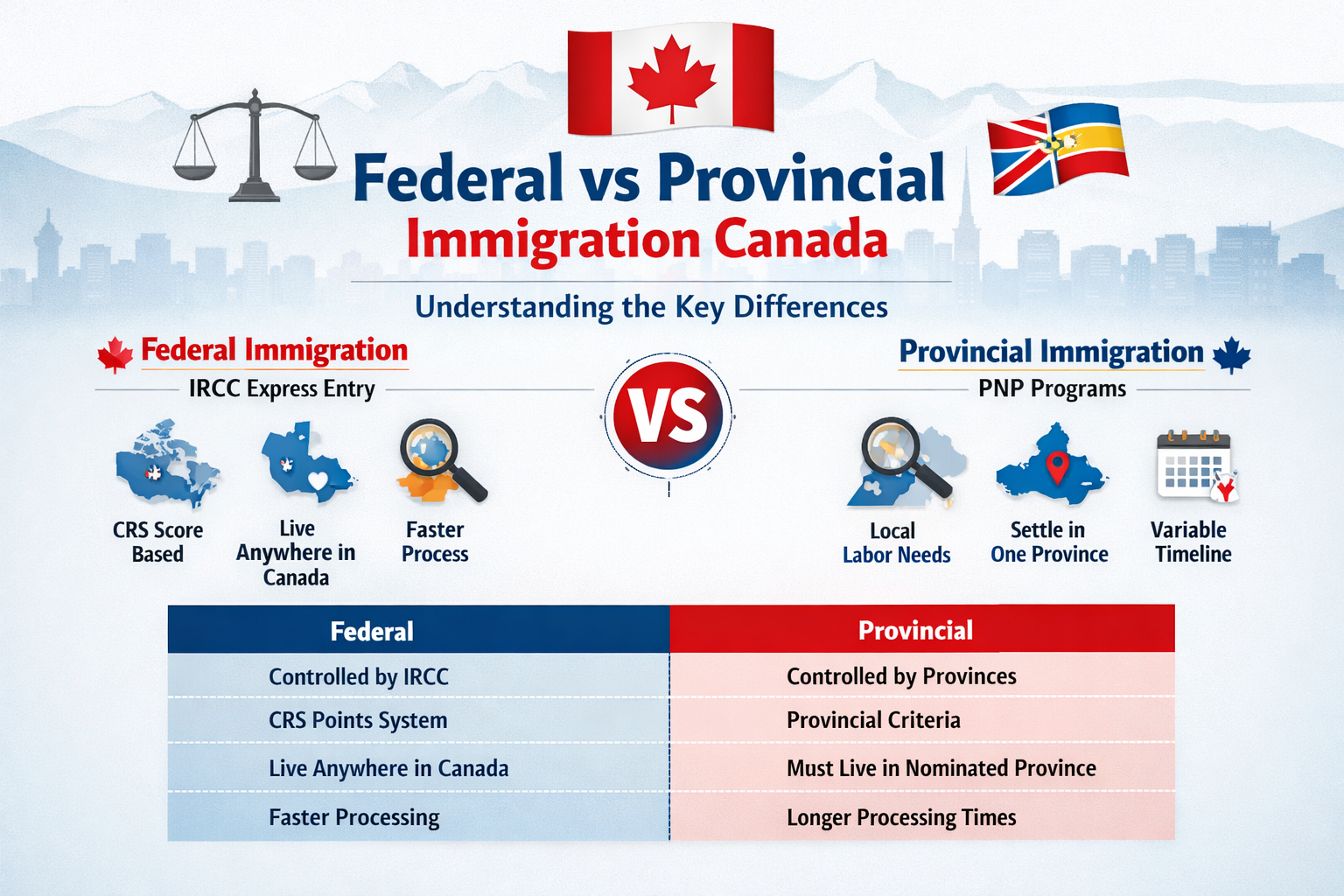
Who controls it — Federal programs are run by the national government. Provincial programs are run by each individual province.
Who decides if you qualify — In federal programs, your CRS score largely determines your fate. In provincial programs, the province assesses your fit for their specific labor market needs.
Where you can settle — Federal permanent residence lets you live anywhere in Canada. A provincial nomination comes with an expectation — and sometimes a formal requirement — to settle in that province, at least initially.
How competitive it is — Federal draws pull from a national pool of hundreds of thousands of candidates. Provincial draws are smaller and more targeted, which often makes them more accessible for applicants who do not score highly enough for federal draws.
How long it takes — Express Entry federal processing targets six months after invitation. Provincial programs vary widely — the nomination itself can take weeks or months depending on the province and stream, and then federal processing follows.
Federal programs work well when your CRS score is competitive, your occupation is in demand nationally, and you have flexibility about where in Canada you want to live.
If you score above the typical invitation threshold for general draws, or if your occupation has been included in recent category-based draws, staying in the federal pool and waiting for an invitation is a reasonable strategy.
People with strong language scores, Canadian work or study experience, or in-demand STEM and healthcare occupations often find the federal route straightforward.
Provincial programs tend to work better when your CRS score is not high enough for federal draws, your occupation is in demand in a specific province but not nationally, or you already have a connection to a particular province through work, family, or a job offer.
They are also worth exploring if your profile is unusual in some way — self-employed, older applicant, non-traditional occupation — that the federal points system does not reward well.
The trade-off is that you are committing to a specific province, at least for an initial period. But for many applicants, that is a reasonable exchange for a realistic path to permanent residence.
Yes, and many applicants do.
Having an active Express Entry profile does not prevent you from applying to a provincial nominee program simultaneously. If a province nominates you, the 600-point boost essentially lifts you out of the federal competition pool. If a federal category draw targets your occupation first, you can accept that invitation instead.
Running both tracks in parallel is not complicated, and it gives you more ways to succeed.
Many people spend months focused entirely on their federal CRS score — working on language tests, waiting for points to improve — while provincial programs that could move faster sit completely unexamined.
The two systems are designed to work together. Using both of them strategically, rather than treating them as alternatives, is usually the smarter approach.
1. Can I apply to multiple provincial nominee programs at the same time?
Yes. There is no rule preventing you from applying to more than one province simultaneously, as long as you meet each program's eligibility criteria.
2. If I get a provincial nomination, do I have to stay in that province forever?
No. Once you have permanent residence you are free to move anywhere in Canada. The expectation to settle in the nominating province applies during the application process and initial settlement period.
3. Does a provincial nomination guarantee permanent residence?
A nomination significantly strengthens your application but does not guarantee it. IRCC still conducts its own assessment, including admissibility checks, before approving permanent residence.
4. Which provinces are the easiest to get a nomination from?
It depends entirely on your occupation and profile. There is no universally easier province — what matters is whether your specific background matches what a province currently needs.
5. Do I need a job offer for provincial programs?
It depends on the stream. Some provincial streams require a job offer. Others do not, particularly streams that draw directly from the Express Entry pool based on occupation or points.
Having an ‘Identity Verified’ badge or being ‘Identity Verified’ simply indicates that an individual has submitted information to complete our identity verification process or we have conducted internal verification using various authorized websites. While this process includes safeguards, it does not guarantee that the person is who they claim to be.
If you encounter any issues with this profile, please report them here. While all consultants who are verified have RCIC ID, we may not have the latest data in terms of their renewal/cancellation/discontinuation of their RCIC ID.
╳The “Verified Consultants” profiles on Immiperts.com are independently compiled using publicly available information from multiple sources, including the official CICC Public Register, consultants’ own websites, other public directories, and social media.
Immiperts.com is a completely independent platform and is not affiliated with, endorsed by, or connected to the College of Immigration and Citizenship Consultants (CICC), IRCC, or any immigration consultant.
All information is collected manually and is for educational and informational purposes only. Consultants may claim, update, or request removal of their profile by contacting us at hello@immiperts.com.
Users are strongly advised to always verify the latest authorization status directly on the official CICC Public Register at college-ic.ca.