

Trying to figure out proof of Canadian citizenship can feel frustrating. Many people don’t know which documents actually count or whether they are already citizens. This confusion often delays passport applications, travel plans, or even career opportunities. Some people only discover much later that they were eligible all along, which makes the situation even more stressful.
The good news is that once you understand the basics, everything becomes much clearer.
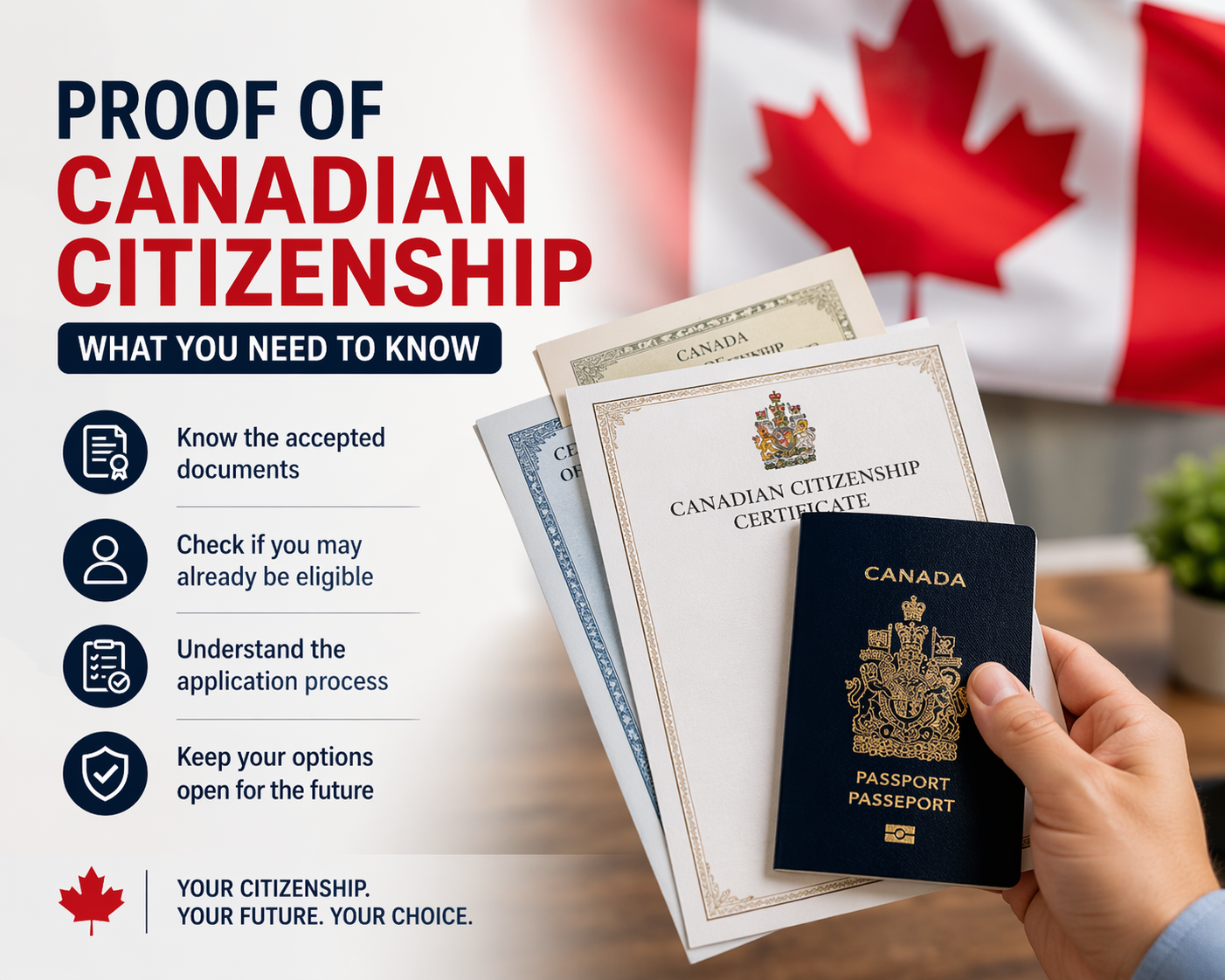
At its simplest, proof of Canadian citizenship is an official confirmation that you are a citizen. Without it, you cannot apply for a Canadian passport or fully access your rights.
For most people, this proof comes as a citizenship certificate. It acts as your main document and stays valid for life.
This is where many people get confused. Not every document linked to Canada works as proof.
Here are the documents that are accepted:
At the same time, some documents people rely on are not enough on their own:
Understanding this difference can save you a lot of time and effort.
All official rules come from
Immigration, Refugees and Citizenship Canada.
This department:
If you ever feel unsure, their guidelines are the final word.
Many people don’t realize they already qualify.
You may be eligible if:
Even if you’ve never lived in Canada, you might still be a citizen. This is why more people are checking their status now.
Not everyone applying plans to move to Canada right away.
Most people do it because they want:
It’s less about relocation and more about keeping choices open.
The process itself is not complicated, but it does require attention to detail.
It generally involves:
Many delays happen because of small mistakes, such as missing documents or unclear records. Taking your time at the start can help avoid these issues.
Once your application is approved, you receive your citizenship certificate.
With this document, you can:
Your citizenship remains valid for life, no matter where you live.
For many people, this process is not about making a big life change right now. It’s about being prepared.
You don’t have to move or make any immediate decisions. You just make sure that if the opportunity comes, you’re ready for it.
In most cases, it takes several months for applications to be processed. The exact time depends on how complete your documents are and how complex your case is. If additional checks or documents are needed, it can take longer. Applying early and submitting clear, complete information can help avoid unnecessary delays.
Yes, if your parents were Canadian citizens at the time of your birth, you may already be a citizen yourself. In this case, you are not applying to become a citizen but to confirm your status. You will need documents that clearly show your relationship to your parents and their citizenship.
No, you do not need to live in Canada to apply for proof of citizenship. Many people apply while living in other countries. As long as you meet the eligibility rules and can provide the required documents, you can complete the process from outside Canada without any issue.
A Canadian passport is a strong document, but it is not always accepted as primary proof in every situation. In many cases, you still need a citizenship certificate or a Canadian birth certificate to confirm your status, especially when applying for official services or legal documentation.
Yes, your children may also be eligible for Canadian citizenship, especially if you qualify through descent. However, eligibility depends on factors like where they were born and your citizenship status at that time. Once your status is confirmed, it becomes easier to understand and apply for their eligibility as well.
Having an ‘Identity Verified’ badge or being ‘Identity Verified’ simply indicates that an individual has submitted information to complete our identity verification process or we have conducted internal verification using various authorized websites. While this process includes safeguards, it does not guarantee that the person is who they claim to be.
If you encounter any issues with this profile, please report them here. While all consultants who are verified have RCIC ID, we may not have the latest data in terms of their renewal/cancellation/discontinuation of their RCIC ID.
╳The “Verified Consultants” profiles on Immiperts.com are independently compiled using publicly available information from multiple sources, including the official CICC Public Register, consultants’ own websites, other public directories, and social media.
Immiperts.com is a completely independent platform and is not affiliated with, endorsed by, or connected to the College of Immigration and Citizenship Consultants (CICC), IRCC, or any immigration consultant.
All information is collected manually and is for educational and informational purposes only. Consultants may claim, update, or request removal of their profile by contacting us at hello@immiperts.com.
Users are strongly advised to always verify the latest authorization status directly on the official CICC Public Register at college-ic.ca.