

Living in a French-speaking community outside Quebec can sometimes mean fewer local services, cultural programs, or opportunities to use French in everyday life. That challenge becomes even more noticeable for newcomers who want to settle, work, raise children, and build community connections in French.
Manitoba and New Brunswick are trying to address part of that gap together.
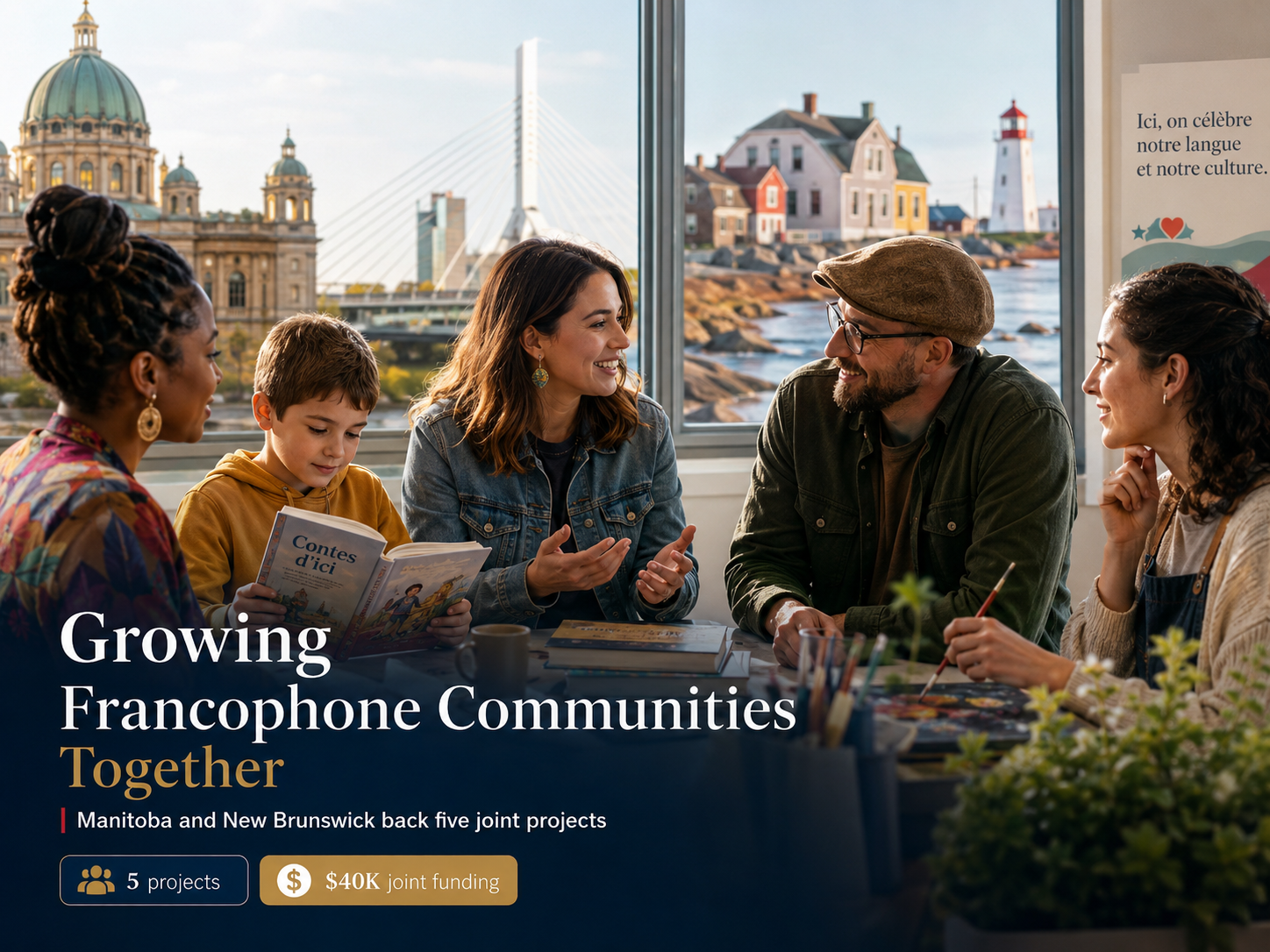
For 2026-27, the two provinces have approved five joint projects supporting French-language education, arts, culture, and community development. Together, they are providing up to $40,000 in annual funding through their interprovincial Francophone cooperation agreement.
Here is what the partnership involves, why it matters, and what Francophone communities can realistically expect from it.
Manitoba approved five collaborative projects with New Brunswick for the 2026-27 fiscal year under the Manitoba-New Brunswick Co-operation and Exchange Agreement.
Glen Simard, Manitoba's minister responsible for Francophone affairs, announced the projects. Manitoba's Francophone Affairs Secretariat helps coordinate the province's participation in the agreement.
The projects are intended to strengthen cooperation between Francophone organizations in both provinces.
Rather than creating one large government-run program, the arrangement allows organizations in Manitoba and New Brunswick to work directly with one another.
Each province can contribute up to $20,000 per year, creating a combined annual funding pool of up to $40,000.
For 2026-27, organizations submitted five projects requesting a combined $42,570.
Because the requests were slightly higher than the available budget, some funding amounts had to be reduced so that the approved projects could remain within the $40,000 limit.
This is a relatively small funding pool, but its purpose is focused. The money is meant to support partnerships and practical community projects rather than large infrastructure programs.
Cooperation between the two provinces is not new.
Manitoba and New Brunswick first signed a memorandum of understanding on interprovincial cooperation in 2002.
In June 2026, the provinces strengthened that relationship through a new four-year Francophone cooperation protocol.
The agreement also supports Manitoba's involvement in the wider Canadian Francophonie, particularly outside Quebec.
The projects are designed to connect organizations rather than simply provide funding for isolated activities.
A community group in Manitoba, for example, may be able to work with an organization in New Brunswick that has experience running a particular French-language cultural, educational, or community program.
That cooperation can include:
This model can help organizations learn from programs that have already worked elsewhere instead of building everything from the beginning.
The two provinces have different Francophone histories, but both have French-speaking communities that form an important part of their cultural identity.
New Brunswick has a particularly strong Francophone population and is Canada's only officially bilingual province. Manitoba also has long-established Francophone communities, including the historic Franco-Manitoban community.
Sharing knowledge can therefore help organizations tackle similar challenges.
Interprovincial cooperation gives organizations another way to find expertise and develop programs without working entirely on their own.
For French-speaking newcomers, community support can play an important role in settling successfully.
Someone arriving in a new province may need more than employment and housing. They may also be looking for schools, cultural activities, social connections, community organizations, and places where they can comfortably communicate in French.
Better-connected Francophone organizations may help make those resources easier to access.
However, it is important to understand what this announcement does not do.
The Manitoba-New Brunswick agreement does not create a new immigration stream, provide permanent residence, guarantee a provincial nomination, or change eligibility rules for existing immigration programs.
Its focus is community development.
Canada has been placing greater attention on maintaining and growing French-speaking communities outside Quebec.
Immigration can help those communities grow, but attracting French-speaking newcomers is only one part of the picture.
People also need reasons to stay.
That means communities need schools, services, cultural connections, social networks, and organizations that can help people feel established over the long term.
Small partnerships such as the Manitoba-New Brunswick agreement can support that wider effort by strengthening the organizations already working within Francophone communities.
The five approved projects will move forward during the 2026-27 fiscal year under the joint agreement.
Future projects will depend on applications, provincial priorities, available funding, and approval by both governments.
For residents and newcomers, the most important point is that the agreement is about building stronger French-language community networks. It is not a major new immigration program, but it can help create the conditions that make Francophone communities more active, connected, and sustainable.
No. The announcement relates to community cooperation and funding between Manitoba and New Brunswick. It does not create a new immigration pathway or change existing permanent residence requirements.
Each province can contribute up to $20,000 annually under the agreement. That gives the program a combined annual funding pool of up to $40,000.
The approved work focuses on French-language education, arts, culture, community development, training, exchanges, and knowledge sharing. Five projects were approved for the 2026-27 fiscal year.
Potentially, yes. Stronger community organizations may provide newcomers with better access to French-language activities, support networks, education, and local connections, although the exact benefits depend on each funded project.
French-speaking communities have existed across Canada for generations and form an important part of the country's linguistic and cultural landscape. Supporting education, culture, services, and community networks can help these communities remain strong and attract or retain French-speaking residents.
Having an ‘Identity Verified’ badge or being ‘Identity Verified’ simply indicates that an individual has submitted information to complete our identity verification process or we have conducted internal verification using various authorized websites. While this process includes safeguards, it does not guarantee that the person is who they claim to be.
If you encounter any issues with this profile, please report them here. While all consultants who are verified have RCIC ID, we may not have the latest data in terms of their renewal/cancellation/discontinuation of their RCIC ID.
╳The “Verified Consultants” profiles on Immiperts.com are independently compiled using publicly available information from multiple sources, including the official CICC Public Register, consultants’ own websites, other public directories, and social media.
Immiperts.com is a completely independent platform and is not affiliated with, endorsed by, or connected to the College of Immigration and Citizenship Consultants (CICC), IRCC, or any immigration consultant.
All information is collected manually and is for educational and informational purposes only. Consultants may claim, update, or request removal of their profile by contacting us at hello@immiperts.com.
Users are strongly advised to always verify the latest authorization status directly on the official CICC Public Register at college-ic.ca.