
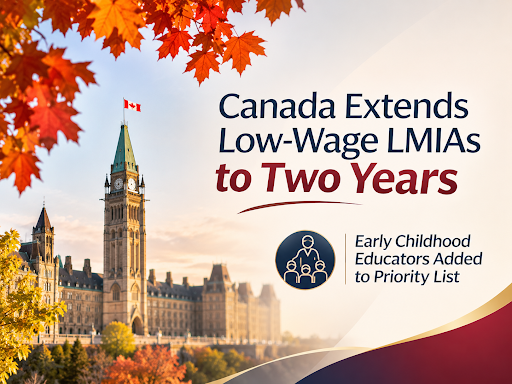


New federal changes allow longer employment periods for temporary foreign workers, while additional regional hiring reforms are proposed for March 2027.
Canada has introduced changes to its Temporary Foreign Worker Program (TFWP), allowing employers to seek longer employment periods for certain foreign workers while addressing labour shortages in essential sectors.
Announced by Minister of Jobs and Families Patty Hajdu on November 6, 2026, the reforms focus on balancing employer needs with employment opportunities for Canadians.
Two measures took effect immediately, while additional regional changes are proposed for March 1, 2027, depending on provincial and territorial participation.
Employers submitting Low-Wage Stream Labour Market Impact Assessment (LMIA) applications on or after November 6 can request employment periods of up to two years.
Previously, the maximum was one year.
The change could reduce repeated applications and provide greater employment stability for businesses and foreign workers.
However, an approved LMIA does not automatically guarantee a work permit or permanent residence.
The government has also expanded exceptions to restrictions affecting regions with higher unemployment.
Generally, low-wage LMIA applications are not processed in census metropolitan areas where unemployment reaches 6% or higher.
Existing exceptions include health care, construction and food processing.
Early childhood educators have now joined that list, allowing qualifying employers to seek workers despite local unemployment restrictions.
The government says this adjustment responds to staffing shortages affecting childcare services.
Ottawa plans additional reforms that would give provinces and territories greater influence over foreign worker recruitment.
In metropolitan areas with unemployment below 6% and populations exceeding 250,000, employers would receive targeted access to occupations identified through federal labour projections.
Similar arrangements would apply to smaller metropolitan areas and rural sections of larger urban regions.
Provinces could add or remove eligible occupations according to local workforce needs.
Rural communities would retain broader access to the Low-Wage Stream.
These measures remain proposals and require participating provincial or territorial governments.
Eligible employers in designated communities could also receive permission to increase their low-wage temporary foreign workforce from 10% to 15%.
The existing 20% limit for priority sectors would remain unchanged.
The government intends to use these adjustments to address regional labour shortages without reducing employment opportunities for Canadians.
Budget 2026 allocates $151.5 million over five years to improve program administration and service delivery.
Another $82 million over four years will support programs that help migrant workers understand their rights.
Employers remain subject to inspections, financial penalties reaching $1 million annually and possible program bans for violations.
Temporary foreign workers represent approximately 1% of Canada's labour force.
Employers should verify eligibility, document recruitment efforts and monitor provincial announcements before changing hiring plans.
Workers should understand that longer LMIA-supported employment periods do not create automatic permanent residence rights.
Further details are expected as federal, provincial and territorial discussions continue.











Having an ‘Identity Verified’ badge or being ‘Identity Verified’ simply indicates that an individual has submitted information to complete our identity verification process or we have conducted internal verification using various authorized websites. While this process includes safeguards, it does not guarantee that the person is who they claim to be.
If you encounter any issues with this profile, please report them here. While all consultants who are verified have RCIC ID, we may not have the latest data in terms of their renewal/cancellation/discontinuation of their RCIC ID.
╳The “Verified Consultants” profiles on Immiperts.com are independently compiled using publicly available information from multiple sources, including the official CICC Public Register, consultants’ own websites, other public directories, and social media.
Immiperts.com is a completely independent platform and is not affiliated with, endorsed by, or connected to the College of Immigration and Citizenship Consultants (CICC), IRCC, or any immigration consultant.
All information is collected manually and is for educational and informational purposes only. Consultants may claim, update, or request removal of their profile by contacting us at hello@immiperts.com.
Users are strongly advised to always verify the latest authorization status directly on the official CICC Public Register at college-ic.ca.