

You Speak French. Why Does Everyone Keep Pointing You to Quebec?
You speak French. Maybe it's your first language, maybe you worked hard to learn it. Either way, every immigration guide you find either sends you straight to Quebec or treats your French skills as a minor footnote.
Quebec has its own immigration system entirely. If it doesn't work for you — or you simply don't want to live there — it can feel like your language skills mean nothing.
Canada has built real, meaningful immigration advantages for French-speaking skilled workers who want to settle anywhere outside Quebec. Most applicants just don't know they exist.
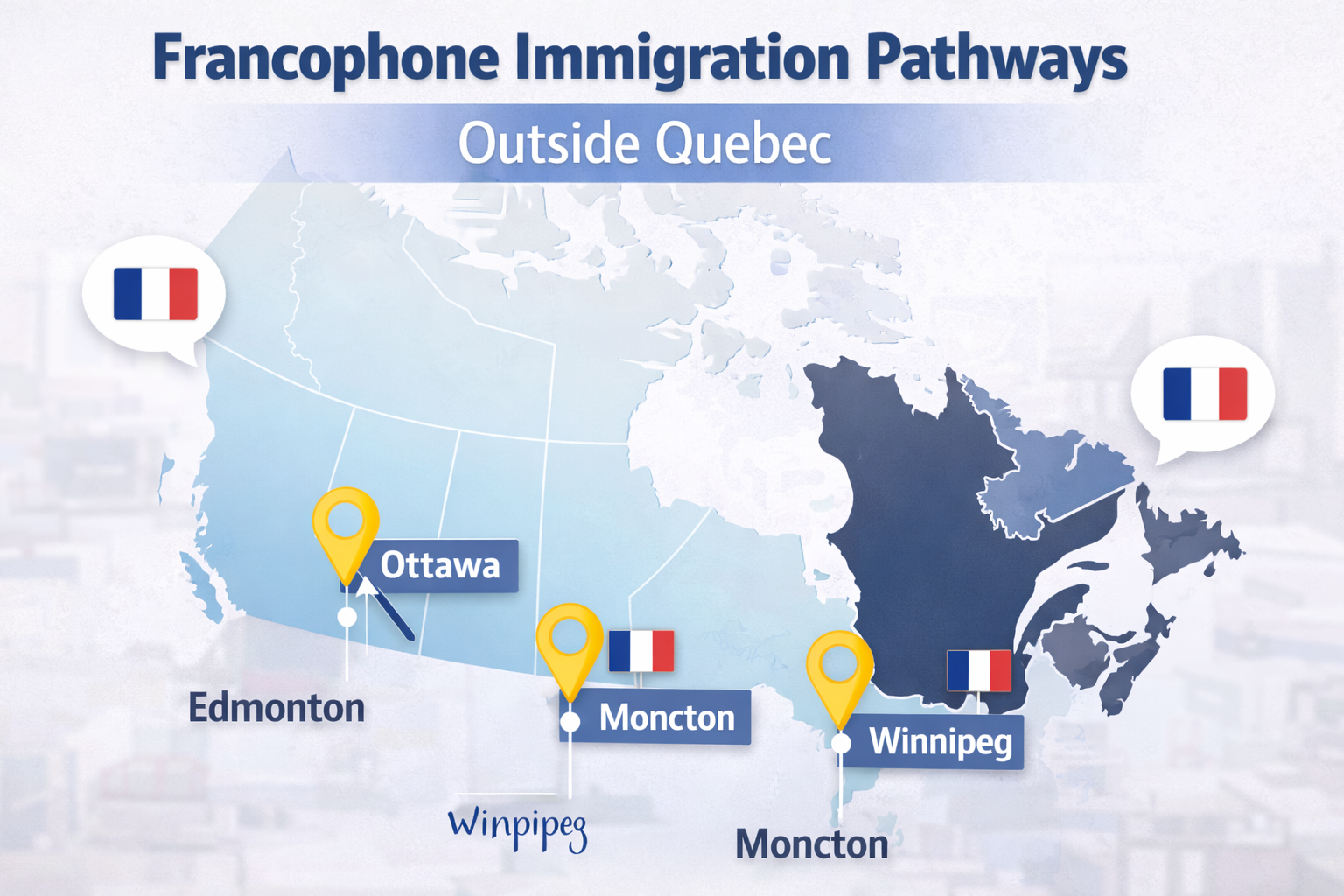
Canada's bilingualism commitment goes beyond politics. Francophone communities outside Quebec — in cities like Moncton, Ottawa, Sudbury, Winnipeg, and Edmonton — have been shrinking relative to the broader population.
The federal government responded by setting a target: francophone immigrants should make up at least five percent of all new permanent residents settling outside Quebec.
To hit that number, they built real incentives into the immigration system. Your French skills aren't just a nice addition to your profile. They are a competitive advantage.
Express Entry is Canada's main skilled worker immigration system. It ranks candidates using a points-based score called the Comprehensive Ranking System, or CRS.
If you speak French at Canadian Language Benchmark 7 or higher, you receive additional CRS points. If you speak both French and English at qualifying levels, you receive even more.
The boost is not small. In a pool where a few points can be the difference between an invitation and waiting indefinitely, this matters.
Beyond the points boost, the government periodically runs category-based draws inside Express Entry. These pulls invite candidates based on specific criteria — and French language proficiency is one of them.
In a francophone draw, only candidates who meet the French language threshold are invited. Your overall CRS score matters less. This means a French speaker with a lower general score can receive an invitation that would otherwise never come in a regular draw.
These draws have become more frequent as the government pushes toward its francophone targets. If you are in the Express Entry pool and speak French, this is worth watching closely.
Several provinces actively want French-speaking immigrants and have built that into their nominee programs.
Ontario has a stream targeting French-speaking skilled workers and graduates from French-language post-secondary institutions. A successful provincial nomination adds 600 CRS points — essentially a guaranteed Express Entry invitation.
New Brunswick, where roughly a third of the population is already French-speaking, actively recruits francophones through its nominee program and community partnerships.
Manitoba, Saskatchewan, and Prince Edward Island have also shown interest in francophone candidates at various points. Always check current provincial websites directly, as criteria change regularly.
Francophone immigration outside Quebec comes with something most pathways don't — an existing support infrastructure.
The federal government funds francophone immigration networks across the country. These include pre-arrival services, settlement support, job search help, and community connection, all in French.
Cities like Moncton, Sudbury, and Winnipeg have established francophone communities with real roots. You are not arriving somewhere unknown and starting from zero.
The accepted tests for Canadian immigration are the TEF Canada and TCF Canada. These are different from the DELF or DALF you may have taken for academic purposes — immigration requires its own specific versions.
For the Express Entry bonus, you generally need Canadian Language Benchmark 7 or above across all four skills: speaking, listening, reading, and writing.
Benchmark 7 is solid intermediate to upper-intermediate. It is not beginner French, but it is not near-native fluency either. Many people who have used French professionally or academically can reach it with focused, targeted preparation.
Many people assume francophone pathways mean committing to a small town permanently. That is not true. Once you have permanent residence, you are free to live anywhere in Canada.
Others think these programs are only for people from francophone African countries or France. They are not. Whether you learned French in Cameroon, Lebanon, Romania, or through years of study, your test score is what the system looks at.
And bilingual candidates — those who qualify in both French and English — actually receive the highest language bonus of all. Speaking English does not dilute your French advantage. It adds to it.
Take the TEF Canada or TCF Canada first. Until you have an official benchmark score, you cannot properly assess where you stand.
Once you have it, build your Express Entry profile and calculate your CRS score with the French language bonus included. Then look at whether any provinces with active francophone streams match your occupation and background.
Federal category draws, provincial nominations, and the CRS language bonus all work together. French-speaking skilled workers have more routes into Canada than most people are aware of — the key is understanding how the pieces connect.
1. Do I need to prove I will live in a francophone community, or is passing the language test enough?
For federal Express Entry pathways, passing the language test at the required benchmark is enough. There is no requirement to settle in a specific francophone community. Some provincial streams may ask for a statement of intent to settle in that province, but permanent residents are free to move anywhere in Canada once approved.
2. I learned French as a third language and have an accent. Will that affect my TEF Canada score?
No. The TEF Canada measures functional ability — comprehension, expression, reading, and writing — not accent or origin. Many successful candidates score well above the required benchmarks while speaking French with a strong accent from their first language.
3. Can I benefit from francophone pathways if my occupation is not on a shortage list?
Yes. The French language bonus and category-based draws are tied to your language score, not your occupation. You still need to meet the general eligibility requirements for whichever Express Entry stream you use, but your occupation does not need to be on a shortage list to benefit.
4. How often do francophone category-based draws happen?
There is no fixed schedule. Draws are announced on the official IRCC website when they occur. Monitor the IRCC website directly or follow a reliable immigration news source. During active periods, draws can happen as frequently as every two weeks.
5. My French is strong but my English is very basic. Will that hurt my application?
Not for francophone-specific pathways. French proficiency alone qualifies you for the language bonus and francophone category draws. Limited English reduces some additional bilingual points you could otherwise earn, but it does not disqualify you from francophone streams at the federal or provincial level.
Having an 'Identity Verified' badge or being 'Identity Verified' simply indicates that an individual has submitted information to complete our identity verification process or we have conducted internal verification using various authorized websites. While this process includes safeguards, it does not guarantee that the person is who they claim to be.
If you encounter any issues with this profile, please report them here. While all consultants who are verified have RCIC ID, we may not have the latest data in terms of their renewal/cancellation/discontinuation of their RCIC ID.
The "Verified Consultants" profiles are created using publicly available information, including data from the IRCC website, official consultant sites, other listing platforms, and social media. Immiperts.com is an independent platform, not affiliated with IRCC or any registered immigration consultants. To update, claim, or remove your profile, please contact us at [email protected].
╳