

You Did Everything Right. So Why Are You Still Waiting?
You met the physical presence requirement. You filed your taxes. You passed the test, attended the ceremony in your mind a hundred times, and submitted a complete application. Months pass. Then more months. The IRCC tracker moves slowly if it moves at all.
This is the part of the citizenship journey nobody warns you about clearly enough. The process is longer than most applicants expect — and the reasons are not always obvious from the outside.
IRCC publishes processing time estimates on its website. At various points, that number has ranged from 12 months to over 24 months for a standard adult application.
What most people miss is that this is an average across all applications. Some files move faster. Many move slower. Your individual timeline depends on factors that have nothing to do with how complete or clean your application is.
Treating the published estimate as a personal deadline will only cause frustration.
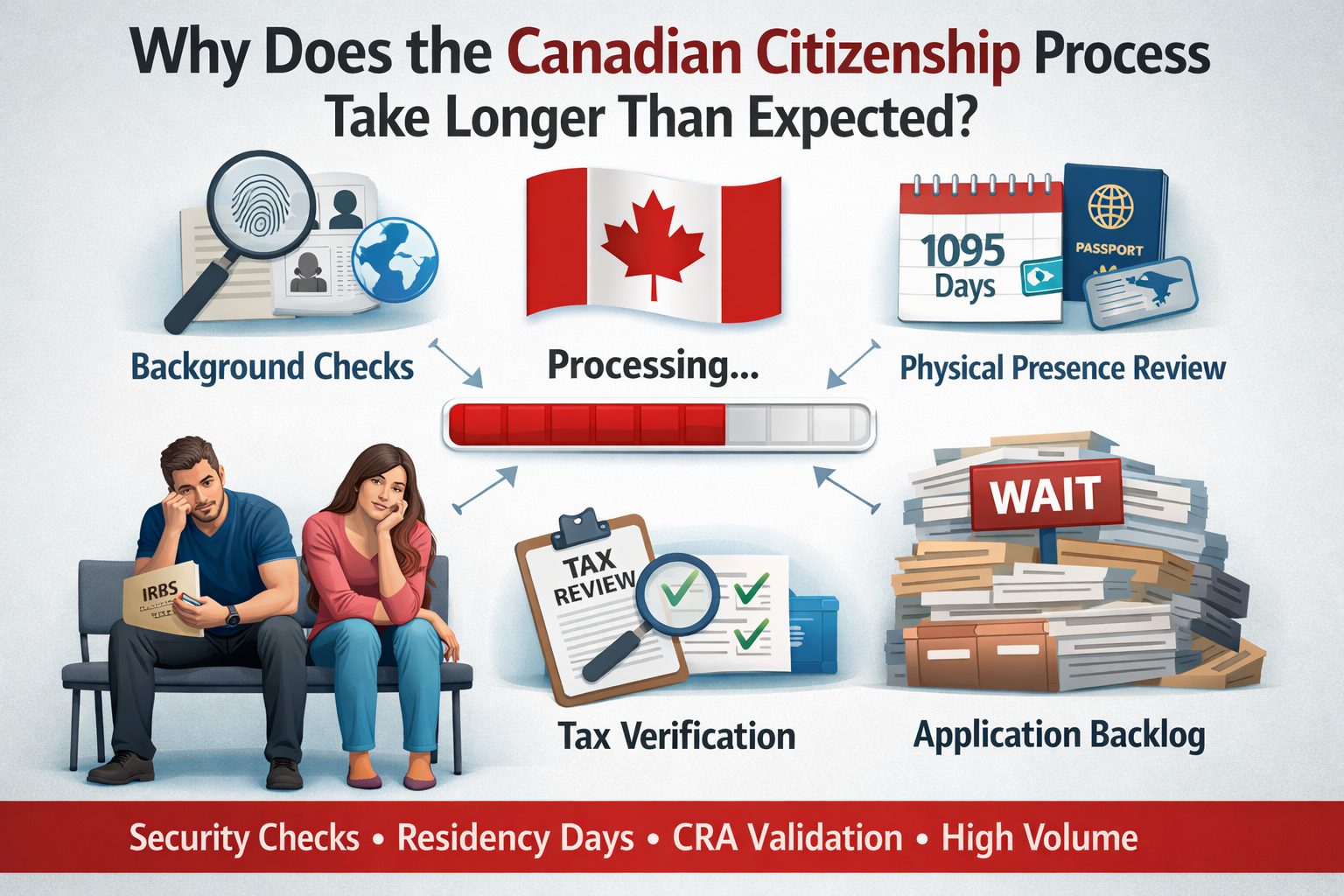
One of the first things IRCC does after receiving your application is verify that you actually meet the physical presence requirement — 1,095 days in Canada within the five years before your application date.
This sounds straightforward, but verifying it is not. Officers cross-reference your travel history against entry and exit records, tax filings, and other documentation. If there are gaps, inconsistencies, or periods that are hard to verify, the file slows down while officers seek clarification.
Even small discrepancies — a travel date that does not match a stamp, a period spent outside Canada that was not clearly documented — can add weeks or months to your file.
Every citizenship applicant goes through a security and criminal background check. This is not a single database query. It involves checks across multiple systems including RCMP records, CSIS security screening, and in some cases international databases.
If your name is common, if you have lived in multiple countries, or if anything in your history requires additional review, these checks take longer. You will not necessarily be told this is happening or how long it will take.
This stage alone can account for months of waiting that feel completely invisible from the applicant's side.
Canada requires citizenship applicants to have filed taxes for at least three of the five years within their eligibility period, if they were required to do so under the Income Tax Act.
IRCC verifies this with the Canada Revenue Agency. If your tax records do not match what you declared on your application, or if CRA records are slow to update, this verification step can stall your file.
Even applicants who filed correctly sometimes experience delays at this stage simply because of processing backlogs at CRA rather than anything wrong on their end.
IRCC processes a high volume of applications. Files that are complete, consistent, and clearly documented move more smoothly through the system.
Applications that have missing documents, unclear answers, name variations across different pieces of ID, or discrepancies between what was declared and what records show get flagged for manual review. Manual review means a human officer looks at your file individually — and those officers have large caseloads.
This is one of the most controllable reasons for delays, and also one of the most common. Small errors or omissions that feel minor to the applicant can create significant processing friction.
After your application is accepted for processing, you eventually get invited to take the citizenship test. For most adult applicants this is now done online, but scheduling still takes time.
If you fail the test, a second attempt is scheduled — adding more time. If you fail again or your file requires additional review, you may be called for an in-person interview with a citizenship officer. That interview needs to be scheduled, conducted, and assessed before your file moves forward.
Each of these steps has its own queue. None of them happen instantly.
Passing your test does not mean you become a citizen that day. After passing, your file goes through a final review before you are scheduled for a citizenship ceremony.
Ceremonies are scheduled in batches by local IRCC offices. Depending on where you live and how many ceremonies are being scheduled in your region, the wait between passing your test and attending your ceremony can range from a few weeks to several months.
For some applicants, this final stretch feels like the longest part — especially when the hard work feels done and citizenship feels so close.
IRCC processes citizenship applications for an entire country. When application volumes spike — after a policy change, during a period of high immigration, or following a backlog caused by pandemic-era office closures — processing times stretch across the board.
Your file does not jump the queue because your situation is straightforward. The system works through files in the order they are received, and high volume affects everyone's wait regardless of individual circumstances.
Check your IRCC online account regularly. Make sure your contact information is current so that any correspondence reaches you without delay.
If IRCC sends you a request for additional documents or information, respond as quickly and completely as possible. Delays in responding to IRCC requests pause your file until they hear back from you.
If your application has been in process significantly longer than the published average with no updates, you can submit a web form inquiry to IRCC. This does not speed up processing but creates a record that your file needs attention.
In cases of urgent travel needs or other pressing circumstances, a Member of Parliament's office can sometimes help flag a file for review — though this is a last resort, not a routine step.
Canadian citizenship, once granted, does not expire. It cannot be taken away under normal circumstances. The rights and security it provides last a lifetime.
That context does not make the waiting easier. But it does put the timeline in perspective. Most applicants who have gone through the process say the frustration of waiting fades quickly once the ceremony is done and the passport is in hand.
1. Can I travel outside Canada while my citizenship application is in progress?
Yes, but keep thorough records of every trip. You are no longer accumulating physical presence days toward eligibility since you have already applied, but travel itself is not prohibited. Just make sure your permanent resident status remains valid while you wait.
2. Will checking my application status speed anything up?
No. Checking your online account or submitting an inquiry does not move your file faster. Respond promptly to any requests from IRCC — that is the most direct way to avoid adding delays.
3. My application has been in process longer than the published estimate. What should I do?
Submit a web form inquiry through the IRCC website. If that does not result in movement, contacting your local Member of Parliament's office is the next practical step.
4. Does having a more complex immigration history make citizenship take longer?
Generally yes. Multiple countries of residence, prior visa issues, name changes, or a longer travel history all require more verification. A straightforward file with consistent documentation tends to move faster.
5. Is there any way to expedite a citizenship application?
IRCC does not have a standard expedite option for citizenship. Urgent humanitarian circumstances can sometimes be considered, but routine requests to speed up processing are not accommodated.
Having an 'Identity Verified' badge or being 'Identity Verified' simply indicates that an individual has submitted information to complete our identity verification process or we have conducted internal verification using various authorized websites. While this process includes safeguards, it does not guarantee that the person is who they claim to be.
If you encounter any issues with this profile, please report them here. While all consultants who are verified have RCIC ID, we may not have the latest data in terms of their renewal/cancellation/discontinuation of their RCIC ID.
The "Verified Consultants" profiles are created using publicly available information, including data from the IRCC website, official consultant sites, other listing platforms, and social media. Immiperts.com is an independent platform, not affiliated with IRCC or any registered immigration consultants. To update, claim, or remove your profile, please contact us at [email protected].
╳