

The Express Entry system does not rely on scores alone when selecting candidates for permanent residence. While the Comprehensive Ranking System (CRS) score plays the main role, another important factor often decides who receives an invitation when many candidates share the same score. This factor is known as the tie-break rule, and it can directly affect your chances even when your score looks competitive.
Many applicants overlook this rule and focus only on improving their CRS score. However, understanding how the tie-break rule works can help you avoid missed opportunities and plan your application more effectively.
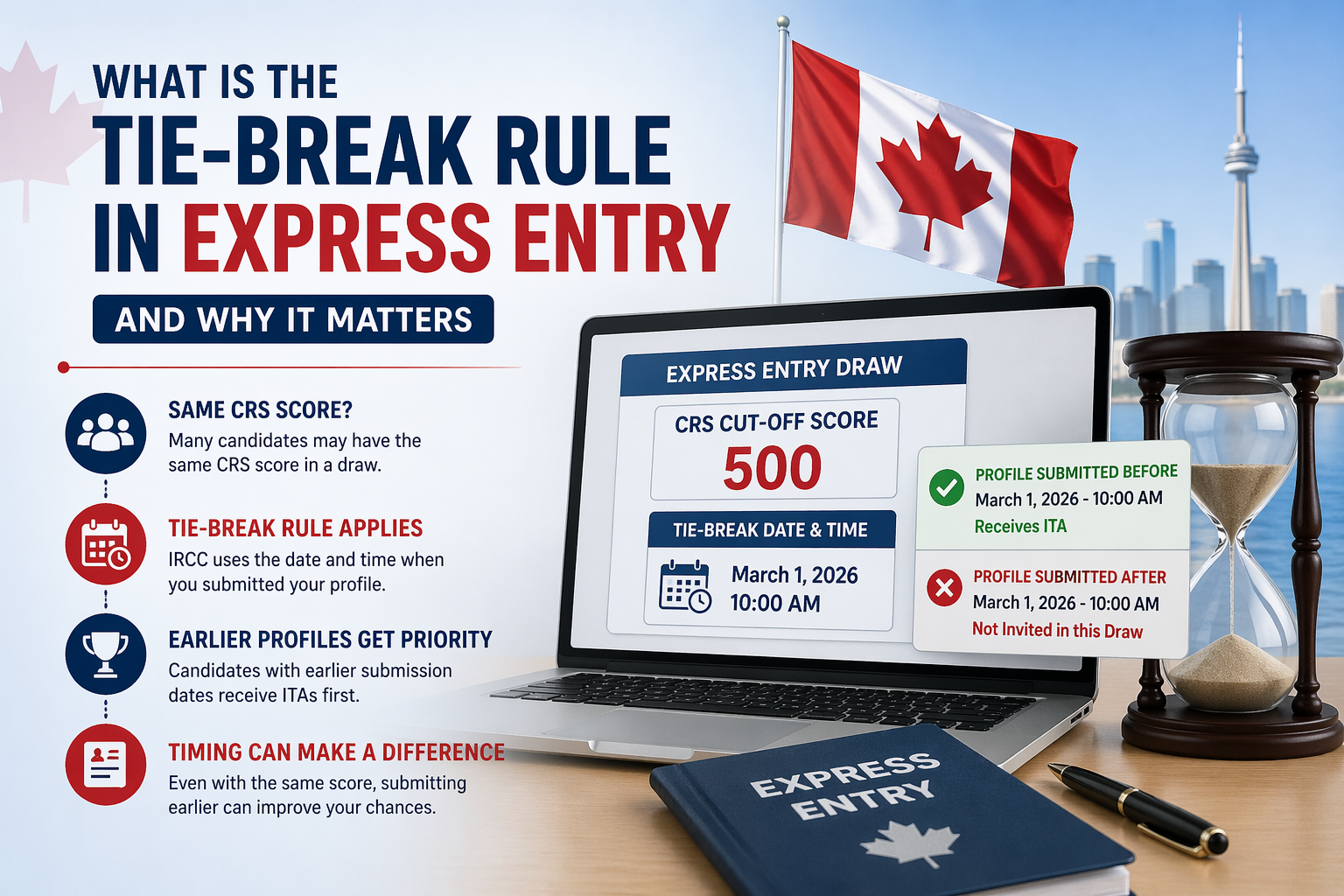
The tie-break rule is a method used to rank candidates who have the same CRS score in an Express Entry draw. When several applicants reach the exact cut-off score, the system needs a fair way to decide who will receive an Invitation to Apply (ITA).
To manage this situation, Immigration, Refugees and Citizenship Canada uses the date and time when each candidate submitted their Express Entry profile.
Candidates who submitted their profiles earlier receive priority over those who submitted later.
The tie-break rule plays a key role because Express Entry draws often include many candidates with identical CRS scores. Without this rule, the system would not be able to rank them properly.
This rule ensures fairness and consistency. It rewards candidates who entered the pool earlier and prevents random selection among people with the same score.
In practical terms, this means that two candidates with the same CRS score may have very different outcomes based only on timing.
Understanding the process clearly helps remove confusion. Here is how the tie-break rule works during a typical Express Entry draw:
Each draw sets a minimum CRS score. Only candidates at or above this score qualify for selection.
It is common for hundreds or even thousands of candidates to have the same CRS score as the cut-off.
The system then uses a specific date and time, known as the tie-break timestamp.
Only candidates who submitted their profiles before that timestamp receive invitations. Others with the same score but later submission dates must wait for future draws.
Imagine a draw where:
In this case:
Anyone who created their profile after that time, even with the same score, will not receive an invitation in that draw.
Many applicants feel confused when they do not receive an ITA despite meeting the cut-off score. The tie-break rule often explains this situation.
Here are common reasons why candidates miss out:
This shows that timing is just as important as scoring in certain cases.
Yes, the tie-break rule applies to every Express Entry draw where more candidates share the same CRS score at the cut-off.
Even in category-based draws or program-specific draws, the system still uses the same approach to rank candidates fairly.
One important detail many applicants overlook is how updates can affect their tie-break position.
When you make significant changes to your profile, such as:
The system may update your profile submission date. This means you could lose your earlier position in the tie-break order.
However, not all updates reset your timestamp. Minor edits may not affect your position. It is important to understand the difference before making changes.
While you cannot control the tie-break rule itself, you can take steps to reduce its impact on your application:
Create your Express Entry profile as soon as you become eligible. This gives you an earlier timestamp and a better position in case of a tie.
Have your language test results, educational assessments, and work experience details ready. This allows you to apply without delay.
A higher score reduces the risk of falling into a tie-break situation. Even a small increase can move you above the cut-off.
Before making updates, consider whether the change will improve your score enough to justify resetting your timestamp.
In recent years, CRS scores have remained competitive, and many candidates often share similar scores. This makes the tie-break rule more important than before.
Even a difference of a few hours in profile submission can decide whether you receive an invitation. As more people apply through Express Entry, this rule continues to play a bigger role in final selection decisions.
Many applicants misunderstand how this rule works. Here are a few clarifications:
Understanding these points can help you avoid unnecessary confusion.
The tie-break rule may seem like a small detail, but it can have a major impact on your immigration journey. Express Entry does not rely on scores alone. Timing plays a crucial role, especially when competition is high.
By understanding how this rule works and planning your application carefully, you can improve your chances and avoid missing out on opportunities. A strong profile combined with the right timing can make all the difference.
1. What exactly is the tie-break rule in Express Entry?
The tie-break rule helps rank candidates who have the same CRS score in a draw. It uses the date and time of profile submission to decide who gets invited first. This ensures that candidates who entered the pool earlier receive priority over those who applied later.
2. Can I miss an invitation even if my CRS score matches the cut-off?
Yes, this happens quite often. If your profile was submitted after the tie-break date, you will not receive an invitation in that draw. Even though your score meets the requirement, timing can still affect your chances.
3. Does updating my Express Entry profile reset my tie-break position?
In many cases, yes. Major updates, such as adding new qualifications or improving your score, can change your submission date. This may move you behind other candidates who submitted earlier, so updates should be done carefully.
4. How can I improve my chances despite the tie-break rule?
You can improve your chances by submitting your profile early and increasing your CRS score. A higher score reduces the risk of being affected by the tie-break rule. Keeping your documents ready also helps you act quickly.5. Is the tie-break rule used in every draw?
The rule is applied whenever multiple candidates share the same CRS score at the cut-off. It ensures fairness and consistency in the selection process. Even in special or category-based draws, the same method is used to rank candidates.
Having an ‘Identity Verified’ badge or being ‘Identity Verified’ simply indicates that an individual has submitted information to complete our identity verification process or we have conducted internal verification using various authorized websites. While this process includes safeguards, it does not guarantee that the person is who they claim to be.
If you encounter any issues with this profile, please report them here. While all consultants who are verified have RCIC ID, we may not have the latest data in terms of their renewal/cancellation/discontinuation of their RCIC ID.
╳The “Verified Consultants” profiles on Immiperts.com are independently compiled using publicly available information from multiple sources, including the official CICC Public Register, consultants’ own websites, other public directories, and social media.
Immiperts.com is a completely independent platform and is not affiliated with, endorsed by, or connected to the College of Immigration and Citizenship Consultants (CICC), IRCC, or any immigration consultant.
All information is collected manually and is for educational and informational purposes only. Consultants may claim, update, or request removal of their profile by contacting us at hello@immiperts.com.
Users are strongly advised to always verify the latest authorization status directly on the official CICC Public Register at college-ic.ca.