

If you're considering living in Canada on a visitor visa, you're not alone. Every year, millions of people come to Canada to explore, visit friends or family, and experience the country's diverse culture. However, many face uncertainty when it comes to their rights, limitations, and how long they can stay. You may find yourself asking, "Can I stay longer? What can I do while I'm in Canada?" These are common questions, and the answers aren’t always straightforward.
A visitor visa, or temporary resident visa (TRV), allows foreign nationals to come to Canada for tourism, business, or family visits. While it’s great for short stays, it comes with its own set of rules that can sometimes be confusing, especially if you're new to the process.
Canada’s immigration laws provide clear guidelines, but many visitors are unsure about their rights during their stay. From what you can and can’t do to how to extend your visa, understanding the limitations and processes will help you make the most of your time in Canada.
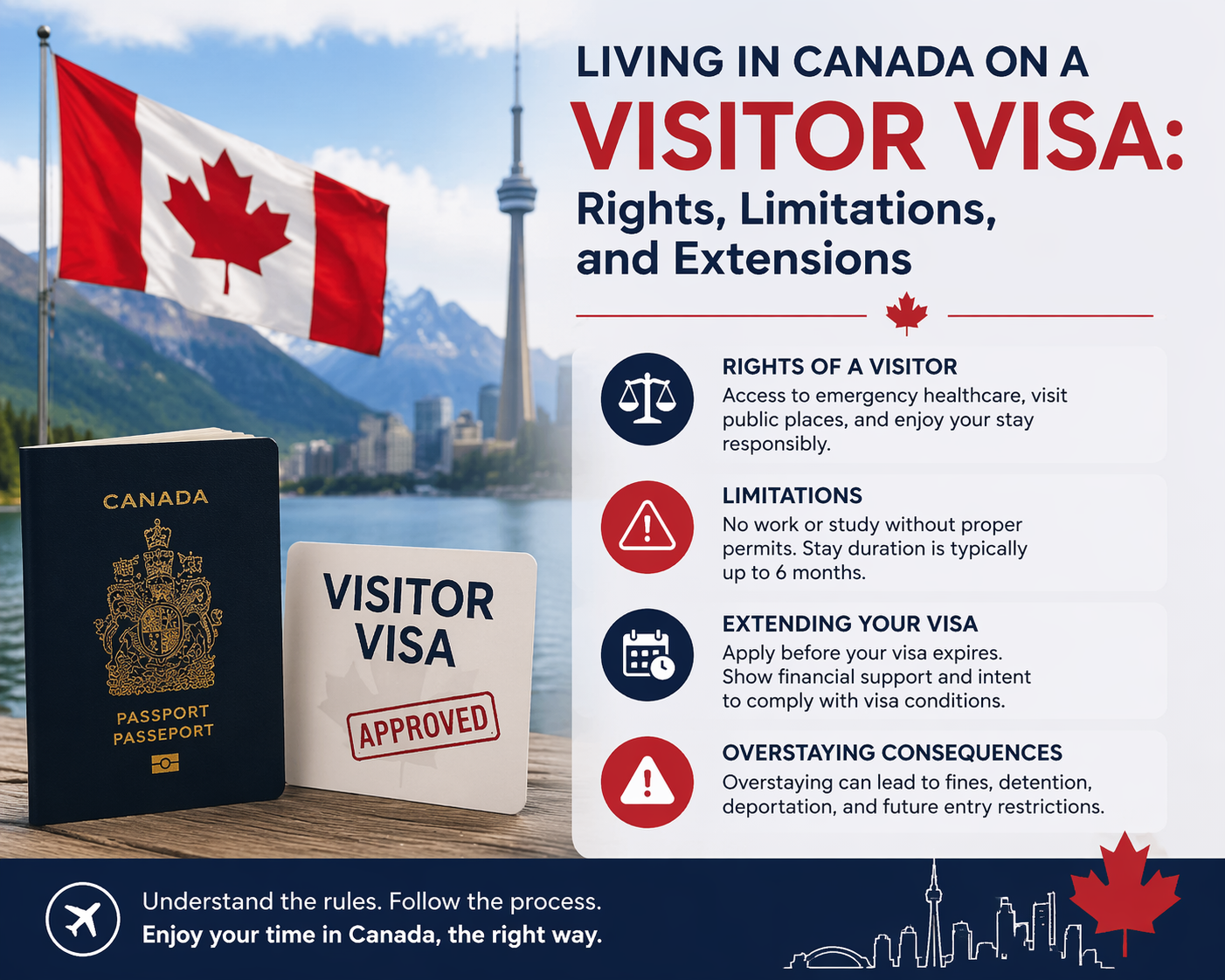
As a visitor to Canada, you do have some basic rights. Visitors are entitled to receive emergency healthcare, but they are generally expected to have travel insurance to cover any health costs during their stay. You can also visit any public places, including tourist attractions, parks, and museums, and you can enjoy the country’s beautiful nature.
However, while you have rights, you also have responsibilities. You must adhere to the terms of your visa, meaning you can't work or study without a proper permit. Violation of these conditions could result in penalties or being asked to leave the country.
One of the biggest limitations of living in Canada on a visitor visa is that it’s meant for short-term stays. Visitors are typically allowed to stay in Canada for up to six months at a time. Beyond that, you’ll need to apply for an extension or leave the country and reapply if you want to stay longer.
Additionally, you cannot work or study in Canada on a visitor visa unless you apply for the appropriate work or study permits. Engaging in work or full-time study without proper permits could lead to deportation or being banned from re-entering the country in the future.
If you’re enjoying your time in Canada and want to stay longer, you can apply for a visitor visa extension. It’s important to apply before your current visa expires. You can apply from within Canada, but you need to demonstrate that you still meet the requirements to remain in the country.
When applying for an extension, you’ll need to show that you have enough funds to support yourself and that you don’t plan to engage in activities like working or studying. If your application is approved, you will be granted additional time to stay.
However, if your extension request is denied, you must leave Canada as soon as possible. It’s crucial to keep track of your visa’s expiry date and make sure to follow all procedures to avoid any complications.
Overstaying your visitor visa in Canada can lead to serious consequences. If you stay longer than allowed, you could face fines, detention, or even deportation. Overstaying your visa can also make it more difficult for you to return to Canada in the future, as it might affect your eligibility for future visas.
If you find yourself in a situation where you’ve overstayed, it's important to contact immigration authorities immediately and seek advice on how to rectify the situation.
Living in Canada on a visitor visa offers great opportunities to explore the country, visit loved ones, or experience a new environment. However, it’s important to understand your rights, limitations, and how to navigate the visa process. Make sure to follow the terms of your visa, apply for extensions when necessary, and avoid overstay to ensure a smooth and enjoyable visit.
1. How long can I stay in Canada on a visitor visa?
Visitors are typically allowed to stay in Canada for up to six months. If you want to stay longer, you must apply for an extension before your visa expires.
2. Can I work or study in Canada on a visitor visa?
No, you cannot work or study in Canada on a visitor visa unless you apply for a work or study permit. Doing so without the correct permit may result in penalties.
3. How do I extend my visitor visa in Canada?
You can extend your visitor visa by applying through Canada’s immigration website before your visa expires. You will need to show proof of financial support and confirm that you don’t plan to work or study.
4. What happens if I overstay my visitor visa in Canada?
If you overstay your visitor visa, you may face penalties, fines, or deportation. It’s essential to leave the country on time or apply for an extension to avoid complications.
5. Can I re-enter Canada after my visitor visa expires?
If you’ve overstayed your visa, it could make it harder to re-enter Canada. It’s best to apply for an extension before your visa expires or leave and reapply if necessary.
Having an ‘Identity Verified’ badge or being ‘Identity Verified’ simply indicates that an individual has submitted information to complete our identity verification process or we have conducted internal verification using various authorized websites. While this process includes safeguards, it does not guarantee that the person is who they claim to be.
If you encounter any issues with this profile, please report them here. While all consultants who are verified have RCIC ID, we may not have the latest data in terms of their renewal/cancellation/discontinuation of their RCIC ID.
╳The “Verified Consultants” profiles on Immiperts.com are independently compiled using publicly available information from multiple sources, including the official CICC Public Register, consultants’ own websites, other public directories, and social media.
Immiperts.com is a completely independent platform and is not affiliated with, endorsed by, or connected to the College of Immigration and Citizenship Consultants (CICC), IRCC, or any immigration consultant.
All information is collected manually and is for educational and informational purposes only. Consultants may claim, update, or request removal of their profile by contacting us at hello@immiperts.com.
Users are strongly advised to always verify the latest authorization status directly on the official CICC Public Register at college-ic.ca.