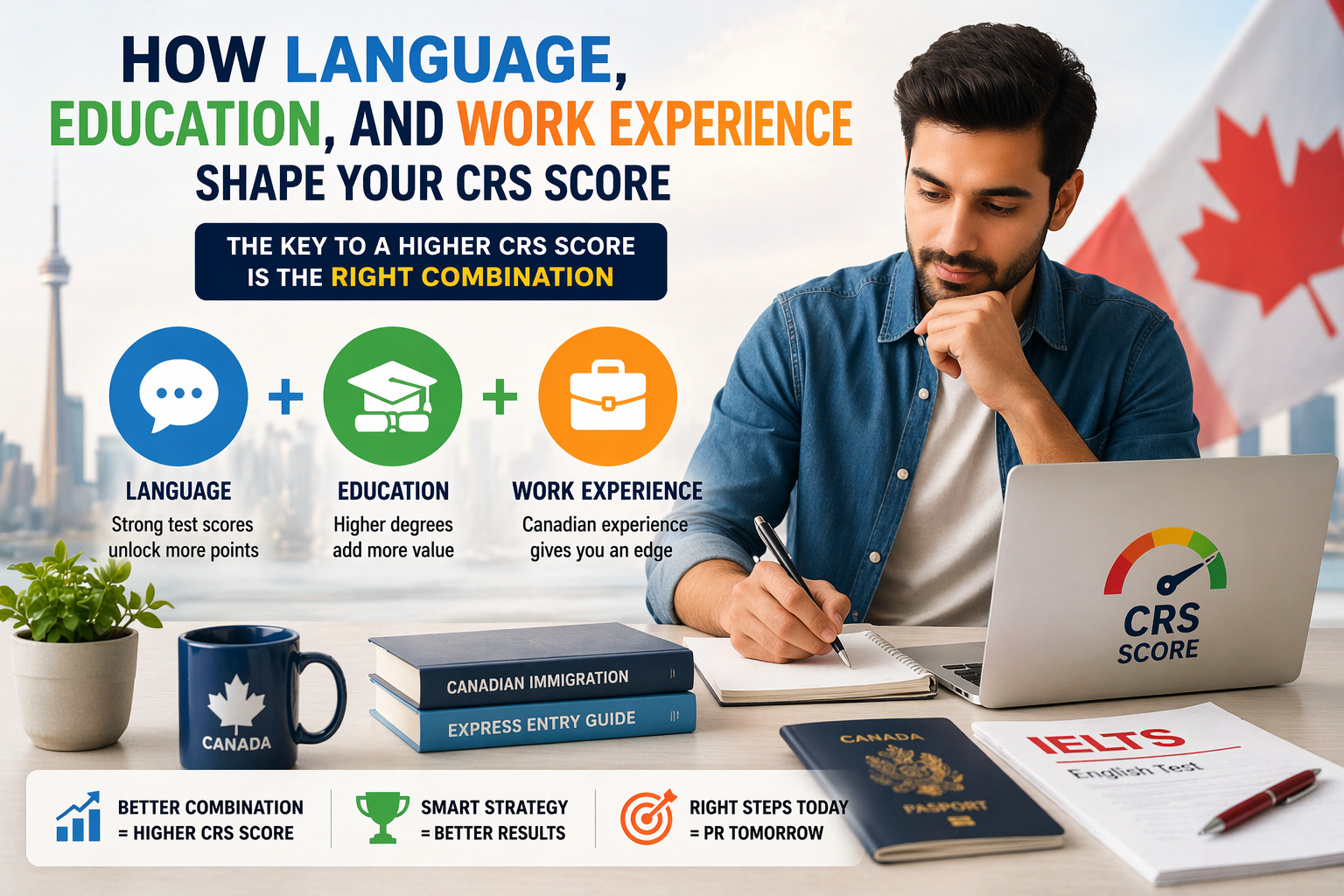


If you’re trying to improve your CRS score for Canada immigration, you’ve probably felt frustrated watching cut-off scores stay high while your profile barely moves. You may have a decent degree or years of experience, yet your score still falls short. This often happens because the system does not reward one strength alone. It looks at how your language skills, education, and work experience work together.
What the CRS system really looks for
The Comprehensive Ranking System does not just count your qualifications. It measures how ready you are to succeed in Canada’s workforce.
It focuses on three main areas:
Each one adds points on its own, but the biggest boosts come when they combine.
Language ability plays a bigger role than most people expect. Even a small improvement in your test scores can lead to a major jump in your CRS points.
For example, someone with high language scores and a degree can gain far more points than someone with the same degree but lower language results.
If your score feels stuck, language is often the fastest way to improve it.
Your level of education matters, but it does not work alone. A higher degree gives you more base points, but its real strength shows when combined with other factors.
For instance, a master’s degree with strong English or French results can significantly increase your total score compared to having just one of those factors.
Work experience adds another layer to your CRS score, but not all experience counts the same.
This type of experience gives you more points and carries more weight. It shows that you already understand the local job market.
This still helps, especially when combined with strong language skills. On its own, it may not raise your score enough, but paired with good language results, it becomes much more valuable.
Many applicants miss this key idea—CRS rewards combinations more than individual strengths.
This means you don’t always need a new degree or years of extra experience. Sometimes, improving one area—like language—can unlock hidden points across your profile.
If your score feels low, focus on what gives the highest return.
Small changes can create a big difference when they activate multiple scoring areas.
A low CRS score does not always mean you lack qualifications. In many cases, it means your strengths are not aligned in a way the system rewards. Once you understand how language, education, and work experience connect, you can make smarter decisions and improve your chances without wasting time or effort.
1. Which factor gives the highest CRS points?
Language skills often provide the biggest boost, especially when combined with education or work experience.
2. Can I increase my CRS score without more work experience?
Yes. Improving your language test scores can significantly raise your points even without additional experience.
3. Does foreign work experience help in CRS scoring?
Yes, but it works best when paired with strong language skills.
4. Is a higher degree always better for CRS score?
It helps, but it becomes more valuable when combined with good language scores and relevant experience.
5. How often can I improve my CRS score?
You can update your profile anytime after improving your language results, education, or work experience.
Having an ‘Identity Verified’ badge or being ‘Identity Verified’ simply indicates that an individual has submitted information to complete our identity verification process or we have conducted internal verification using various authorized websites. While this process includes safeguards, it does not guarantee that the person is who they claim to be.
If you encounter any issues with this profile, please report them here. While all consultants who are verified have RCIC ID, we may not have the latest data in terms of their renewal/cancellation/discontinuation of their RCIC ID.
╳The “Verified Consultants” profiles on Immiperts.com are independently compiled using publicly available information from multiple sources, including the official CICC Public Register, consultants’ own websites, other public directories, and social media.
Immiperts.com is a completely independent platform and is not affiliated with, endorsed by, or connected to the College of Immigration and Citizenship Consultants (CICC), IRCC, or any immigration consultant.
All information is collected manually and is for educational and informational purposes only. Consultants may claim, update, or request removal of their profile by contacting us at hello@immiperts.com.
Users are strongly advised to always verify the latest authorization status directly on the official CICC Public Register at college-ic.ca.