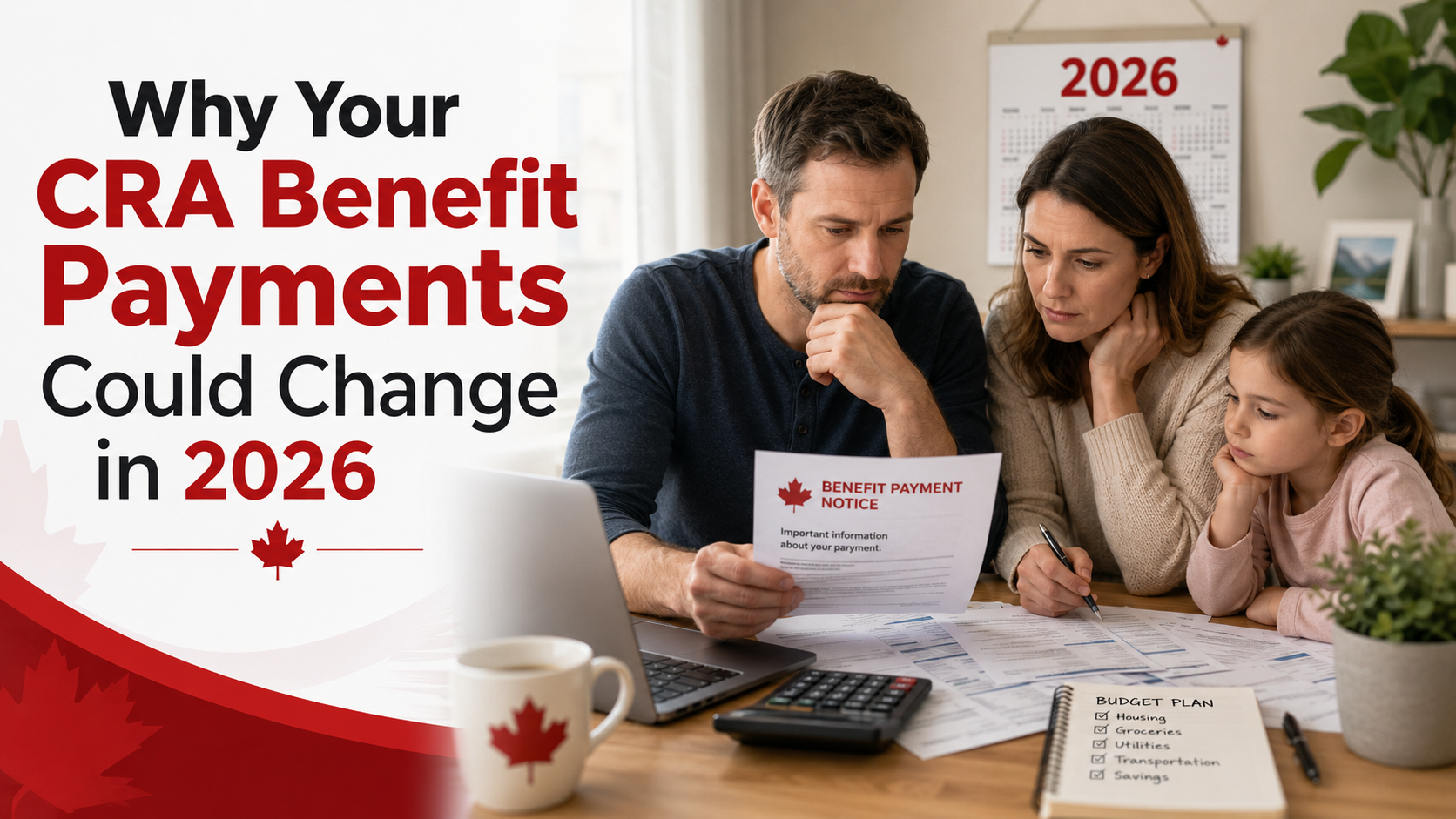


CRA benefit payments change in 2026 for many Canadians because the Canada Revenue Agency updates benefit amounts using your latest tax return, family income, marital status, province, children, and eligibility details. That can be stressful when rent, groceries, childcare, transportation, and daily bills are already hard to manage. A smaller payment, a delayed deposit, or a stopped benefit can create real pressure for families, seniors, newcomers, students, and low-income workers.
The good news is that most CRA payment changes are not random. They usually happen because something changed in your tax file, household, income, or benefit year calculation.
A CRA benefit payment change means your payment amount is different from what you received before. It may increase, decrease, stop, restart, or arrive later than expected.
This can happen with several benefits and credits, including:
Many of these payments are based on your annual tax return. That means the CRA does not always use your current month’s income. Instead, it often uses your most recently assessed tax return to decide how much you should receive.
July is an important month for many CRA benefits.
Several federal and provincial benefit programs follow a July-to-June payment cycle. This means your payment from January to June 2026 may be based on older tax information, while your payment from July 2026 onward may be based on your 2025 tax return.
That is why many people notice a change in July.
Your payment may go down if your 2025 income was higher. It may go up if your 2025 income was lower. It may also stop if you or your spouse did not file a tax return, even if you had no income.
Income is one of the biggest reasons CRA benefit payments change.
If you earned more in 2025 than in the previous year, your benefit amount may decrease in 2026. If your income dropped, your payment may increase.
For families, the CRA often looks at combined family income. This means your spouse or common-law partner’s income can also affect your payment.
Your CRA benefits may change if you got married, became common-law, separated, divorced, or became widowed.
A change in marital status can affect your family income calculation. It can also change who receives certain family-based benefits.
You should update your marital status with the CRA as soon as possible. Waiting too long can lead to overpayments, underpayments, or repayment requests later.
This is one of the most common reasons payments stop.
To receive many CRA benefits, you must file your tax return every year. This is true even if you had no income.
If you have a spouse or common-law partner, they usually need to file as well. If one person does not file, the CRA may not have enough information to calculate the family benefit amount.
The Canada Child Benefit can change when a child reaches certain ages.
Families usually receive a higher amount for children under age six. When a child turns six, the payment may decrease.
When a child turns 18, Canada Child Benefit payments for that child usually stop. This can cause a noticeable drop in monthly income for families who rely on that support.
If a child moved in with you, moved out, or now lives part-time with another parent, your benefit amount may change.
Shared custody can also affect how child benefits are divided. The CRA may adjust payments based on where the child lives and who is mainly responsible for care.
It is important to report custody changes quickly. If the CRA later finds that payments were sent to the wrong person, repayment may be required.
Some benefits are connected to the province or territory where you live.
If you move from one province to another, your federal payments may continue, but your provincial or territorial credits may change. For example, someone who moves out of Ontario may no longer qualify for the Ontario Trillium Benefit.
Even if your direct deposit information is still correct, you should update your address. An outdated address can delay letters, reviews, and payments.
If your bank account is closed or your direct deposit details are wrong, your payment may not arrive.
The CRA may send the payment by cheque or hold it until your information is corrected. This can cause delays, especially if you moved and did not update your mailing address.
Before payment dates, check that your direct deposit information is current.
Sometimes the CRA reviews a benefit file to confirm details such as address, custody, marital status, income, or residency.
If you receive a review letter, do not ignore it. You may need to send documents by a deadline.
If you do not respond, your payments may stop until the CRA receives and reviews the information.
If the CRA paid you more than you were eligible to receive, it may recover the amount from future payments.
This does not always mean you did something wrong. Overpayments can happen because of late updates, reassessments, income changes, or delayed information.
Still, repayment can reduce your monthly or quarterly benefit amount, so it is important to read CRA notices carefully.
The Canada Child Benefit helps eligible families with the cost of raising children.
Your payment may change based on:
If your child turned six or 18, your payment may change. If your income rose, your payment may decrease. If your income fell, you may receive more.
Families should make sure both partners file their tax returns and keep child-related information updated.
In 2026, changes to grocery-related federal support may affect people who normally receive lower-income tax credits.
Some people may receive higher support, while others may see no payment if their income or eligibility changed.
Your amount depends on your tax return, family situation, marital status, and number of eligible children. Filing your taxes on time is the most important step.
The Ontario Trillium Benefit helps eligible Ontario residents with sales tax, energy costs, and property tax or rent-related expenses.
Your OTB may change if:
If you expected an Ontario Trillium Benefit payment and did not receive it, check your CRA account and confirm that your address and tax return are up to date.
Many provinces and territories offer credits through the CRA.
These may be affected by your income, address, family size, age, or housing situation. If you moved provinces, your payment may change even if your income stayed the same.
Always update your address before the next payment cycle.
Start by signing in to your CRA account. Look at your benefit notices, payment history, and personal details.
Check whether the change is connected to a new tax year calculation, reassessment, missing return, or review.
Your benefit notice usually explains how your payment was calculated.
It may show your family income, payment period, eligible children, and new monthly or quarterly amount.
Do not only check your bank deposit. The notice often explains the reason behind the change.
Make sure the CRA has the correct:
Small errors can cause big payment problems.
If you or your partner missed a tax return, file it as soon as possible.
Many benefit payments cannot be calculated until the CRA has the required tax information.
Even if you have no income, filing is still important.
If the CRA asks for documents, send them before the deadline.
Examples may include proof of address, proof of custody, school records, lease documents, or marital status information.
Ignoring a letter can stop your payments.
The best way to avoid payment issues is to stay ahead of changes.
Before July 2026, you should:
These steps may seem simple, but they can prevent delays, overpayments, and stopped benefits.
A lower payment does not always mean there is a mistake.
It may be lower because your income increased, your child aged into a different benefit range, your marital status changed, or the CRA is recovering an overpayment.
However, if the amount still looks wrong, review your benefit notice carefully. Then check your tax return, family details, and CRA messages.
If something is incorrect, update your information or contact the CRA.
A stopped payment can happen when the CRA is missing information.
The most common reasons include:
Check your CRA account first. It usually gives the clearest reason for the payment stop.
Newcomers to Canada may qualify for some CRA benefits, but eligibility depends on immigration status, residency, family situation, and the type of benefit.
Some benefits may require a person to live in Canada for a certain period before qualifying. Others may require a separate form if the person did not file a Canadian tax return in the previous year.
Newcomers should keep copies of immigration documents, proof of address, birth certificates for children, and tax documents.
CRA benefit payments can change in 2026 for many reasons, but most changes come down to income, tax filing, family details, address, province, or eligibility.
The biggest mistake is waiting until a payment is missing before checking your account. The better approach is to review your CRA information before the July benefit recalculation period.
File your taxes, keep your details updated, read every notice, and respond quickly if the CRA asks for documents. These simple steps can help protect your payments and reduce stress when money is already tight.
Your CRA benefit payment may have changed because the CRA used newer tax information to recalculate your amount. Changes in income, marital status, children, custody, address, or eligibility can all affect your payment.
CRA benefits are usually based on income and family details, not only the cost of living. If your income increased or your household situation changed, your payment may go down even when your personal expenses are still high.
Yes. Many CRA benefits require you to file a tax return every year, even if you had no income. If you have a spouse or common-law partner, they may need to file too.
Check CRA My Account to review your payment history, benefit notices, and messages. Also confirm that your tax return, address, direct deposit, and family details are up to date.
They may increase after the CRA recalculates your benefits using your latest tax return. This usually happens during the new benefit year, so filing your return on time is the key step.
Having an ‘Identity Verified’ badge or being ‘Identity Verified’ simply indicates that an individual has submitted information to complete our identity verification process or we have conducted internal verification using various authorized websites. While this process includes safeguards, it does not guarantee that the person is who they claim to be.
If you encounter any issues with this profile, please report them here. While all consultants who are verified have RCIC ID, we may not have the latest data in terms of their renewal/cancellation/discontinuation of their RCIC ID.
╳The “Verified Consultants” profiles on Immiperts.com are independently compiled using publicly available information from multiple sources, including the official CICC Public Register, consultants’ own websites, other public directories, and social media.
Immiperts.com is a completely independent platform and is not affiliated with, endorsed by, or connected to the College of Immigration and Citizenship Consultants (CICC), IRCC, or any immigration consultant.
All information is collected manually and is for educational and informational purposes only. Consultants may claim, update, or request removal of their profile by contacting us at hello@immiperts.com.
Users are strongly advised to always verify the latest authorization status directly on the official CICC Public Register at college-ic.ca.