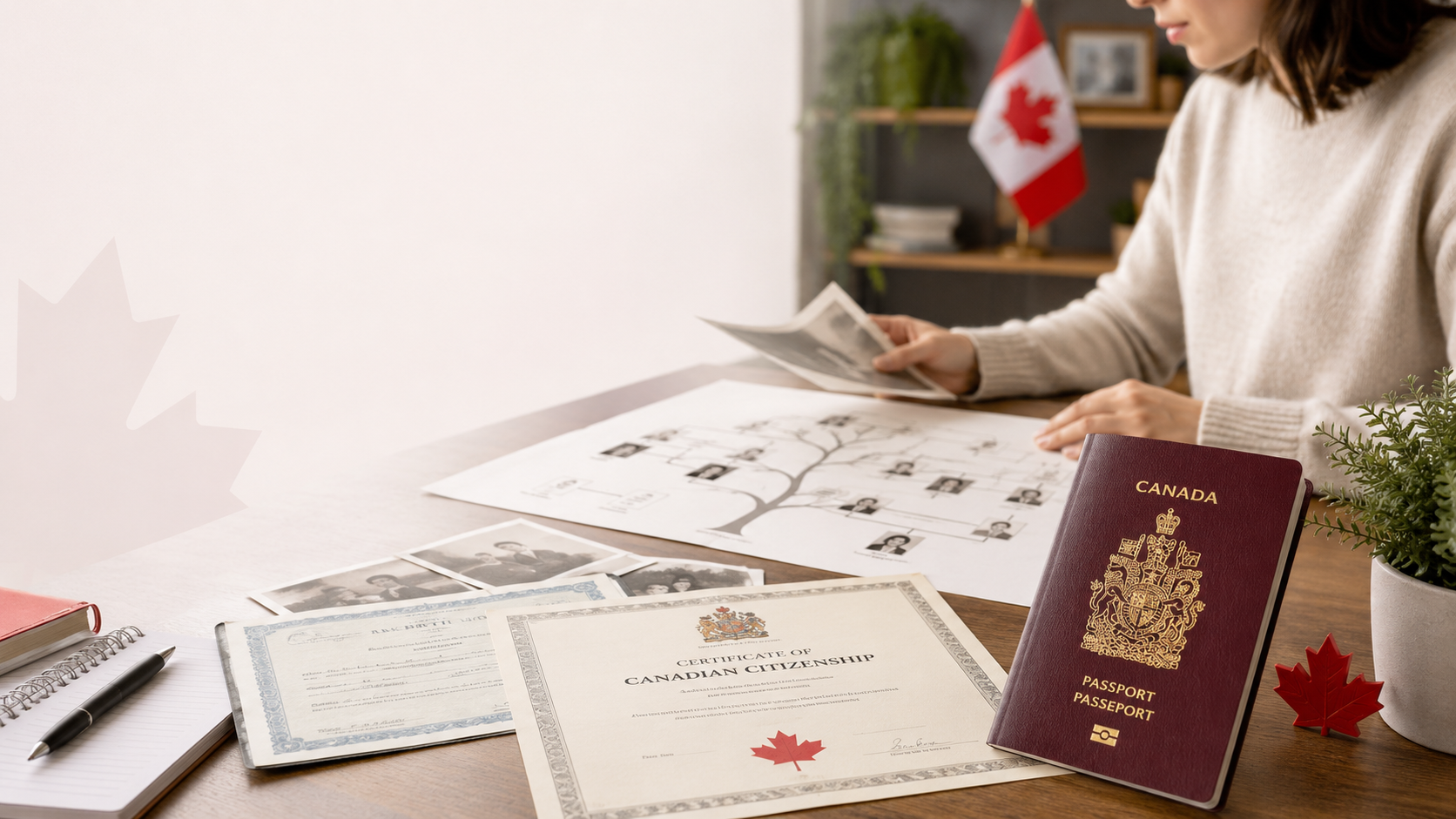


Applying for a Canadian passport with inherited citizenship can feel stressful when your family history is clear, but your paperwork is not. Many people know they have a Canadian parent, grandparent, or older family connection, yet they get stuck because Canada will not issue a passport based on family stories alone. You first need proof that you are legally recognized as a Canadian citizen.
Inherited Canadian citizenship is often called citizenship by descent.
It means a person may be Canadian because one of their parents was already a Canadian citizen at the time of their birth. In some cases, after recent legal changes, this may also help people whose Canadian connection goes beyond the first generation.
But there is one important point to understand:
A Canadian family connection is not the same thing as having a Canadian passport.
A passport is a travel document. Before you can get one, you usually need a citizenship certificate that proves Canada recognizes you as a citizen.
A Canadian passport is available only to Canadian citizens.
If you were born in Canada, your Canadian birth certificate may be enough to prove citizenship in many passport cases. But if you were born outside Canada and became Canadian through a parent, you usually need a citizenship certificate first.
The Government of Canada says a citizenship certificate proves Canadian citizenship and can be used to apply for a passport, but the certificate itself is not a travel document.
So the usual order is:
Canada changed its citizenship rules on December 15, 2025, when Bill C-3 took effect. The law changed how Canada deals with citizenship by descent and the old first-generation limit.
Before this change, many people born outside Canada could not automatically get citizenship if their Canadian parent was also born outside Canada. This was known as the first-generation limit.
Under the updated rules, Canada says some people born outside Canada in the second generation or later may now be citizens in certain situations.
This matters for families where Canadian citizenship passed through a parent who was also born abroad.
If you were born outside Canada before December 15, 2025, you may now be Canadian if you were born to a Canadian parent. Canada also says this may apply if your parents became Canadian because of the 2025 rule change.
That means some people who were previously blocked by the old rule may now have a path to proof of citizenship.
However, you should not assume approval is automatic in practice. You still need documents that show the family link clearly. IRCC will need to see official records, not just ancestry notes or family claims.
For people born outside Canada on or after December 15, 2025, the rules are different.
A person born in the second generation or later outside Canada may be Canadian if their Canadian parent also met Canada’s physical presence rule. That parent must have spent at least 1,095 days in Canada before the child’s birth.
This rule is important for Canadian citizens by descent who want to pass citizenship to children born abroad in the future.
The 1,095-day rule means the Canadian parent must have spent at least three years in Canada before the child was born or adopted.
These days do not have to be all at once. What matters is whether the total time adds up to at least 1,095 days.
This rule mainly affects people born or adopted outside Canada on or after December 15, 2025, when the Canadian parent was also born or adopted outside Canada.
Yes, in most inherited citizenship cases.
A citizenship certificate is the document that confirms your Canadian citizenship. It is especially important if you were born outside Canada and do not have a Canadian birth certificate.
The certificate can help you apply for:
Canada charges $75 for a citizenship certificate application.
Your document list depends on your family situation, but most applicants should expect to prove two things:
You may need:
The goal is to create a clean paper trail from you to the Canadian person in your family line.
For example, if your Canadian link is through your mother, you may need your birth certificate showing her name, plus her Canadian proof of citizenship.
If your Canadian link is through a grandparent, you may need records connecting each generation.
The process starts with the Government of Canada’s proof of citizenship application.
Here is the simple version:
Review whether you are applying as someone born abroad to a Canadian parent, someone affected by the old first-generation limit, or someone with a more complex family history.
Gather official records before you apply. Missing or unclear documents can delay the application.
Some applicants may be able to apply online, while others may need to use a paper application. The correct method depends on the case.
The citizenship certificate fee is currently $75.
Processing times can vary. Canada says timing depends on factors such as application type, completeness, verification needs, and whether IRCC needs more information.
Some people applied while Canada was using temporary measures for people affected by the old first-generation limit.
Now that Bill C-3 is in force, Canada says applications still in progress will be reviewed under the updated rules. Applicants in that situation do not need to submit a new citizenship certificate application only because the law changed.
This is useful for people who applied before the new rules fully took effect.
No, not for regular international travel.
A citizenship certificate proves status, but it is not a passport. If you plan to travel, you should apply for a Canadian passport after you receive your certificate.
The Government of Canada clearly separates the two: the certificate proves citizenship, while a passport is the travel document.
How to Apply for a Canadian Passport After Approval
Once you receive your citizenship certificate, you can apply for a Canadian passport.
For a first adult passport, you generally need:
If you are applying from inside Canada, you can submit the application through the available passport service options. If you are in the United States, you can apply from there using the process for Canadians in the U.S.
For Canadians applying from the United States, the service standard is 20 business days, plus mailing time.
Canada also says applicants may be eligible for a full refund if a passport application takes longer than 30 business days to process, as long as the application meets the refund rules.
Urgent and express options may be available in some situations, but extra fees and proof of urgency may be required.
Many delays happen because people apply before their file is ready.
Watch for these common problems:
A strong application tells a clear story through documents. The officer should be able to follow the family line without guessing.
Start with your Canadian link.
Ask yourself:
Once you answer these questions, the process becomes easier to understand.
You may be able to handle a simple case on your own.
But help may be useful if:
A licensed immigration lawyer or authorized representative can review your documents and help you avoid mistakes. This is especially helpful when old records, cross-border family history, or past citizenship loss may be involved.
If you inherited Canadian citizenship, a Canadian passport may be within reach, but the passport is not the first step.
Your first goal is to prove citizenship. For most people born outside Canada, that means getting a Canadian citizenship certificate. Once that certificate is approved, you can apply for a passport and use it as official travel identification.
The 2025 law change has made the path clearer for many families, especially those affected by the old first-generation limit. Still, every case depends on documents, dates, and family history.
Yes, you may be able to apply, but if you were born outside Canada, you will usually need a citizenship certificate first. The passport office needs official proof that Canada recognizes you as a citizen.
It may be possible in some cases because Canada changed the first-generation limit rules in 2025. Your eligibility depends on your date of birth, your parent’s citizenship status, and whether the family connection can be proven with official documents.
No. A citizenship certificate proves that you are Canadian, but it does not let you travel like a passport. You normally use the certificate to support your Canadian passport application.
For Canadians applying from the United States, the service standard is 20 business days, plus mailing time. Delays can happen if the application is incomplete or if officials need more information.
The biggest mistake is applying without a complete document trail. If your records do not clearly connect you to your Canadian parent or family line, your application can be delayed or refused.
Having an ‘Identity Verified’ badge or being ‘Identity Verified’ simply indicates that an individual has submitted information to complete our identity verification process or we have conducted internal verification using various authorized websites. While this process includes safeguards, it does not guarantee that the person is who they claim to be.
If you encounter any issues with this profile, please report them here. While all consultants who are verified have RCIC ID, we may not have the latest data in terms of their renewal/cancellation/discontinuation of their RCIC ID.
╳The “Verified Consultants” profiles on Immiperts.com are independently compiled using publicly available information from multiple sources, including the official CICC Public Register, consultants’ own websites, other public directories, and social media.
Immiperts.com is a completely independent platform and is not affiliated with, endorsed by, or connected to the College of Immigration and Citizenship Consultants (CICC), IRCC, or any immigration consultant.
All information is collected manually and is for educational and informational purposes only. Consultants may claim, update, or request removal of their profile by contacting us at hello@immiperts.com.
Users are strongly advised to always verify the latest authorization status directly on the official CICC Public Register at college-ic.ca.