

PSTQ in Canadian immigration can feel confusing for skilled workers who want to settle in Quebec but do not know where to start. Many applicants struggle with French requirements, job codes, Arrima invitations, Quebec selection rules, and the second federal step for permanent residence. This guide explains the process in plain English so you can understand whether the PSTQ may fit your profile.
PSTQ stands for Programme de sélection des travailleurs qualifiés, known in English as the Skilled Worker Selection Program.
It is Quebec’s main immigration program for skilled workers who want to live and work in Quebec permanently. The program is open to people already in Quebec and people applying from outside Canada.
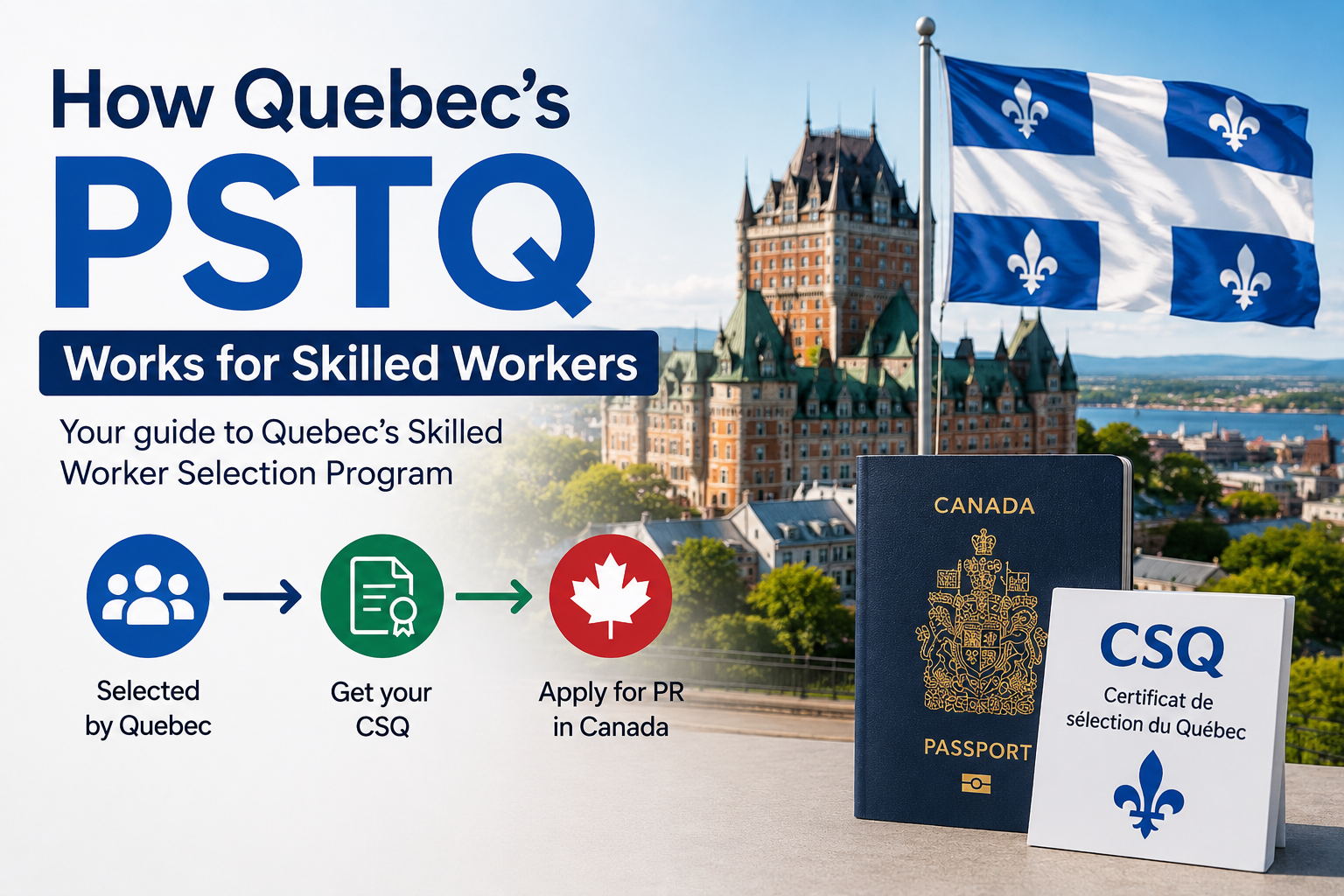
Quebec uses PSTQ to select workers who match the province’s labour needs. After Quebec selects you, you receive a Certificat de sélection du Québec, commonly called a CSQ. A CSQ is not a permanent residence. It is Quebec’s approval that allows you to apply to the Canadian federal government for permanent residence.
Canada’s federal immigration department says Quebec has a special agreement with the Government of Canada. This means applicants must apply to Quebec first before applying federally for permanent residence as Quebec-selected skilled workers.
The PSTQ has become especially important because Quebec has changed how it selects skilled workers.
The older Regular Skilled Worker Program, known as PRTQ, has been replaced by the PSTQ. Quebec has also stated that the PSTQ is now the only path for the permanent selection of skilled workers under Quebec’s skilled worker system.
This matters for applicants because the process is no longer just about wanting to move to Quebec. You must create a strong expression of interest, meet the right stream requirements, show French ability where required, and wait for Quebec to invite you.
The PSTQ process usually follows this order:
Your Arrima expression of interest is free and remains valid for 12 months. If you are not invited during that period, it becomes invalid, but you may create a new one.
To be considered under PSTQ, you must generally be a skilled worker who plans to settle in Quebec and work there.
Quebec lists basic requirements. You must be at least 18 years old, intend to settle in Quebec for work, be likely able to do the job, and avoid certain ineligible sectors. You must also meet the requirements of the stream under which Quebec considers your application.
Applicants must also sign a Financial Self-Sufficiency Contract. This means you confirm that you can support yourself and your accompanying family members for the first three months after becoming a permanent resident. Adults included in the application may also need to complete Quebec’s values attestation.
Quebec uses four streams under the PSTQ. The stream that applies to you depends mainly on your main occupation, your NOC code, your TEER category, whether your job is regulated, and whether you have exceptional talent.
This stream is for applicants whose main occupation falls under TEER 0, 1, or 2.
You generally need at least one year of full-time paid work experience, or the equivalent, in your main occupation within the five years before applying. You also need a qualifying diploma and French ability: oral French at level 7 or higher and written French at level 5 or higher on Quebec’s French scale.
This stream may fit people in professional, technical, management, or specialized roles, as long as the occupation is not one that must go through the regulated professions stream.
This stream is for applicants whose main occupation falls under TEER 3, 4, or 5.
You generally need at least two years of paid work experience in your main occupation, including at least one year in Quebec, within the five years before your application. You also need the required education and spoken French at level 5 or higher.
This stream may be relevant for workers in trades, support roles, service jobs, manual occupations, and other roles that require practical training or hands-on experience.
This stream is for people whose occupation is regulated in Quebec.
A regulated profession is a job where you may need permission from a professional body or regulatory authority before you can practise. Examples may include certain health, engineering, legal, accounting, education, construction, and technical occupations.
Quebec says fully regulated occupations must go through Stream 3. Applicants need a document from the regulatory authority, such as authorization to practise or proof of partial or full recognition of their training or diploma.
French requirements depend on the TEER level of the occupation. For TEER 0, 1, or 2, applicants need oral French at level 7 or higher and written French at level 5 or higher. For TEER 3, 4, or 5, applicants need spoken French at level 5 or higher.
This stream is for applicants who can clearly show exceptional expertise that may contribute to Quebec’s prosperity.
You must have practised your main occupation for at least three years in the five years before applying. You must also show recognized achievements or obtain an opinion from one of Quebec’s listed partners in fields such as strategic economic sectors, research, arts, or sports.
This stream is not for ordinary skilled worker profiles. It is meant for people with strong, proven accomplishments.
You cannot simply submit a full PSTQ application whenever you want. First, you must submit an expression of interest in Arrima.
Once your profile is in the pool, Quebec may invite you if your profile matches the province’s needs and you meet the French level required for your profession. Quebec evaluates profiles using a scoring system based on factors that support work and social integration.
If you receive an invitation, you must accept it within 30 days. If you do not respond within 30 days, your expression of interest becomes invalid and is removed from the pool.
After accepting your invitation, you must submit your permanent selection application.
For Stream 1, Stream 2, Stream 4, and Stream 3 applicants who already have proof from a regulatory authority, Quebec gives 60 days from the date of acceptance to submit the application, documents, and fees.
For some Stream 3 applicants who do not yet have proof of recognition from the regulatory authority, Quebec gives one year from the date of acceptance to submit the application.
As of January 1, 2026, Quebec’s listed application review fees are $940 for the main applicant, $201 for a spouse or common-law partner, and $201 for each dependent child. Fees are non-refundable, even if the application is refused or rejected.
Your document list depends on your profile, stream, family situation, education, and work history. Common documents may include:
Quebec says documents must be scanned in colour, legible, complete, accurate, and submitted in the required format. If documents are incomplete or not in the required format, Quebec may give you 60 days to correct the issue. If you do not, your application can be rejected.
Quebec checks whether your application includes all required documents and whether you meet the program rules.
You and your accompanying family members aged 18 or older may need to obtain the attestation about democratic values and Quebec values within 60 days after Quebec asks for it. Quebec may also request an interview to verify your information.
There are three possible outcomes:
A refusal usually relates to not meeting program requirements. A rejection often relates to missing, false, doubtful, or unsupported information.
After you receive your CSQ, you must apply to the federal government for permanent residence.
IRCC says applicants who have been selected by Quebec and obtained a CSQ must submit a separate permanent residence application. A federal officer then reviews the application under Canadian immigration rules, including medical, security, and criminality checks.
This is an important point. Quebec selection is not the final approval. Canada still makes the final permanent residence decision.
Some applicants may be able to keep working or apply for a work permit while waiting, but the rules depend on their situation.
IRCC has a work permit measure for certain Quebec skilled workers who have been invited under PSTQ and submitted a permanent selection application to Quebec. The measure may allow eligible workers to keep working for their Quebec employer for up to 12 months. The deadline to apply is listed as December 31, 2026.
This measure is not for everyone. It is mainly tied to specific work permit and employer conditions. Spouses, common-law partners, and dependants are not eligible for that specific work permit, though they may qualify under another work program if they meet the rules.
French is one of the most important parts of PSTQ.
Quebec has made French a core selection condition for several streams. Stream 1, Stream 2, and Stream 3 all include French requirements. In general, stronger French can improve your chances, especially if your occupation is in demand and your profile also includes Quebec work or study experience.
For applicants who are serious about PSTQ, improving French should not be left until the last minute. Test results are often needed, and language preparation can take months.
Your main occupation affects your stream. It also affects how Quebec reads your profile. Choose the NOC code that honestly matches your duties, not just the job title you prefer.
Some applicants only discover late that their profession is regulated in Quebec. That can delay the file because they may need documents from a regulatory authority.
Deadlines are strict. You have 30 days to accept an invitation. After that, you may have 60 days or, in specific Stream 3 cases, one year to submit the application.
Work experience letters should clearly support your role, dates, hours, duties, and paid experience. Vague letters can create problems.
A CSQ is Quebec’s selection certificate. You still need federal permanent residence approval from IRCC.
Before starting, ask yourself:
The PSTQ is now one of the most important routes for skilled workers who want to settle in Quebec permanently. It is not a simple “apply and wait” program. It is an invitation-based system where your occupation, French level, education, work experience, Quebec ties, and documents all matter.
For many applicants, the biggest challenge is not eligibility alone. It is timing, preparation, and making sure the profile is accurate before Quebec sends an invitation. A strong PSTQ plan starts with the right NOC code, honest information, French preparation, and a clear understanding of both Quebec and federal steps.
PSTQ means Programme de sélection des travailleurs qualifiés, or Skilled Worker Selection Program. It is Quebec’s selection program for skilled workers who want to live and work in Quebec permanently.
No. PSTQ can lead to a Quebec Selection Certificate, called a CSQ, but that is not permanent residence. After receiving a CSQ, you must apply to IRCC for federal permanent residence approval.
In most PSTQ streams, yes. French requirements depend on the stream and the TEER level of your occupation, but French is a key selection factor for Quebec skilled worker immigration.
A job offer may help in some cases, but it is not always required to submit an expression of interest. Quebec decides invitations based on its criteria, your occupation, French level, score, and labour needs.
An Arrima expression of interest is valid for 12 months. If Quebec does not invite you during that time, it becomes invalid, but you may create a new one for free.
Having an ‘Identity Verified’ badge or being ‘Identity Verified’ simply indicates that an individual has submitted information to complete our identity verification process or we have conducted internal verification using various authorized websites. While this process includes safeguards, it does not guarantee that the person is who they claim to be.
If you encounter any issues with this profile, please report them here. While all consultants who are verified have RCIC ID, we may not have the latest data in terms of their renewal/cancellation/discontinuation of their RCIC ID.
╳The “Verified Consultants” profiles on Immiperts.com are independently compiled using publicly available information from multiple sources, including the official CICC Public Register, consultants’ own websites, other public directories, and social media.
Immiperts.com is a completely independent platform and is not affiliated with, endorsed by, or connected to the College of Immigration and Citizenship Consultants (CICC), IRCC, or any immigration consultant.
All information is collected manually and is for educational and informational purposes only. Consultants may claim, update, or request removal of their profile by contacting us at hello@immiperts.com.
Users are strongly advised to always verify the latest authorization status directly on the official CICC Public Register at college-ic.ca.