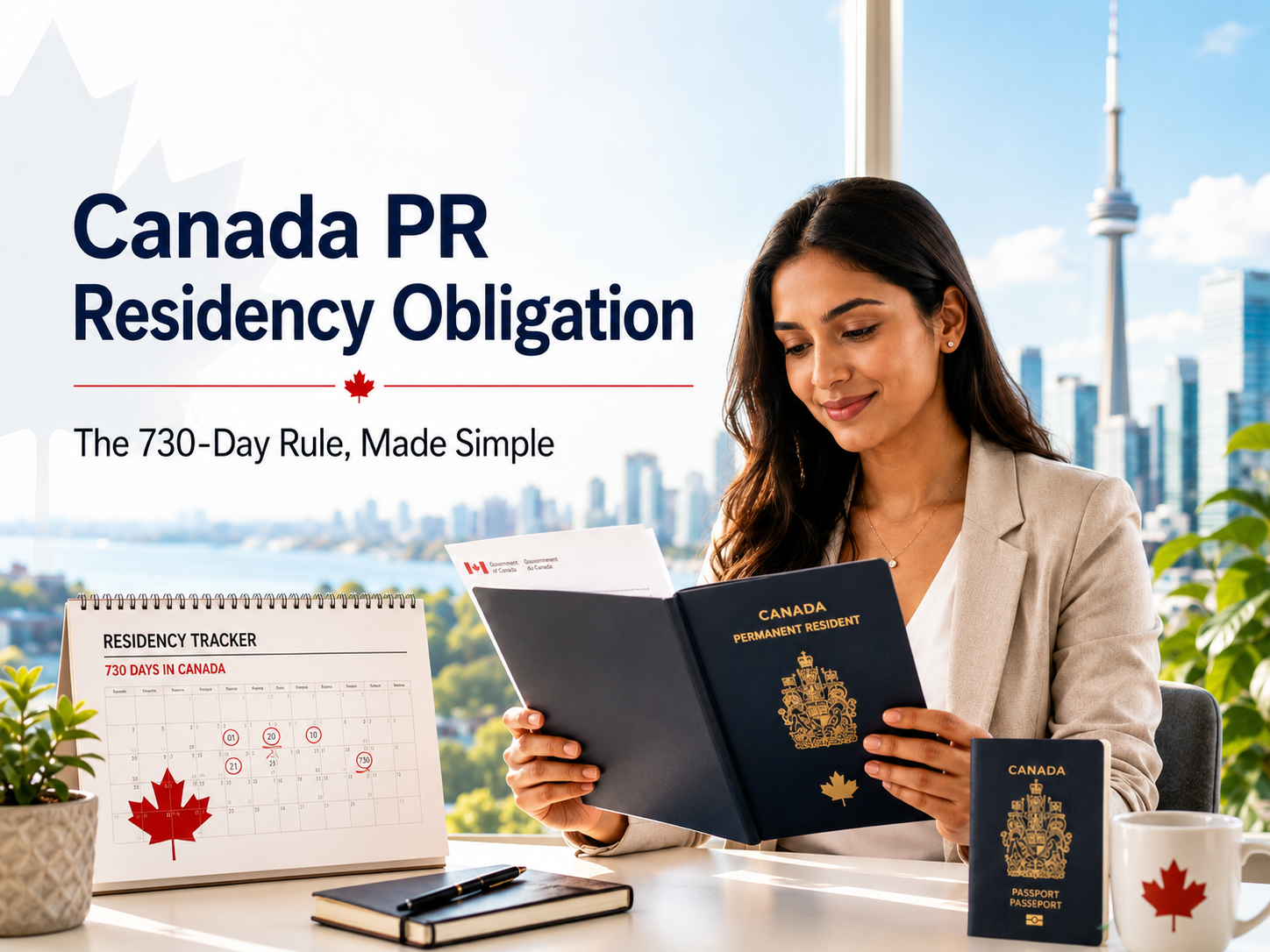


The Canada PR residency obligation looks simple, but one wrong travel decision can put your PR status at risk. Many new permanent residents think a valid PR card is enough, until they renew it, apply for a PRTD, or return to Canada after a long stay abroad. The real challenge is not just keeping the card active; it is proving that you have spent enough time in Canada under the 730-day rule.
A Canadian permanent resident must be physically present in Canada for at least 730 days in every five-year period.
These 730 days do not need to be continuous. You do not have to live in Canada for two straight years without leaving. You can divide the days across the five-year period.
For example, you may spend:
As long as the total reaches 730 days within the required five-year period, you may meet the residency obligation.
In simple words, Canada expects permanent residents to treat Canada as their main home, not just as a backup option.
Many new PRs think the five-year period starts from the day they landed in Canada and ends exactly five years later. That is only partly true in the beginning.
Once you have been a permanent resident for five years or more, the government usually looks at the five years immediately before the day your status is checked.
This is called a rolling five-year period.
That means your old days in Canada do not stay useful forever. As time passes, older days fall outside the five-year window.
Suppose you became a PR and lived in Canada for three full years. Then you left Canada and stayed outside for two years.
At the end of five years, you may still be safe because you already spent three years in Canada.
But if you stay outside Canada longer, your early days in Canada will slowly fall out of the five-year count. After some time, you may no longer have 730 days within the most recent five-year period.
This is where many PRs get caught. They were once safe, but later became at risk because they stayed outside Canada too long.
If you have been a PR for less than five years, officers may look at whether you can still complete 730 days before your fifth anniversary as a PR.
For example, if you became a PR two years ago and spent most of that time outside Canada, you may still have time to return and complete your days.
But if you wait too long, you may reach a point where it is no longer possible to complete 730 days within your first five years.
That is why new PRs should not leave day-counting until the last moment. A long delay abroad can create a serious problem when it is time to renew the PR card or return to Canada.
No. Your PR card and your PR status are not the same thing.
Your PR card is a travel and identity document. It helps prove your PR status when you return to Canada by commercial transport, such as a flight, bus, train, or boat.
If your PR card expires, you do not automatically lose your permanent resident status.
However, an expired PR card can create a travel problem. If you are outside Canada without a valid PR card, you may need to apply for a Permanent Resident Travel Document, also called a PRTD, to return to Canada by commercial transport.
That PRTD application can trigger a review of whether you meet the residency obligation.
Many new permanent residents first face the residency obligation issue when they apply to renew their PR card.
At that time, you usually need to give details of your travel history. You may need to show where you lived, when you left Canada, when you returned, and whether any time outside Canada should count toward your obligation.
If your travel history shows long absences, IRCC may ask more questions.
This does not mean every long trip creates a problem. But it does mean you should be careful, honest, and well-prepared.
You should keep records such as:
The more organized your records are, the easier it becomes to explain your time.
The clearest way to meet the residency obligation is to be physically present in Canada.
A day spent inside Canada normally counts toward your 730 days.
Your days do not need to be perfect or connected. Short trips outside Canada are allowed. The main question is whether you still have enough days in Canada within the required five-year period.
For most PRs, this is the safest approach: live in Canada for most of the time and keep a clear record of all trips outside Canada.
Yes, in some situations, time outside Canada may count toward your residency obligation.
This usually applies when you are outside Canada for a reason that Canadian immigration law accepts.
Some common examples include:
If you are outside Canada while accompanying your Canadian citizen spouse or common-law partner, those days may count.
This can also apply to a dependent child accompanying a Canadian citizen parent.
The key point is that you must actually be accompanying that person. It is not enough to simply be married to a Canadian citizen while living separately in another country.
Some permanent residents may count time outside Canada if they are working full-time for a Canadian business outside Canada.
But this rule is often misunderstood.
Not every company with a Canadian connection will qualify. A foreign branch, foreign subsidiary, or international employer may not automatically count as a Canadian business for this purpose.
You may need strong documents to prove:
This is one of the most common areas where people make mistakes.
Time outside Canada may also count if you are accompanying a permanent resident spouse, common-law partner, or parent who is employed full-time by a qualifying Canadian business abroad or by Canadian public service.
Again, the details matter. You should not assume the exception applies without checking your situation properly.
This is one of the most important parts of the residency obligation.
Many PRs think, “My company has a Canadian office, so my time abroad should count.”
That is not always true.
For example, a person may work for a company in Canada and then move to another country to work for a related company. If that foreign company is legally incorporated outside Canada, the time may not count the way the person expects.
This is why you should not depend on a verbal promise from an employer. You need proper documents and a clear understanding of the rule.
If your PR status depends on this exception, speak with a licensed Canadian immigration lawyer or consultant before staying abroad for a long period.
A Permanent Resident Travel Document is usually needed when a PR is outside Canada and does not have a valid PR card to return by commercial transport.
This can happen if:
When you apply for a PRTD, the visa office may review whether you meet the residency obligation.
If the officer believes you do not meet the rule, your application may be refused. Your PR status may also come under risk, though you may have the right to appeal.
This is why PRs should avoid travelling abroad when their PR card is close to expiry.
A safe approach is simple: renew your PR card and receive the new card before leaving Canada for any important or long trip.
When you return to Canada, a border officer may ask questions about how long you have been outside the country.
This does not happen to everyone. But it can happen if your travel pattern raises concerns.
For example, you may face questions if:
If the officer believes you may not meet the residency obligation, you may be sent for further inspection. In serious cases, the officer may prepare a report.
A report does not always mean you lose PR status immediately. But it can start a formal process that may lead to a removal order if the concern is confirmed.
You may still have appeal rights, but the process can become stressful and time-sensitive.
You should not guess your days.
Create a simple record of every trip outside Canada. This record should include:
Keep this record updated from the beginning of your PR journey.
You can use a spreadsheet, notebook, or digital document. The format does not matter as much as accuracy.
Canada’s citizenship physical presence rule is different from the PR residency obligation.
Citizenship requires a different day count. PR status requires 730 days in the relevant five-year period.
Because the rules are not the same, do not rely only on the citizenship calculator to decide whether you meet your PR residency obligation.
If you think you are short of the required days, do not panic, but do not ignore it.
First, count your days carefully.
Then check whether any time outside Canada can legally count under an exception.
If you are still short, speak with a licensed Canadian immigration lawyer or consultant before you:
In some cases, humanitarian and compassionate reasons may be considered. These may include serious family issues, medical emergencies, hardship, or the best interests of a child.
But these arguments are not automatic. You need strong evidence and a clear explanation.
Yes, in many cases, a permanent resident may have the right to appeal a negative residency obligation decision to the Immigration Appeal Division.
An appeal can consider whether you actually met the residency obligation. If you did not, the appeal may also consider humanitarian and compassionate factors.
These can include:
Appeal deadlines can be short. If you receive a negative decision, do not wait. Get professional advice quickly.
The best way to protect your PR status is to plan your time carefully.
Here are practical steps:
Try to live in Canada for most of your first five years as a PR. This gives you a safety buffer if you later need to travel for family, work, or personal reasons.
Write down every trip outside Canada. Do this while the information is fresh. Do not try to rebuild five years of travel history at the last minute.
If your PR card is close to expiry, renew it before leaving Canada. IRCC does not mail PR cards outside Canada.
If your time outside Canada is based on a job, confirm whether the employment really meets the Canadian business exception.
Save proof of your life in Canada and your reasons for being outside Canada. Good records can make a big difference later.
If you are close to falling short of 730 days, get help early. Waiting until your PR card renewal or PRTD refusal can make the situation harder.
The Canada PR residency obligation is not difficult to understand, but it is easy to miscalculate.
The rule is not just about having a valid PR card. It is about whether you have spent enough time in Canada or whether your time outside Canada legally counts.
For most permanent residents, the safest path is simple: live in Canada for a clear part of every five-year period, track your travel, and avoid long absences without proper planning.
If you are already short of days or unsure about your situation, do not guess. Count your days carefully and speak with a licensed immigration professional before making your next move.
You generally need to be in Canada for at least 730 days within every five-year period. The days do not need to be continuous, so short trips outside Canada are allowed.
No, an expired PR card does not automatically mean you lost PR status. But if you are outside Canada without a valid PR card, you may need a PRTD to return by commercial transport.
Yes, but only in specific cases. Time abroad may count if you are with a Canadian citizen spouse or parent, or if you meet certain Canadian business or public service employment rules.
Your PR status may be reviewed during PR card renewal, a PRTD application, or at the border. If a negative decision is made, you may have appeal rights, but deadlines can be short.
Yes, if your PR card is close to expiry, it is safer to renew it and receive the new card before you leave Canada. IRCC does not send PR cards to addresses outside Canada.
Having an ‘Identity Verified’ badge or being ‘Identity Verified’ simply indicates that an individual has submitted information to complete our identity verification process or we have conducted internal verification using various authorized websites. While this process includes safeguards, it does not guarantee that the person is who they claim to be.
If you encounter any issues with this profile, please report them here. While all consultants who are verified have RCIC ID, we may not have the latest data in terms of their renewal/cancellation/discontinuation of their RCIC ID.
╳The “Verified Consultants” profiles on Immiperts.com are independently compiled using publicly available information from multiple sources, including the official CICC Public Register, consultants’ own websites, other public directories, and social media.
Immiperts.com is a completely independent platform and is not affiliated with, endorsed by, or connected to the College of Immigration and Citizenship Consultants (CICC), IRCC, or any immigration consultant.
All information is collected manually and is for educational and informational purposes only. Consultants may claim, update, or request removal of their profile by contacting us at hello@immiperts.com.
Users are strongly advised to always verify the latest authorization status directly on the official CICC Public Register at college-ic.ca.