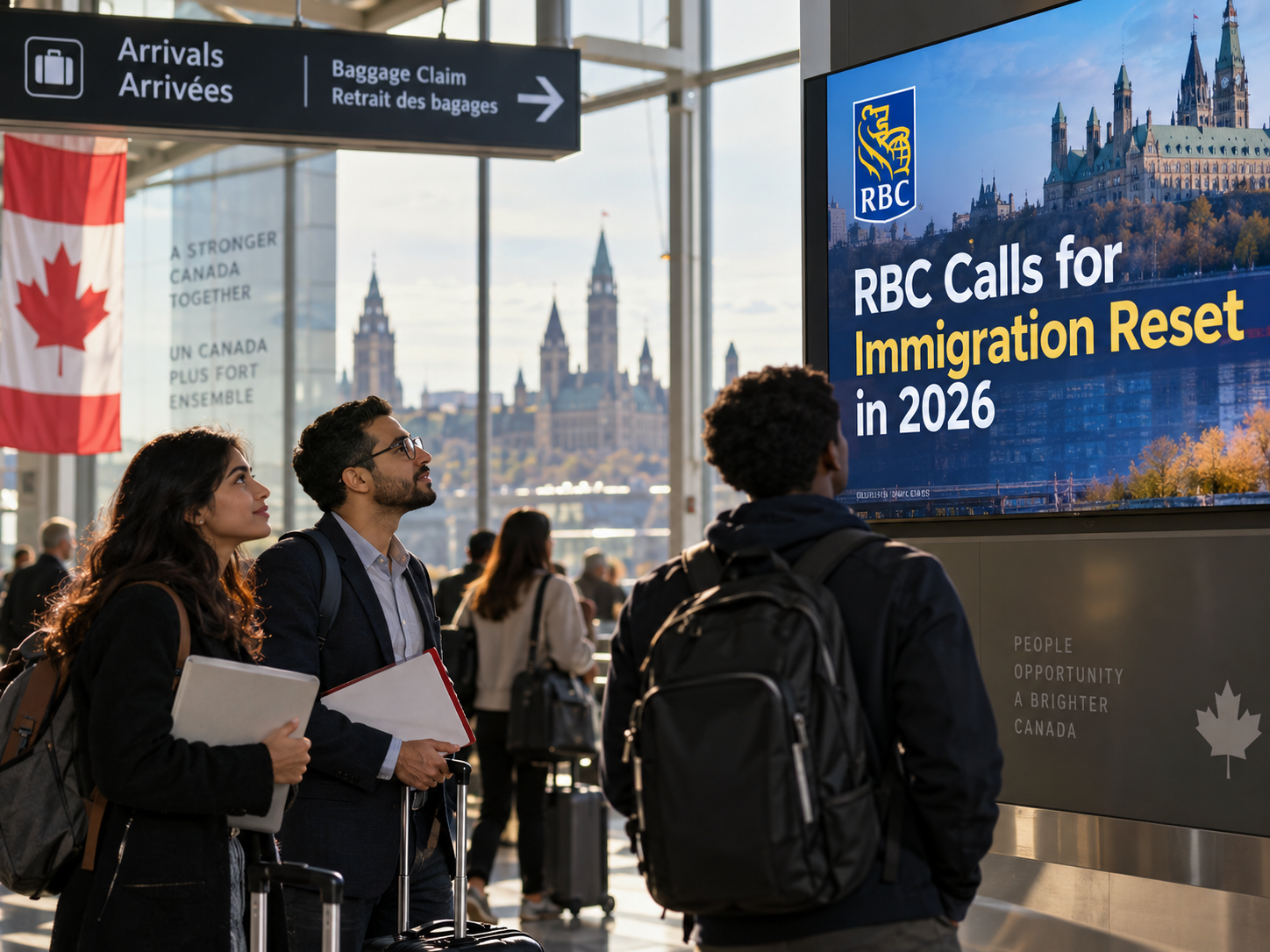


Canada’s immigration system has become harder to predict. Applicants have faced changing rules and tighter temporary resident limits, while communities have felt pressure on housing and public services. RBC says the problem is not immigration itself. Its concern is that Canada has moved too quickly between expansion and restriction, making long-term planning difficult.
Royal Bank of Canada’s 2026 report, A Smarter Immigration Strategy, argues for a more stable, skills-focused and transparent system. These are recommendations, not government policy.
RBC’s main proposals are:
RBC points to the sharp population increase between 2022 and 2024. Its report says Canada added about three million migrants in that period, roughly equal to a decade of immigration at earlier rates.
That growth happened while housing, transportation, health care and education systems were under pressure. Canada then moved in the opposite direction, introducing tighter controls on temporary residents and international students.
RBC argues that these swings created uncertainty. It also notes that more than 25 rule changes affected international students over roughly two years.
The federal government’s 2026–2028 Immigration Levels Plan sets permanent resident admissions at 380,000 a year. It targets 385,000 new temporary resident arrivals in 2026 and 370,000 in both 2027 and 2028. Ottawa also wants temporary residents below 5% of Canada’s population by the end of 2027.
Express Entry uses the Comprehensive Ranking System, or CRS, to rank eligible candidates based on age, education, language ability and skilled work experience.
Category-based selection lets IRCC invite candidates who meet specific priorities, even when other people may have higher CRS scores.
RBC argues this weakens the original points-first model and says local shortages are better handled by provinces.
IRCC takes a different view. The federal government says category-based selection helps meet economic goals. In 2026, categories include French-language proficiency, health care and social services, STEM, trades, education, transport and several groups with Canadian work experience.
The debate is therefore about how Canada should balance overall ranking with targeted labour needs.
Labour shortages vary across Canada. One province may need tradespeople while another needs health professionals or workers in smaller communities.
RBC argues that provinces are better placed to identify these gaps and connect immigration selection with licensing, training and local employment.
Under this approach, Ottawa could keep a more consistent national points system while provincial nominee programs handle more occupation-specific targeting.
The two-step model means a person first comes to Canada temporarily to work or study, gains Canadian experience, and later competes for permanent residence.
RBC believes Canada should give more attention to temporary residents with strong long-term economic prospects. Canadian work experience can help newcomers build local skills, connections and employment history.
The current federal plan already moves partly in this direction. Ottawa says it intends to accelerate the transition of up to 33,000 temporary workers to permanent residence in 2026 and 2027.
Nothing changes immediately. RBC cannot change immigration law, and IRCC has not announced that it will adopt these recommendations.
Still, applicants can take one practical lesson from the report: do not build an immigration plan around one category alone.
Categories may change, but a competitive CRS profile remains useful across different Express Entry draws. IRCC continues to rank eligible candidates by CRS even within category-based rounds.
RBC is not arguing that Canada should stop immigration. It is calling for steadier growth, clearer rules, stronger emphasis on skills and better coordination between Ottawa and the provinces.
For applicants, the safest approach is simple: follow official IRCC rules, not forecasts. RBC’s report may influence the policy debate, but only government decisions can change eligibility, Express Entry categories or immigration targets.
No. RBC is a private financial institution. Its report offers recommendations, while immigration rules are set by governments.
RBC mainly recommends stable population growth of about 1% a year rather than sharp increases followed by sharp cuts. Its focus is predictability and stronger outcomes.
Yes. RBC recommends moving Express Entry closer to a points-first model and leaving more occupation-specific selection to provinces and territories.
Yes. IRCC continues to use category-based selection in 2026 alongside general and program-specific Express Entry rounds.
Not because of the report alone. Applicants should follow current IRCC rules, improve their CRS profile and monitor official updates.
Having an ‘Identity Verified’ badge or being ‘Identity Verified’ simply indicates that an individual has submitted information to complete our identity verification process or we have conducted internal verification using various authorized websites. While this process includes safeguards, it does not guarantee that the person is who they claim to be.
If you encounter any issues with this profile, please report them here. While all consultants who are verified have RCIC ID, we may not have the latest data in terms of their renewal/cancellation/discontinuation of their RCIC ID.
╳The “Verified Consultants” profiles on Immiperts.com are independently compiled using publicly available information from multiple sources, including the official CICC Public Register, consultants’ own websites, other public directories, and social media.
Immiperts.com is a completely independent platform and is not affiliated with, endorsed by, or connected to the College of Immigration and Citizenship Consultants (CICC), IRCC, or any immigration consultant.
All information is collected manually and is for educational and informational purposes only. Consultants may claim, update, or request removal of their profile by contacting us at hello@immiperts.com.
Users are strongly advised to always verify the latest authorization status directly on the official CICC Public Register at college-ic.ca.