
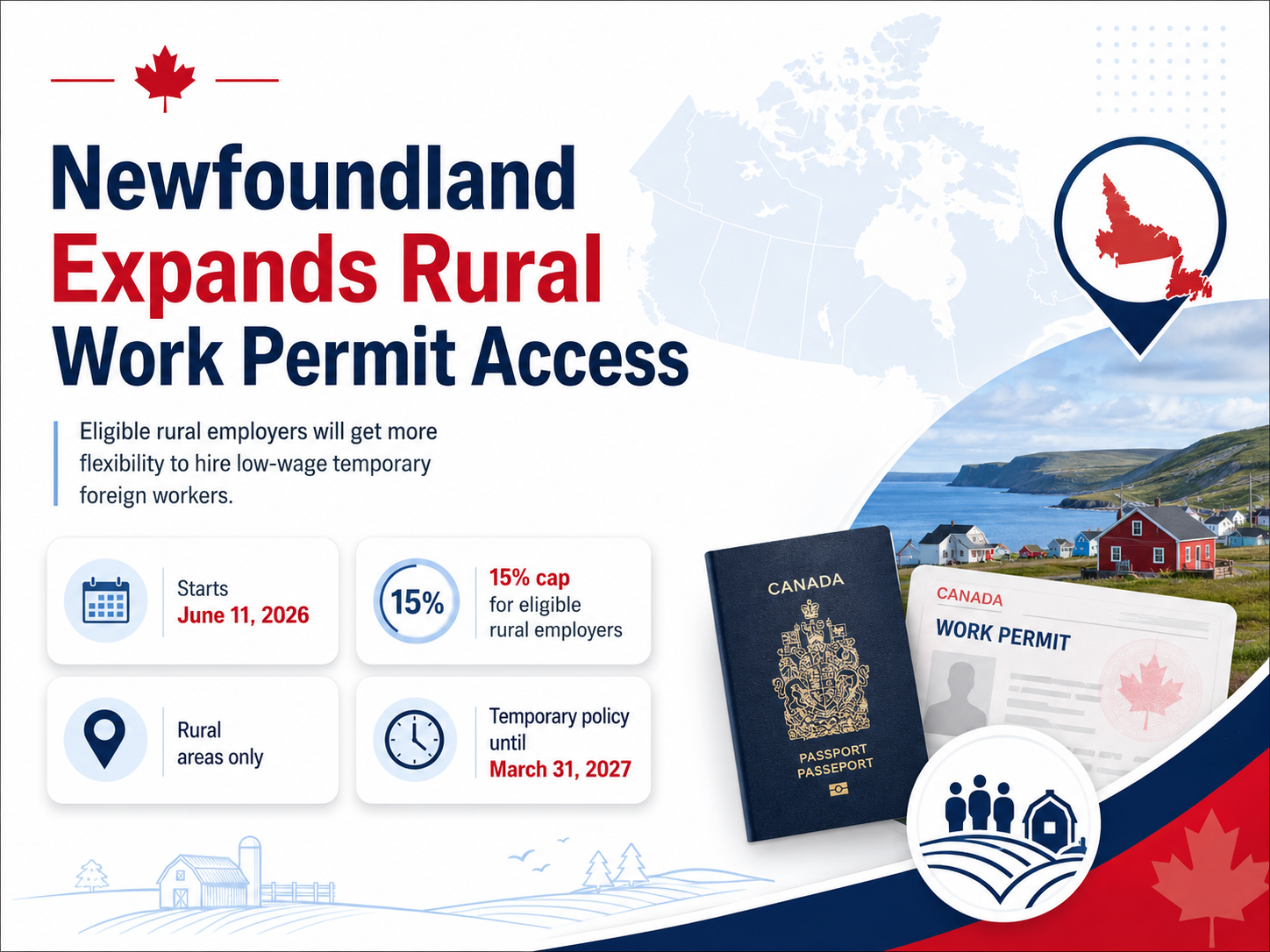


Newfoundland and Labrador will allow eligible rural employers more flexibility when hiring low-wage temporary foreign workers.
Newfoundland and Labrador has joined a federal temporary policy that gives rural employers more room to hire low-wage temporary foreign workers.
The province is the latest to opt into Ottawa’s measure under the Temporary Foreign Worker Program, also known as the TFWP. The policy is designed to help rural businesses deal with labour shortages when they cannot find enough Canadian citizens or permanent residents to fill jobs.
Only employers located outside Newfoundland and Labrador census metropolitan areas, as defined by Statistics Canada, can use the new measures.
The federal government first introduced the temporary public policy on April 1, 2026. Newfoundland and Labrador’s participation was confirmed in a June 2 update on the federal government’s website.
The province will apply both available measures across all sectors. The changes will take effect on June 11, 2026, and are expected to remain in place until March 31, 2027.
Under the policy, eligible rural employers may keep their current number of low-wage temporary foreign workers if that number is already above the standard 10 per cent cap. They may also benefit from a higher 15 per cent cap, instead of the usual 10 per cent limit, for low-wage temporary foreign workers.
The policy does not remove the regular rules of the Temporary Foreign Worker Program.
Employers must still show that they tried to recruit Canadian citizens and permanent residents before hiring foreign workers. Those who fail to meet regular TFWP requirements will not qualify for the new flexibility.
The measures also do not apply to employers located outside rural areas. Rural employers that submitted a Labour Market Impact Assessment, or LMIA, before June 11, 2026, will not benefit from the policy for that application. The new measures will apply only when an eligible employer submits a new LMIA during the active period.
Employment and Social Development Canada also says low-wage positions under the permanent residence dual-intent stream are excluded. A dual-intent LMIA can support both a permanent residence application and a temporary work permit application.
Certain sectors already have a 20 per cent cap for temporary foreign workers, and that will not change under this policy.
These include construction, food manufacturing, hospitals, nursing and residential care facilities, and some in-home caregiver roles. Covered caregiver positions include registered nurses, licensed practical nurses, home childcare providers, home support workers, live-in caregivers, personal care attendants, and attendants for persons with disabilities.
The move may help rural Newfoundland and Labrador employers in sectors that depend on the TFWP, especially in communities where low-wage jobs are hard to fill locally.
It may also create more job opportunities for foreign workers in selected rural communities, depending on whether employers meet the program rules.
British Columbia, Manitoba, New Brunswick, Nova Scotia, and Quebec have already opted into the measures. Alberta and Nunavut are not participating. Details from other jurisdictions have not yet been released but are expected later.











Having an ‘Identity Verified’ badge or being ‘Identity Verified’ simply indicates that an individual has submitted information to complete our identity verification process or we have conducted internal verification using various authorized websites. While this process includes safeguards, it does not guarantee that the person is who they claim to be.
If you encounter any issues with this profile, please report them here. While all consultants who are verified have RCIC ID, we may not have the latest data in terms of their renewal/cancellation/discontinuation of their RCIC ID.
╳The “Verified Consultants” profiles on Immiperts.com are independently compiled using publicly available information from multiple sources, including the official CICC Public Register, consultants’ own websites, other public directories, and social media.
Immiperts.com is a completely independent platform and is not affiliated with, endorsed by, or connected to the College of Immigration and Citizenship Consultants (CICC), IRCC, or any immigration consultant.
All information is collected manually and is for educational and informational purposes only. Consultants may claim, update, or request removal of their profile by contacting us at hello@immiperts.com.
Users are strongly advised to always verify the latest authorization status directly on the official CICC Public Register at college-ic.ca.