
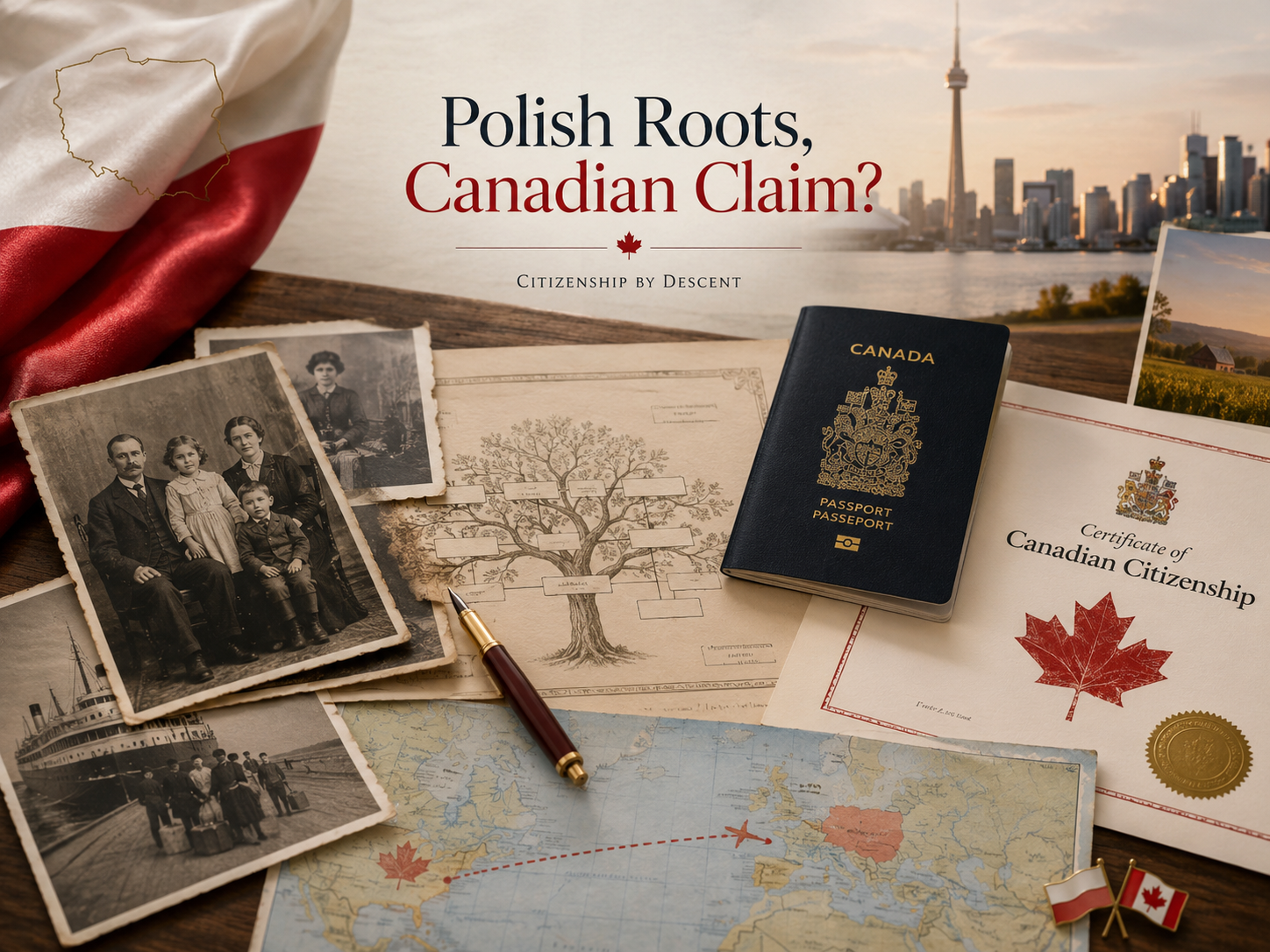


New citizenship rules may benefit descendants whose Polish family histories include a Canadian branch.
A Polish family connection to Canada could now carry more weight than many descendants realize. Changes to Canada’s Citizenship Act that took effect on December 15, 2025, removed the first-generation limit on citizenship by descent in some cases.
The change may affect people whose Polish ancestors settled in Canada before later generations moved elsewhere, including the United States.
Polish migration to North America often sent relatives to both Canada and the United States. Many newcomers originally preferred major American centres such as Chicago, Detroit and New York. However, tighter United States immigration limits introduced in 1924 encouraged more Eastern Europeans to consider Canada.
Polish settlers established communities in Ontario and across the Prairies. Wilno, Ontario, became one of Canada’s earliest Polish settlements after Kashubian families arrived during the 1850s. Later arrivals settled in Manitoba, Saskatchewan and Alberta, often working in agriculture.
Canada also welcomed Polish veterans and displaced people after the Second World War. About 4,500 Polish veterans entered in 1946 and 1947 under farm labour agreements. In September 1949, 123 Polish Catholic orphans arrived at Halifax’s Pier 21.
These arrivals did not automatically receive citizenship. Some later became naturalized Canadians, allowing citizenship rights to pass through their families under the rules in force at the time.
Before Bill C-3, citizenship by descent generally stopped after the first generation born outside Canada. A Canadian-born or naturalized citizen could usually pass citizenship to a child born abroad, but that child often could not pass it to another foreign-born generation.
Bill C-3 changed that system. For people born outside Canada before December 15, 2025, Immigration, Refugees and Citizenship Canada says a person is likely already Canadian when a parent was a Canadian citizen at the time of birth. The rule can also apply when that parent became Canadian automatically because of the same legislative changes.
People born abroad on or after December 15, 2025, face an additional test in second-generation or later cases. Their Canadian parent, who was also born abroad, must generally have spent at least 1,095 days in Canada before the child’s birth.
Polish ancestry alone does not create a claim. A person must show a direct parent-child chain connecting them to someone who held Canadian citizenship.
Useful documents may include Canadian birth certificates, naturalization files, passenger lists, census entries and homestead records. Library and Archives Canada keeps passenger records for many arrivals between 1865 and 1935.
Researchers should also check alternate spellings. Polish surnames may appear in anglicized forms, with missing accents or under historical place names.
Someone who believes they qualify does not normally apply to become a citizen. They apply for a citizenship certificate, which allows the federal government to confirm their status. The certificate can then support a Canadian passport application.
Because citizenship depends on individual dates, documents and family relationships, applicants should confirm their circumstances through official federal guidance or qualified legal advice before making travel or passport plans.









Having an ‘Identity Verified’ badge or being ‘Identity Verified’ simply indicates that an individual has submitted information to complete our identity verification process or we have conducted internal verification using various authorized websites. While this process includes safeguards, it does not guarantee that the person is who they claim to be.
If you encounter any issues with this profile, please report them here. While all consultants who are verified have RCIC ID, we may not have the latest data in terms of their renewal/cancellation/discontinuation of their RCIC ID.
╳The “Verified Consultants” profiles on Immiperts.com are independently compiled using publicly available information from multiple sources, including the official CICC Public Register, consultants’ own websites, other public directories, and social media.
Immiperts.com is a completely independent platform and is not affiliated with, endorsed by, or connected to the College of Immigration and Citizenship Consultants (CICC), IRCC, or any immigration consultant.
All information is collected manually and is for educational and informational purposes only. Consultants may claim, update, or request removal of their profile by contacting us at hello@immiperts.com.
Users are strongly advised to always verify the latest authorization status directly on the official CICC Public Register at college-ic.ca.