
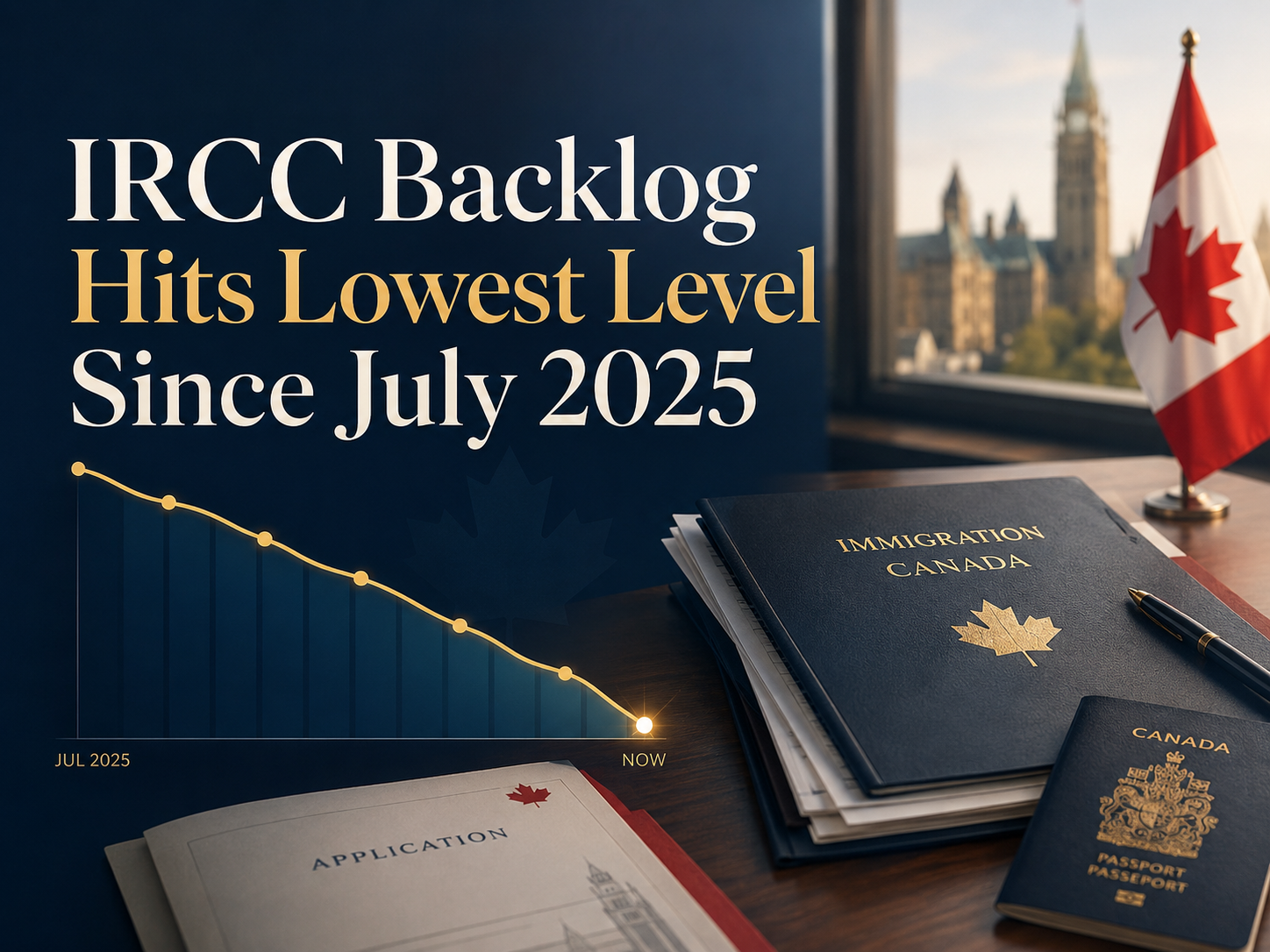


IRCC’s April figures show a smaller overall backlog, with Express Entry reaching a record low.
Canada’s immigration application backlog fell again in April, reaching its lowest level since July 2025, according to new figures from Immigration, Refugees and Citizenship Canada.
As of April 30, 2026, IRCC had 2,153,900 applications in its total inventory. Of those, 1,231,200 were processed within the department’s service standards, while 922,700 were considered backlogged.
The April backlog marked a 1.32 per cent drop from March, when 935,000 applications were listed as backlogged. It also continued a downward trend that began after the backlog passed one million applications in late 2025.
Permanent residence applications made up a major part of IRCC’s inventory. By the end of April, the department had 1,038,100 permanent residence applications on hand, up by 18,900 from the previous month.
IRCC processed 480,400 of those applications, or 46 per cent, within service standards. The remaining 557,700 were counted as backlogged.
The biggest improvement came through Express Entry. Its backlog fell to nine per cent, the lowest level reported since IRCC began publishing these figures. Five months earlier, the Express Entry backlog had reached 32 per cent. The department had projected a 20 per cent backlog for April.
Enhanced Provincial Nominee Program applications also improved. Their backlog dropped to 37 per cent, down from 38 per cent in March. That figure stayed within the projected 40 per cent level and marked the lowest point since February 2025.
Family sponsorship applications moved in the opposite direction. Their backlog rose from 22 per cent in March to 23 per cent in April, slightly below the projected 25 per cent. It was the highest level reported for this category since April 2023.
From January 1 to April 30, IRCC finalized 155,500 permanent residence applications and welcomed 112,900 new permanent residents to Canada.
Temporary residence applications showed a smaller inventory in April. IRCC ended the month with 842,000 applications, 23,000 fewer than in March.
The department processed 548,900 applications, or 64 per cent, within service standards. Another 293,100 were counted as backlogged.
Work permits saw pressure increase. Their backlog rose to 37 per cent, up from 34 per cent in March and above the projected 29 per cent.
Study permits improved, falling from a 40 per cent backlog in March to 35 per cent in April. However, that was still above the projected 27 per cent. Visitor visas also improved slightly, dropping from 46 per cent to 45 per cent.
Between January and April, IRCC finalized 145,000 study permit applications and 618,500 work permit applications, including extensions.
IRCC had 273,800 citizenship grant applications in its inventory at the end of April, up by 3,700 from March.
The department processed 211,900 applications, or 77 per cent, within service standards. The remaining 61,900 applications, or 23 per cent, were backlogged.
This was the third month in a row that the citizenship grant backlog remained at 23 per cent. In April, Canada welcomed 24,200 new citizens.
IRCC uses service standards as internal targets for processing most applications. For example, Express Entry applications usually carry a six-month service standard, while family sponsorship applications have a 12-month standard.
Applications that pass these timelines without a final decision count as backlog.











Having an ‘Identity Verified’ badge or being ‘Identity Verified’ simply indicates that an individual has submitted information to complete our identity verification process or we have conducted internal verification using various authorized websites. While this process includes safeguards, it does not guarantee that the person is who they claim to be.
If you encounter any issues with this profile, please report them here. While all consultants who are verified have RCIC ID, we may not have the latest data in terms of their renewal/cancellation/discontinuation of their RCIC ID.
╳The “Verified Consultants” profiles on Immiperts.com are independently compiled using publicly available information from multiple sources, including the official CICC Public Register, consultants’ own websites, other public directories, and social media.
Immiperts.com is a completely independent platform and is not affiliated with, endorsed by, or connected to the College of Immigration and Citizenship Consultants (CICC), IRCC, or any immigration consultant.
All information is collected manually and is for educational and informational purposes only. Consultants may claim, update, or request removal of their profile by contacting us at hello@immiperts.com.
Users are strongly advised to always verify the latest authorization status directly on the official CICC Public Register at college-ic.ca.