
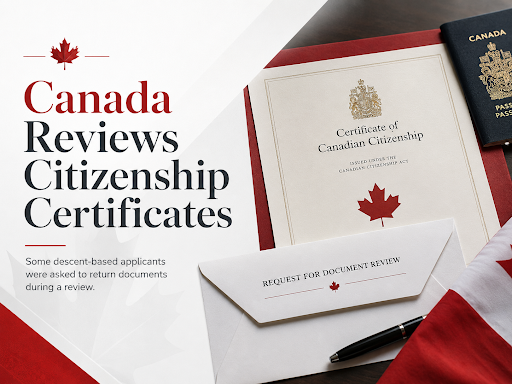


Some recent applicants are being asked to return their citizenship certificates while Ottawa reviews their proof of Canadian descent.
Some people who recently received Canadian citizenship certificates are now facing a new review from Immigration, Refugees and Citizenship Canada.
The issue affects applicants who applied for citizenship by descent under Canada’s expanded citizenship rules. Some had already received a citizenship certificate. Others had taken further steps, including applying for a passport or Social Insurance Number, as they prepared to move to Canada.
On June 13, Canada’s citizenship department sent emails to some recent certificate holders in the United States. The message said their citizenship claim, which had already been approved, was now “under review.”
The letters refer to subsection 26(1) of the Citizenship Regulations. This rule allows the Registrar of Canadian Citizenship to ask someone to surrender a citizenship certificate if officials believe the person may not be entitled to it.
The process does not automatically mean citizenship has been revoked. However, it does mean the government is reviewing the file again.
Applicants who received a paper certificate were asked to return it during the review. Those with electronic certificates may not have anything physical to send back. The letter also allows recipients to submit more documents to support their citizenship claim.
If IRCC confirms the person is entitled to citizenship, the certificate will be returned or remain valid.
IRCC gave two main reasons for reviewing these files.
First, some applicants submitted documents that did not come directly from the original source authority. A source authority can be a civil registry, vital statistics office, provincial archive, or another official body that creates and holds the record.
Second, some applicants did not provide a written explanation or proof of effort when they could not get an original source document.
In many cases, the concern appears to be whether the applicant clearly proved an unbroken family line from a Canadian citizen to themselves.
People who received surrender letters appear to fall into a few common groups.
Some used records from genealogy websites such as Ancestry or FamilySearch as their main proof. Others used certified documents from archives and are now unsure whether those archives qualify as source authorities.
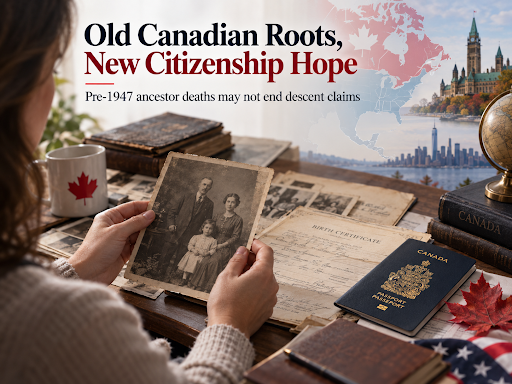
Some applicants had missing records for older ancestors, including people born in the 1800s. In those cases, the problem was not always the missing record itself, but the lack of a clear explanation to IRCC.
Applicants who receive a letter can still respond with more evidence. They should carefully address the exact concern raised by IRCC.
A strong application usually includes official records for each generation in the family line. Birth certificates are often the clearest proof. Marriage certificates can also be important when names change between generations.
If a record does not exist, applicants should explain why. They should also try to get a “letter of no record” from the proper office. This shows that the authority searched for the document but could not find it.
Certified copies are also important because they show that the issuing authority has confirmed the record as genuine.
The review process may take several months. Applicants should keep copies of every document they send.
For many people, the issue is not whether they are Canadian. It is whether they have proved it in the way the government requires.









Having an ‘Identity Verified’ badge or being ‘Identity Verified’ simply indicates that an individual has submitted information to complete our identity verification process or we have conducted internal verification using various authorized websites. While this process includes safeguards, it does not guarantee that the person is who they claim to be.
If you encounter any issues with this profile, please report them here. While all consultants who are verified have RCIC ID, we may not have the latest data in terms of their renewal/cancellation/discontinuation of their RCIC ID.
╳The “Verified Consultants” profiles on Immiperts.com are independently compiled using publicly available information from multiple sources, including the official CICC Public Register, consultants’ own websites, other public directories, and social media.
Immiperts.com is a completely independent platform and is not affiliated with, endorsed by, or connected to the College of Immigration and Citizenship Consultants (CICC), IRCC, or any immigration consultant.
All information is collected manually and is for educational and informational purposes only. Consultants may claim, update, or request removal of their profile by contacting us at hello@immiperts.com.
Users are strongly advised to always verify the latest authorization status directly on the official CICC Public Register at college-ic.ca.