
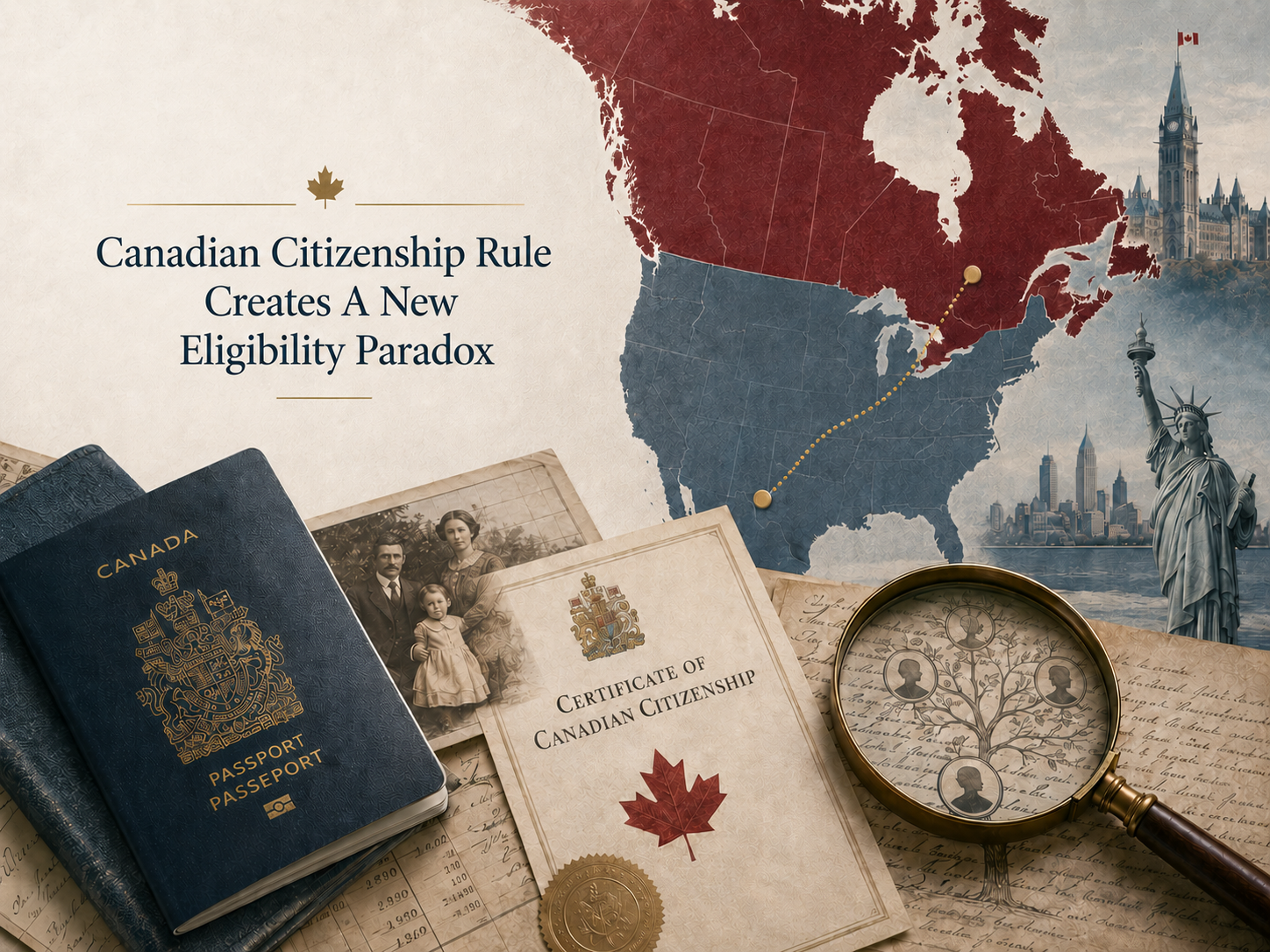


Canada’s new citizenship rules may make millions of Americans eligible, but many may never know they qualify.
Millions of people in the United States may now qualify for Canadian citizenship through family history, but many may never realize it.
Canada’s new citizenship law, introduced through Bill C-3, has changed who can claim citizenship by descent. The law removed the first-generation limit, which previously stopped many people born outside Canada from passing or claiming citizenship beyond one generation.
Under the new rules, people born before December 15, 2025, may qualify if they can prove an unbroken family line to a Canadian ancestor. The number of generations does not matter if the link can be documented.
The change means some Americans are not applying to become Canadian in the usual sense. If they qualify under the law, they are already Canadian citizens. Their task is to apply for a certificate that proves that status.
For example, a teacher in Ohio whose great-grandmother was born in Quebec and later moved to Michigan may now qualify. Under the previous rule, that family connection would have been too distant. Under the new law, it may be enough. If the teacher qualifies, her children may also qualify.
Early estimates suggest large numbers of Americans could be eligible. In New England, about one in four people may qualify. Connecticut alone may have about 300,000 eligible residents. Vermont and New Hampshire also rank among the states with high shares of potentially eligible residents.
Even these figures may not show the full picture. Many family histories have become difficult to trace because names changed, records were lost, or stories faded over time.
Between 1840 and 1930, nearly 900,000 French-speaking Canadians left Quebec for textile mill jobs in New England. As families settled in the United States, many surnames were anglicized or changed. Linguist Marc Picard has documented hundreds of these name changes, which can make Canadian roots harder to recognize today.
Geography can offer the first clue. Families with roots in New England, Louisiana, Michigan, Minnesota, or Wisconsin may have Canadian ancestry worth checking.
Surnames can also point to a possible link. Names such as Tremblay, Ouellet, Roy, and Desjardins have strong Canadian connections. Some English versions, such as White, King, Wood, Carter, and Mayhew, may also hide French-Canadian origins.
Still, a name or location is not proof. These clues only suggest where a person should begin looking.
Interest in citizenship by descent has grown sharply. Quebec’s national archives reported an increase of about 3,000 per cent in requests for vital records over the past year, with most requests coming from Americans.
The proof of citizenship process currently takes about 15 months, and demand continues to grow. Even so, many eligible people may never apply because they do not connect their family history to Canada.
For those with a Canadian surname, a northern family story, or roots in a migration hotspot, checking the family record may be worthwhile.













Having an ‘Identity Verified’ badge or being ‘Identity Verified’ simply indicates that an individual has submitted information to complete our identity verification process or we have conducted internal verification using various authorized websites. While this process includes safeguards, it does not guarantee that the person is who they claim to be.
If you encounter any issues with this profile, please report them here. While all consultants who are verified have RCIC ID, we may not have the latest data in terms of their renewal/cancellation/discontinuation of their RCIC ID.
╳The “Verified Consultants” profiles on Immiperts.com are independently compiled using publicly available information from multiple sources, including the official CICC Public Register, consultants’ own websites, other public directories, and social media.
Immiperts.com is a completely independent platform and is not affiliated with, endorsed by, or connected to the College of Immigration and Citizenship Consultants (CICC), IRCC, or any immigration consultant.
All information is collected manually and is for educational and informational purposes only. Consultants may claim, update, or request removal of their profile by contacting us at hello@immiperts.com.
Users are strongly advised to always verify the latest authorization status directly on the official CICC Public Register at college-ic.ca.