
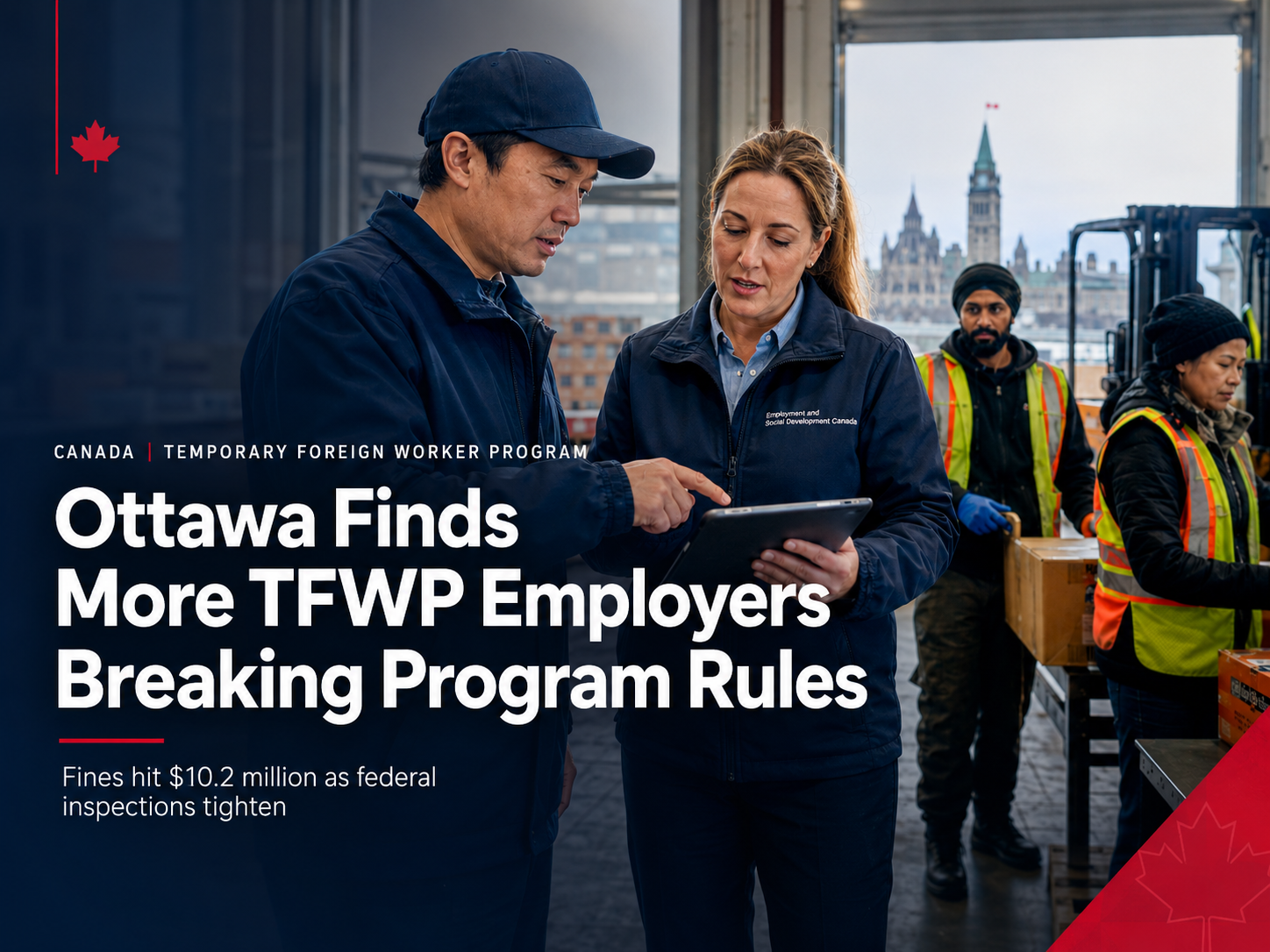


New federal figures show higher non-compliance, larger fines, and a sharp drop in temporary worker admissions.
Ottawa says more employers using Canada’s Temporary Foreign Worker Program failed to follow program rules over the past fiscal year, as the federal government continues to tighten oversight of the system.
Employment and Social Development Canada said 12 per cent of employers were found non-compliant after 1,488 inspections completed between April 1, 2025, and March 31, 2026. That marks an increase from 10 per cent in the 2024-25 fiscal year, according to a July 9, 2026, government release.
Employer penalties also rose sharply. Ottawa issued $10.2 million in fines during the latest fiscal year, more than double the $4.5 million recorded the year before.
The violations involved several areas, including workplace health and safety, employment standards legislation, and the integrity of job offers made to foreign workers.
The government said it remains committed to making sure the Temporary Foreign Worker Program, or TFWP, is used only as “a last resort option for employers who cannot find qualified Canadians and permanent residents to fill job vacancies.”
Employers must receive approval from Employment and Social Development Canada before hiring through the TFWP. The department issues a positive or neutral Labour Market Impact Assessment, known as an LMIA, when it determines the hiring is not expected to harm Canada’s domestic labour market.
The latest figures come after Ottawa strengthened compliance activity in 2024. That year also brought an annual admissions target for temporary residents and a pause on low-wage LMIAs in regions with higher unemployment.
A job is considered part of the low-wage stream when it pays less than 120 per cent of the regional median wage. In Alberta and Ontario, that level was $36 per hour at the time of writing.
Earlier in 2026, the government added another requirement for employers seeking LMIAs. Applications must now show efforts to recruit young workers. Ottawa also doubled the minimum job advertising period from four weeks to eight weeks.
According to the government release, officers reviewing LMIAs must now use stricter standards for applications in sectors considered higher risk.
The TFWP has faced growing criticism as unemployment has risen in Canada. At the Liberal caucus last September, Prime Minister Mark Carney said the program “must have a focused approach that targets specific, strategic sectors, and needs in specific regions.”
At the same time, Ottawa has allowed some targeted expansion. In March, the federal government approved a broader low-wage TFWP stream for rural areas. In participating provinces and territories, rural employers across all sectors can now hire foreign workers for up to 15 per cent of their workforce. The previous limit was 10 per cent.
Temporary foreign worker admissions have dropped significantly this year. From January to April, Canada recorded 14,655 TFWP admissions, down from 31,565 during the same period in 2024.
Ottawa’s 2026 annual admissions target for the TFWP is 60,000. That makes up about one-quarter of the wider target of 230,000 worker admissions.
The remaining 170,000 work permit admissions are assigned to the International Mobility Program. Unlike the TFWP, that program does not require an LMIA and operates under a broader mandate that includes cultural development.
Admissions through the International Mobility Program have also fallen sharply. They dropped 69 per cent compared with 2024, from 142,805 to 43,705.











Having an ‘Identity Verified’ badge or being ‘Identity Verified’ simply indicates that an individual has submitted information to complete our identity verification process or we have conducted internal verification using various authorized websites. While this process includes safeguards, it does not guarantee that the person is who they claim to be.
If you encounter any issues with this profile, please report them here. While all consultants who are verified have RCIC ID, we may not have the latest data in terms of their renewal/cancellation/discontinuation of their RCIC ID.
╳The “Verified Consultants” profiles on Immiperts.com are independently compiled using publicly available information from multiple sources, including the official CICC Public Register, consultants’ own websites, other public directories, and social media.
Immiperts.com is a completely independent platform and is not affiliated with, endorsed by, or connected to the College of Immigration and Citizenship Consultants (CICC), IRCC, or any immigration consultant.
All information is collected manually and is for educational and informational purposes only. Consultants may claim, update, or request removal of their profile by contacting us at hello@immiperts.com.
Users are strongly advised to always verify the latest authorization status directly on the official CICC Public Register at college-ic.ca.