
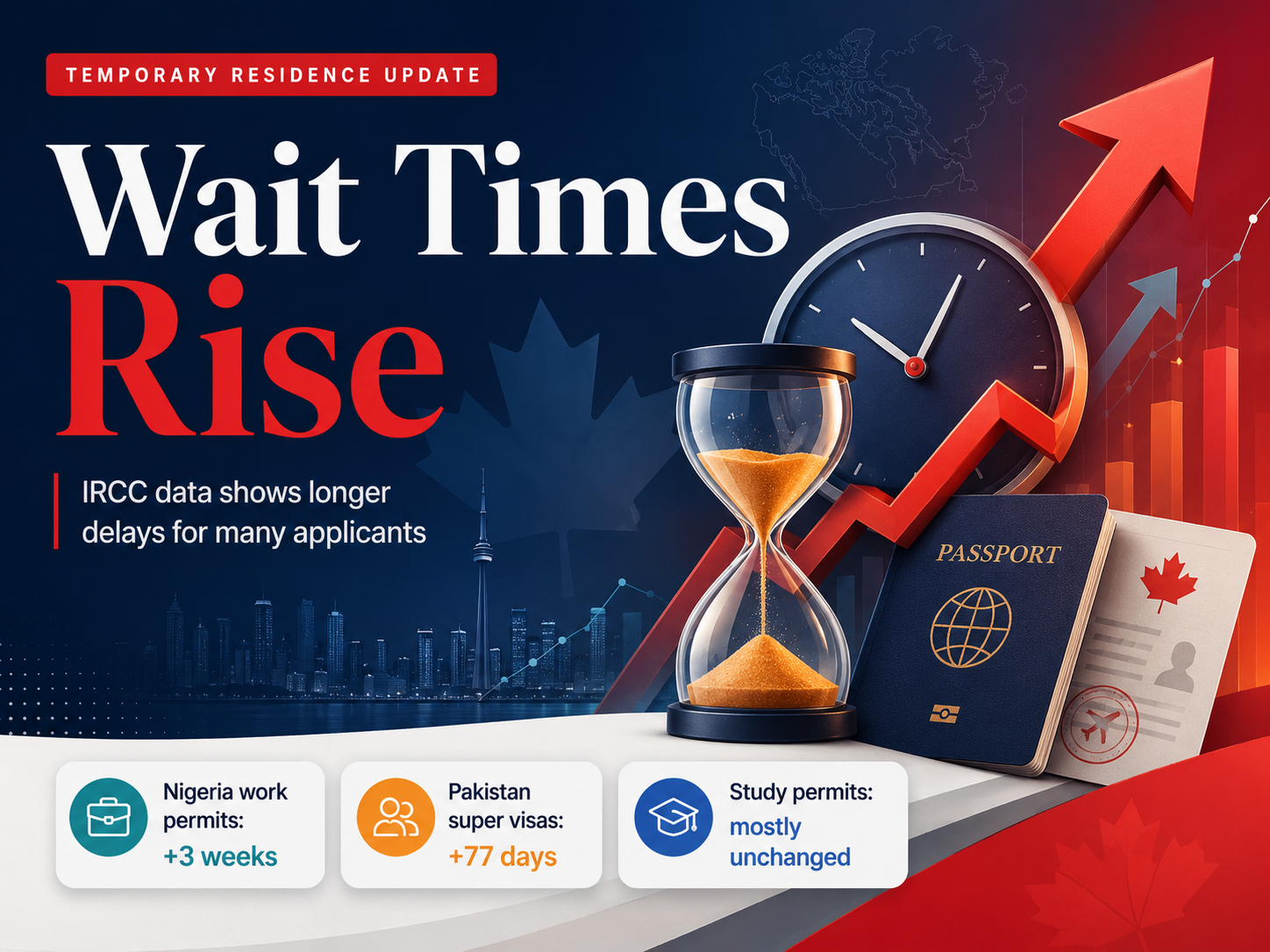


Temporary residence applicants saw longer processing times in several categories, according to IRCC’s July 7 update.
Processing times for many temporary residence applications increased in Immigration, Refugees and Citizenship Canada’s latest weekly update.
The July 7 figures show longer waits across several work permit, visitor visa and super visa categories. The data compares current timelines with the previous update from July 2.
While some applicants saw small improvements, the overall trend showed more delays than progress. The sharpest increase was seen in super visa applications from Pakistan, where the estimated wait jumped by 77 days in one week.
Work permit processing times changed in different directions depending on where applicants applied from.
In-Canada work permit applications improved slightly, falling from 129 days to 127 days. Applications from the Philippines also improved, dropping from eight weeks to seven weeks.
However, applicants from Pakistan and Nigeria saw longer waits. Pakistan’s work permit processing time increased from five weeks to six weeks. Nigeria rose from eight weeks to 11 weeks, marking a three-week increase.
Processing times remained unchanged for India at nine weeks and the United States at four weeks.
IRCC’s service standard is 120 days for in-Canada work permit applications and 60 days for applications submitted from outside Canada.
Study permit processing times did not change in this update.
Applications from inside Canada remained at seven weeks. India, Nigeria and the United States stayed at five weeks. Pakistan remained at six weeks, while the Philippines stayed at four weeks.
IRCC’s service standard is 120 days for study permit applications submitted inside Canada and 60 days for applications submitted from outside Canada.
Visitor visa processing times showed modest improvement in several countries.
In-Canada visitor visa applications dropped from 38 days to 36 days. India improved from 21 days to 20 days, while Pakistan fell from 38 days to 34 days. The United States also improved, moving from 32 days to 29 days.
The Philippines stayed unchanged at 17 days. Nigeria was the only country listed to see an increase, rising from 56 days to 59 days.
IRCC does not list a service standard for in-Canada visitor visa applications. For applications outside Canada, the service standard is 14 days.
Super visa processing times increased in nearly every listed country.
Pakistan saw the largest jump, rising from 102 days to 179 days in just one week. India increased from 50 days to 52 days. Nigeria rose from 32 days to 33 days, and the Philippines climbed from 52 days to 57 days.
The United States remained unchanged at 123 days. IRCC’s service standard for super visas is 112 days.
IRCC publishes processing times to help applicants understand how long their files may take. These timelines are estimates, not guarantees.
Actual processing times can vary based on application volume, case details, missing documents, backlogs and operational limits. IRCC uses both past data and current processing capacity to prepare its estimates.
Temporary residence processing times are updated weekly, while permanent residence and citizenship timelines are generally updated monthly. Service standards are reviewed less often and have not changed for temporary residence applications since 2018–2019.








Having an ‘Identity Verified’ badge or being ‘Identity Verified’ simply indicates that an individual has submitted information to complete our identity verification process or we have conducted internal verification using various authorized websites. While this process includes safeguards, it does not guarantee that the person is who they claim to be.
If you encounter any issues with this profile, please report them here. While all consultants who are verified have RCIC ID, we may not have the latest data in terms of their renewal/cancellation/discontinuation of their RCIC ID.
╳The “Verified Consultants” profiles on Immiperts.com are independently compiled using publicly available information from multiple sources, including the official CICC Public Register, consultants’ own websites, other public directories, and social media.
Immiperts.com is a completely independent platform and is not affiliated with, endorsed by, or connected to the College of Immigration and Citizenship Consultants (CICC), IRCC, or any immigration consultant.
All information is collected manually and is for educational and informational purposes only. Consultants may claim, update, or request removal of their profile by contacting us at hello@immiperts.com.
Users are strongly advised to always verify the latest authorization status directly on the official CICC Public Register at college-ic.ca.