


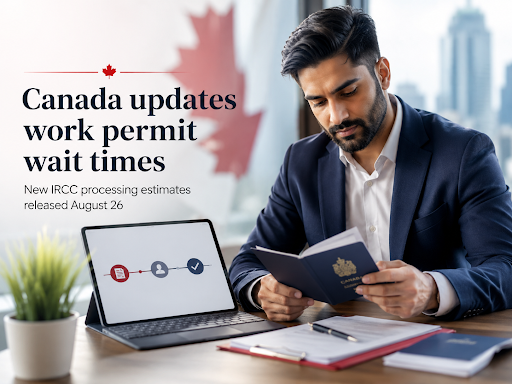
IRCC’s latest figures show mixed changes for work permits, visitor visas and super visas, while study permit estimates remain stable.
Immigration, Refugees and Citizenship Canada has released updated processing-time estimates for temporary residence applications as of July 22, 2026.
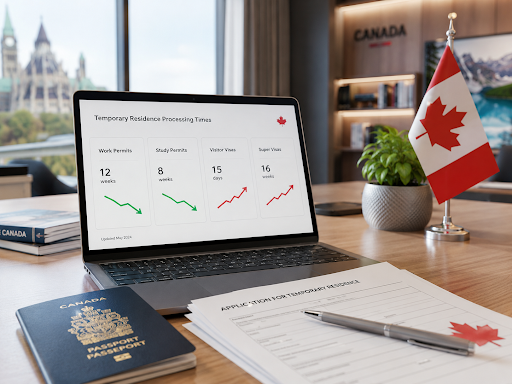
The latest figures show modest changes across work permits, visitor visas and super visas. Study permit processing times remained unchanged for all countries included in the weekly comparison.
The estimates give applicants a general idea of how long newly submitted applications may take. They do not guarantee that IRCC will finalize an individual case within the published period.
Applicants seeking work permits from inside Canada saw a small improvement. The estimated processing time fell from 124 days on July 15 to 122 days on July 22.
The estimate for applications from India remained unchanged at nine weeks. Nigeria stayed at six weeks, while the United States remained at three weeks.
Waits increased in two countries. Pakistan’s estimate rose by three weeks, from seven to 10 weeks. The Philippines increased from six weeks to seven weeks.
IRCC’s service standard is 120 days for initial work permit applications and extensions submitted inside Canada. The standard for applications submitted outside Canada is 60 days.
Study permit processing times did not change during the latest reporting period.
Applications submitted from inside Canada remained at seven weeks. India and Nigeria stayed at five weeks, while Pakistan remained at six weeks.
The estimate for the United States was also five weeks. Applicants from the Philippines continued to face the shortest listed wait, at four weeks.
These estimates have remained unchanged for four consecutive weeks.
The department’s service standards are 120 days for in-Canada study permit applications and extensions, and 60 days for applications submitted outside Canada.
Visitor visa applications submitted from inside Canada recorded the largest improvement in this category. The estimate fell by five days, from 34 days to 29 days.
Waits also declined slightly for applications from the United States and the Philippines. The U.S. estimate dropped from 28 to 27 days, while the Philippines fell from 17 to 16 days.
Processing times increased by one day for India and Pakistan, reaching 21 and 40 days respectively. Nigeria’s estimate rose by two days, from 61 to 63 days.
IRCC lists a 14-day service standard for visitor visa applications submitted outside Canada. No service standard applies to in-Canada submissions.
Super visa applicants saw both increases and decreases.
Pakistan recorded the largest increase, rising seven days from 187 to 194 days. Nigeria’s estimate increased from 36 to 39 days.
Waits improved for India, the United States and the Philippines. India fell from 50 to 49 days, while the U.S. dropped from 126 to 124 days.
The Philippines recorded the largest improvement, falling five days from 73 to 68 days.
Super visa applications must be submitted from outside Canada. The service standard is 112 days.
IRCC calculates some processing times by examining how long it took to finalize 80 per cent of recent applications. Other estimates use the department’s existing inventory, staffing levels, processing capacity and expected application volumes.
Processing starts when IRCC receives a complete application and ends when it makes a decision. Missing documents, complex cases, security checks and requests for additional information can cause delays.
The next weekly update is expected around July 29, 2026.










Having an ‘Identity Verified’ badge or being ‘Identity Verified’ simply indicates that an individual has submitted information to complete our identity verification process or we have conducted internal verification using various authorized websites. While this process includes safeguards, it does not guarantee that the person is who they claim to be.
If you encounter any issues with this profile, please report them here. While all consultants who are verified have RCIC ID, we may not have the latest data in terms of their renewal/cancellation/discontinuation of their RCIC ID.
╳The “Verified Consultants” profiles on Immiperts.com are independently compiled using publicly available information from multiple sources, including the official CICC Public Register, consultants’ own websites, other public directories, and social media.
Immiperts.com is a completely independent platform and is not affiliated with, endorsed by, or connected to the College of Immigration and Citizenship Consultants (CICC), IRCC, or any immigration consultant.
All information is collected manually and is for educational and informational purposes only. Consultants may claim, update, or request removal of their profile by contacting us at hello@immiperts.com.
Users are strongly advised to always verify the latest authorization status directly on the official CICC Public Register at college-ic.ca.