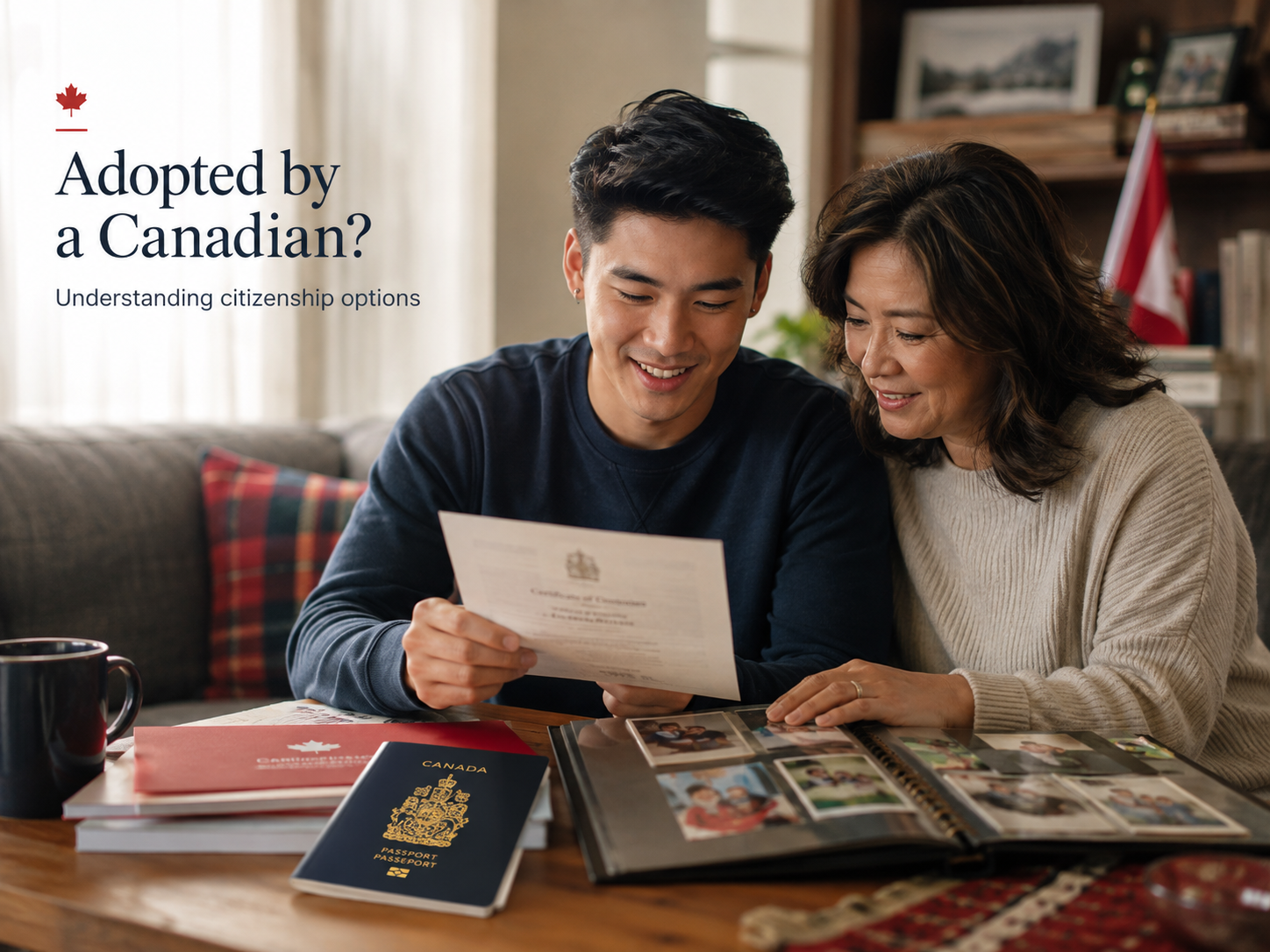


For someone who has always known a Canadian parent simply as “Mom” or “Dad,” it can be painful to learn that citizenship law may treat that relationship differently. Canadian citizenship by descent for adopted people is not always automatic, even after a legal adoption. Bill C-3 has opened a door for some families, but old records, missing documents and unclear citizenship histories can still leave adoptees feeling connected to Canada in every personal way, yet unable to prove that connection on paper.
Bill C-3 took effect on December 15, 2025. It changed the former first-generation limit, which had blocked some people born or adopted outside Canada from receiving citizenship through a Canadian parent in the second generation or later.
Many biological children born abroad before that date may now be citizens automatically and can apply for a citizenship certificate as proof.
Adopted people are treated differently. A person adopted outside Canada generally needs approval for a direct grant of citizenship under the adoption provisions of the Citizenship Act.
An adopted person may qualify when at least one adoptive parent was a Canadian citizen at the time of adoption and could legally pass on citizenship.
For someone born and adopted outside Canada before December 15, 2025, Bill C-3 may allow a direct-grant application even if the Canadian parent was also born or adopted abroad.
For adoptions on or after December 15, 2025, a Canadian parent born or adopted abroad may need to prove a substantial connection to Canada. This generally means spending at least 1,095 days in Canada before the adoption.
Citizenship is not automatic under this route. Immigration, Refugees and Citizenship Canada, or IRCC, must approve the application. Once approved, the adopted person receives a citizenship certificate.
A Canadian citizen or permanent resident may instead sponsor an adopted child for permanent residence. The person may later apply for citizenship through naturalization.
A parent or guardian may apply for an eligible minor after the child becomes a permanent resident. An adult must meet the citizenship requirements in force when applying.
This route may be necessary when the direct-grant rules do not apply.
IRCC looks beyond the adoption certificate. It checks whether the adoption created a real parent-child relationship and followed the law.
The adoption must:
These conditions are set out in section 5.1 of the Citizenship Act.
A genuine parent-child relationship must have existed before the adopted person turned 18 and at the time of adoption.
This rule prevents an adult adoption created mainly for citizenship purposes from being treated the same as a long-standing family relationship. IRCC may request records showing when the relationship began and how it developed.
Possibly, but the adopted ancestor’s status must be established first.
If your parent or grandparent was adopted by a Canadian citizen abroad, that ancestor may first need citizenship through the adoption provisions. IRCC can then assess whether citizenship passed to later generations.
The outcome can depend on the adoption date, how the Canadian parent became a citizen and whether the 1,095-day connection rule applies.
A stepchild does not automatically receive citizenship through a Canadian stepparent. Citizenship may become possible after a qualifying legal adoption, but the adoption must meet the same legal and genuine-relationship rules.
Family sponsorship may be another option when the stepchild qualifies as the biological or adopted dependent child of the Canadian citizen’s spouse or partner. Sponsorship is an immigration route, not citizenship by descent.
Build a clear family and citizenship timeline. Collect:
The citizenship application has separate stages for checking whether the parent can pass on citizenship and whether the adopted person meets the adoption requirements. Complete, consistent records can help IRCC assess both questions.
Do not assume that adoption alone created Canadian citizenship. First identify the correct route, confirm the adoption date and check whether the Canadian parent could pass on citizenship.
Complex cases may involve old records, several countries or a long ancestral chain. Consider guidance from an authorized Canadian immigration lawyer or licensed immigration consultant, and compare the advice with current IRCC instructions.
No. It expanded eligibility, but most people adopted abroad still need approval for a direct citizenship grant. The adoption and Canadian parent must meet the Citizenship Act requirements.
Possibly. IRCC generally requires evidence that a genuine parent-child relationship existed before age 18 and continued when the adult adoption occurred.
Usually, the person must first complete the citizenship grant process for adopted people. After IRCC approves the grant, the person receives a citizenship certificate.
No, not through the step-relationship alone. A qualifying legal adoption, another citizenship basis or a separate immigration route may be needed.
They may, but the adopted ancestor’s Canadian citizenship must first be confirmed. Eligibility then depends on dates, the citizenship history and the rules applying to later generations.
Having an ‘Identity Verified’ badge or being ‘Identity Verified’ simply indicates that an individual has submitted information to complete our identity verification process or we have conducted internal verification using various authorized websites. While this process includes safeguards, it does not guarantee that the person is who they claim to be.
If you encounter any issues with this profile, please report them here. While all consultants who are verified have RCIC ID, we may not have the latest data in terms of their renewal/cancellation/discontinuation of their RCIC ID.
╳The “Verified Consultants” profiles on Immiperts.com are independently compiled using publicly available information from multiple sources, including the official CICC Public Register, consultants’ own websites, other public directories, and social media.
Immiperts.com is a completely independent platform and is not affiliated with, endorsed by, or connected to the College of Immigration and Citizenship Consultants (CICC), IRCC, or any immigration consultant.
All information is collected manually and is for educational and informational purposes only. Consultants may claim, update, or request removal of their profile by contacting us at hello@immiperts.com.
Users are strongly advised to always verify the latest authorization status directly on the official CICC Public Register at college-ic.ca.