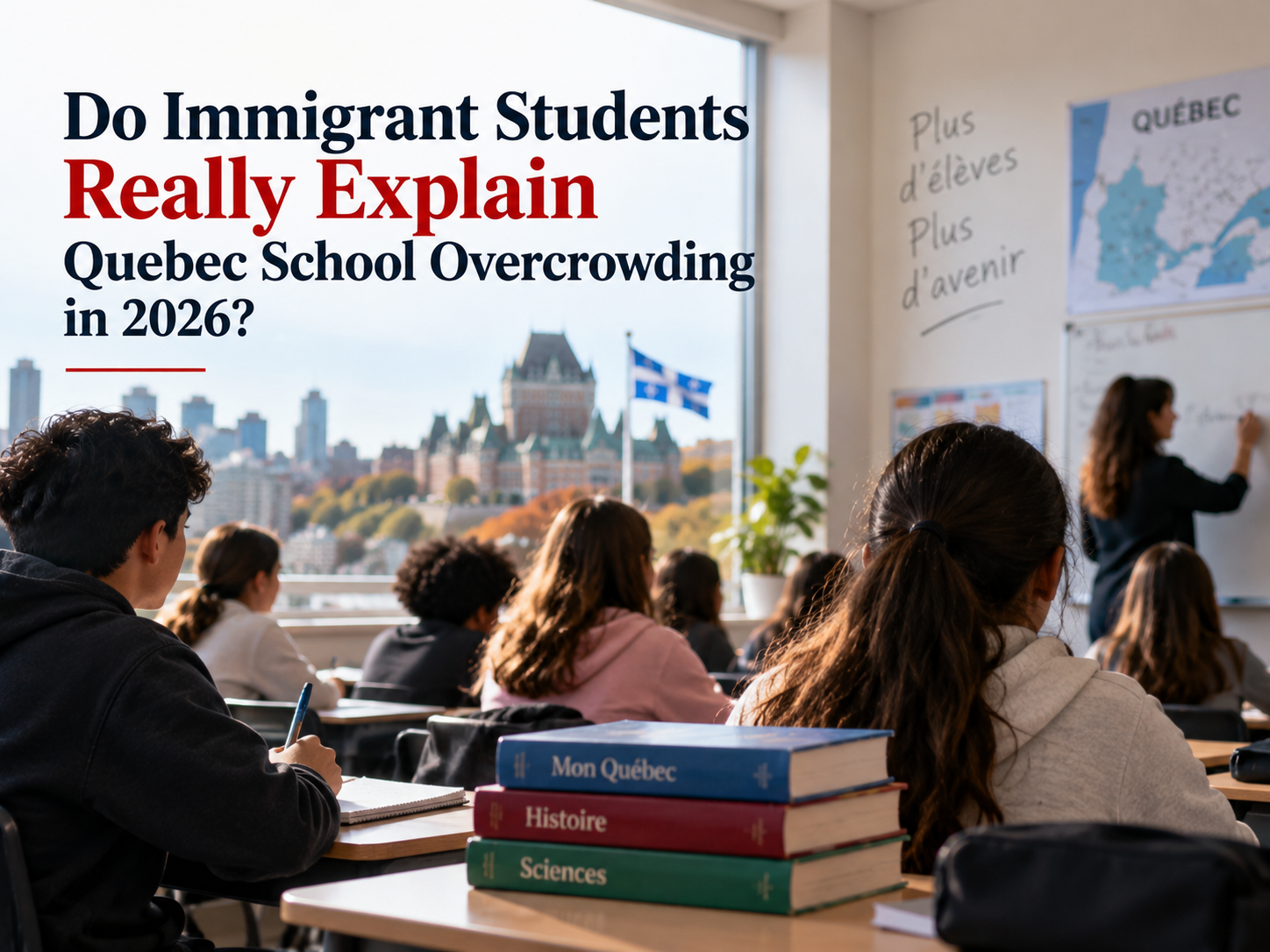


When a school adds portable classrooms, it is easy to assume the reason is simply “too many newcomers.” In Quebec in 2026, the reality is more complicated. Immigration has increased enrolment in some communities, but overcrowding also reflects uneven population growth, ageing buildings, construction delays and capacity planning that has struggled to keep up.
Immigrant students add pressure in some schools, but current evidence does not show that they alone explain Quebec’s school-space shortage.
The debate intensified during Quebec’s 2026 election campaign. Parti Québécois leader Paul St-Pierre Plamondon pointed to École secondaire Roger-Comtois in Quebec City and argued that immigration had pushed the school beyond capacity.
Roger-Comtois opened a 24-room modular pavilion in 2026. The school service centre said the new space was designed for nearly 500 students and was needed because of sustained enrolment growth.
The overcrowding is real. What is less clear is whether immigration is the main cause.
Data provided by the Centre de services scolaire de la Capitale to Le Devoir showed that Roger-Comtois had 2,441 students in 2026. Of those, 293 were classified as immigrant students, or about 12% of enrollment. In 2019, the school had 83 immigrant students.
That increase matters, but it does not prove that immigration alone created the space shortage.
There is also a definition problem. In the wider school service centre, part of the increase in students from immigrant backgrounds involved second-generation students — children born in Quebec with at least one parent born abroad. Calling all of them newly arrived students can give the wrong impression.
No.
Quebec’s International Student Program mainly covers foreign students in vocational training, colleges and universities. Current provincial limits on international student applications apply to those levels, not ordinary elementary and secondary enrolment.
School-age children may enter Quebec with permanent resident, refugee claimant or temporary resident families. Quebec-born children of immigrant parents may also appear in broader statistics on immigrant-background students.
These groups should not be treated as interchangeable.
Several pressures are happening at once.
Some suburbs and regions are adding families faster than others. That means an individual school can become crowded even when population growth across Quebec is slowing.
The Capitale-Nationale region, for example, is still projected to experience significant longer-term population growth.
New schools and expansions require land, funding, approvals and construction. Enrolment can rise much faster.
That is one reason school service centres turn to modular classrooms. They provide additional space while longer-term projects move forward.
The problem is not limited to schools experiencing immigration-related growth.
Quebec’s Education Ministry has projected a shortage of about 1,000 elementary classrooms by 2027–28. It also projected a shortage of roughly 25,000 secondary-school student spaces by 2032–33.
Those shortages are expected across several regions, showing that Quebec faces a broader infrastructure and capacity challenge.
Quebec is trying to expand its school network while maintaining older buildings.
The province has committed billions of dollars to school infrastructure, including renovations, maintenance, expansions and new construction.
That means available funding and construction capacity must address both deteriorating buildings and growing enrollment.
Not recently.
Temporary immigration rose sharply between 2022 and 2024. But the Institut de la statistique du Québec estimated that Quebec had about 514,050 non-permanent residents on January 1, 2026, down from 565,450 one year earlier.
That represents a decline of about 51,400 people.
This does not erase earlier pressure. Families who arrived during previous years may still have children enrolled in schools. Local trends can also differ sharply from province-wide numbers.
Still, it shows why claims that temporary immigration is simply continuing to rise everywhere in Quebec in 2026 need more context.
Yes, in some communities.
But additional pressure is noNewcomer families can increase enrolment quickly, particularly where schools were already close to capacity. Schools may also need additional French-language learning and integration support.
t the same as being the only cause.
The evidence points to immigration, suburban growth, movement within Quebec, ageing infrastructure, delayed school projects and planning limits working together.
A more useful question is: How much of a particular school’s enrollment growth comes from each source, and did classroom capacity grow at the same pace?
That question can be answered with enrollment and demographic data rather than assumptions.
Only partly, and the impact differs from one community to another.
Immigrant students clearly contribute to enrolment growth in some Quebec schools. Ignoring that would give an incomplete picture.
But saying immigrant students explain school overcrowding across Quebec also goes beyond the evidence available in 2026.
Roger-Comtois demonstrates the difference. Immigration-related enrolment increased substantially, yet immigrant students represented about 12% of its total 2026 enrolment. Meanwhile, Quebec was already facing documented shortages of classrooms and student spaces across several regions.
School overcrowding is therefore better understood as a capacity problem shaped by several demographic and infrastructure pressures, rather than a problem caused by one group of students.
No province-wide evidence establishes that immigrant students are the main cause. Immigration can increase enrolment in certain communities, but population shifts, ageing schools, delayed construction and limited classroom capacity also contribute.
School service centre data reported by Le Devoir put the figure at 293 out of 2,441 students. That represents roughly 12% of the school’s total enrollment.
Modular classrooms provide additional space faster than building a permanent school or major expansion. They are often used when student numbers rise beyond an existing building’s capacity.
Not in the way the term is normally used. Quebec’s International Student Program primarily covers vocational, college and university studies, while children attending regular public schools can come from several different immigration situations.
The latest provincial estimate showed a decline rather than continued growth. Quebec had about 514,050 non-permanent residents on January 1, 2026, approximately 51,400 fewer than one year earlier.
Having an ‘Identity Verified’ badge or being ‘Identity Verified’ simply indicates that an individual has submitted information to complete our identity verification process or we have conducted internal verification using various authorized websites. While this process includes safeguards, it does not guarantee that the person is who they claim to be.
If you encounter any issues with this profile, please report them here. While all consultants who are verified have RCIC ID, we may not have the latest data in terms of their renewal/cancellation/discontinuation of their RCIC ID.
╳The “Verified Consultants” profiles on Immiperts.com are independently compiled using publicly available information from multiple sources, including the official CICC Public Register, consultants’ own websites, other public directories, and social media.
Immiperts.com is a completely independent platform and is not affiliated with, endorsed by, or connected to the College of Immigration and Citizenship Consultants (CICC), IRCC, or any immigration consultant.
All information is collected manually and is for educational and informational purposes only. Consultants may claim, update, or request removal of their profile by contacting us at hello@immiperts.com.
Users are strongly advised to always verify the latest authorization status directly on the official CICC Public Register at college-ic.ca.