
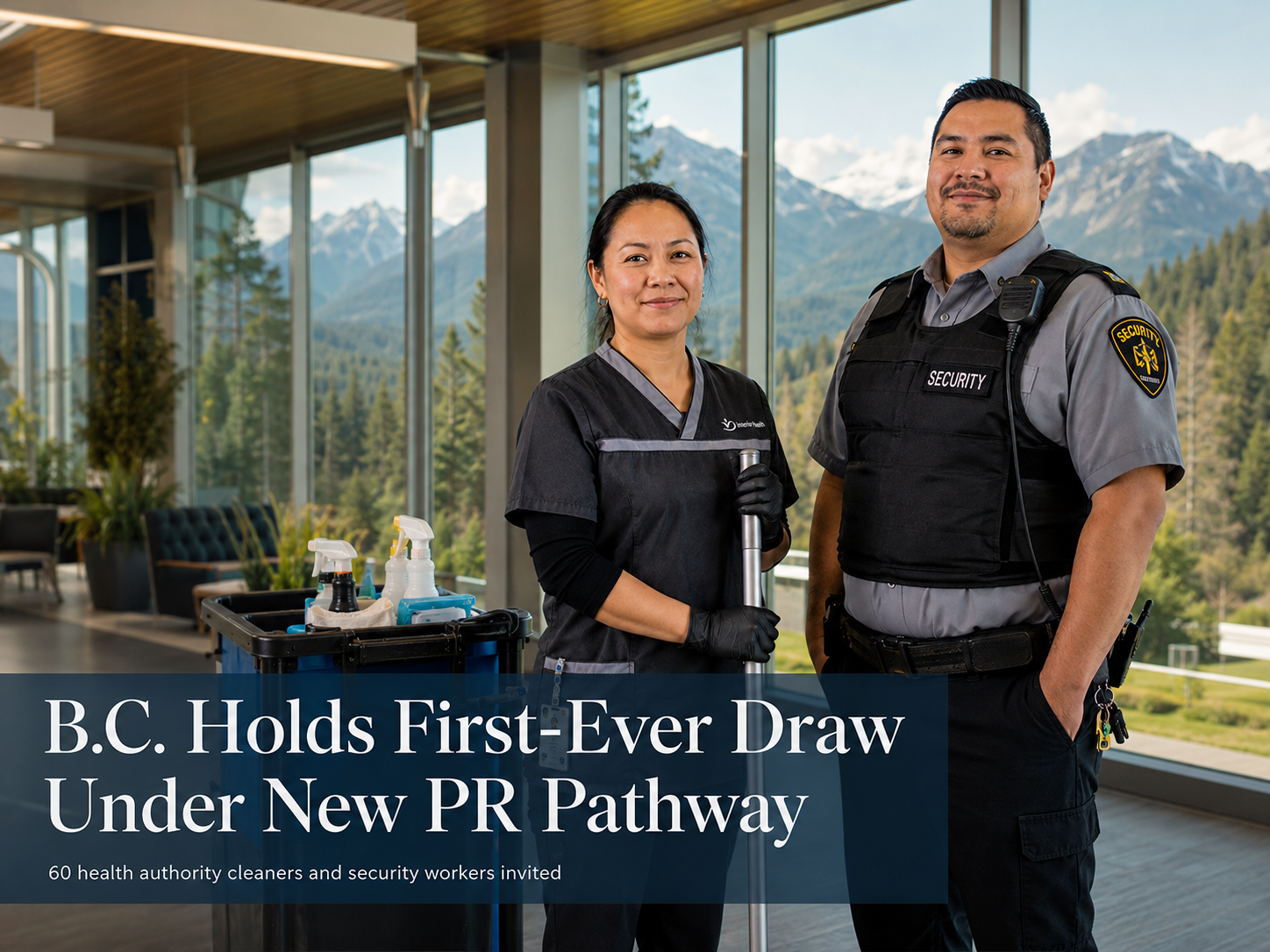


Sixty cleaning and security workers received invitations under British Columbia’s new temporary immigration initiative.
British Columbia has held its first selection round under a new pathway designed to help certain rural and remote health authority workers pursue permanent residence.
On July 23, the British Columbia Provincial Nominee Program invited 60 cleaning and security workers to apply for provincial nomination. All selected candidates worked for a B.C. health authority in an eligible rural or remote community.
The draw recorded a minimum score of 50 points, the province’s lowest cut-off score in 2026.
The Temporary Rural and Remote Health Support Initiative aims to nominate up to 250 eligible cleaners and security workers.
Registration opened on June 15 and will remain available until August 31, 2026.
The province created the temporary initiative for workers holding regular, permanent and full-time positions in one of three eligible occupational groups.
These include janitors, caretakers and heavy-duty cleaners under NOC 65312, light-duty cleaners under NOC 65310, and security guards and related security workers under NOC 64410.
British Columbia did not say which occupations were represented among the 60 candidates invited in the first draw.
Candidates must complete at least nine months of full-time employment in an eligible occupation before registering with the provincial nominee program.
The experience must be gained with the same employer. Workers also need a valid job offer when they register and when they submit their application.
They must continue working full-time in that position throughout the application process.
Employment completed while holding a study permit does not count toward the required nine months. Work completed as part of an educational program, including a co-op placement, is also excluded.
Any leave lasting longer than two weeks cannot be included in the qualifying employment period.
Workers employed in several major regional districts cannot use the pathway.
The excluded areas include the Central Okanagan Regional District, Metro Vancouver Regional District and Capital Regional District.
However, workers on Galiano Island, Mayne Island, Pender Island, Salt Spring Island and Saturna Island remain eligible despite being within the Capital Regional District.
Applicants must receive support from an authorized representative of their health authority.
Eligible employers include Fraser Health, Interior Health, Island Health, Northern Health, Vancouver Coastal Health, Providence Health Care, the Provincial Health Services Authority and the First Nations Health Authority.
Each organization follows its own process for deciding which employee applications it will support.
Candidates must hold at least a high school diploma and meet the program’s minimum income requirement.
They must satisfy the income threshold during the full nine months before registration and continue meeting it when submitting their application.
Applicants must also meet the general requirements for candidates applying through the Skills Immigration category.
The initiative forms part of B.C.’s revised immigration strategy for 2026, organized around three priorities: Care, Build and Innovate.
The health support pathway falls under the Care category, which focuses on strengthening healthcare and related services.
British Columbia announced the initiative on April 23 during a broader restructuring of its provincial nominee program. The changes placed greater emphasis on healthcare and trades, cancelled the planned reopening of student streams and removed several previous pathways.
The province said it revised the program after the federal government reduced its nomination allocation.
B.C.’s annual quota fell from 8,000 nominations in 2024 to 5,254 in 2026. The provincial government had requested 9,000 nomination spaces.











Having an ‘Identity Verified’ badge or being ‘Identity Verified’ simply indicates that an individual has submitted information to complete our identity verification process or we have conducted internal verification using various authorized websites. While this process includes safeguards, it does not guarantee that the person is who they claim to be.
If you encounter any issues with this profile, please report them here. While all consultants who are verified have RCIC ID, we may not have the latest data in terms of their renewal/cancellation/discontinuation of their RCIC ID.
╳The “Verified Consultants” profiles on Immiperts.com are independently compiled using publicly available information from multiple sources, including the official CICC Public Register, consultants’ own websites, other public directories, and social media.
Immiperts.com is a completely independent platform and is not affiliated with, endorsed by, or connected to the College of Immigration and Citizenship Consultants (CICC), IRCC, or any immigration consultant.
All information is collected manually and is for educational and informational purposes only. Consultants may claim, update, or request removal of their profile by contacting us at hello@immiperts.com.
Users are strongly advised to always verify the latest authorization status directly on the official CICC Public Register at college-ic.ca.