
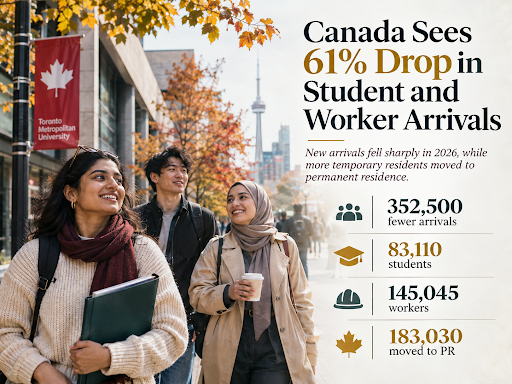


Canada’s temporary immigration levels decline as more existing temporary residents transition to permanent residence.
Canada recorded 352,500 fewer international student and temporary worker arrivals between January and September 2026 compared with the same period in 2024, reflecting the federal government’s efforts to manage temporary immigration.
According to figures released by Immigration, Refugees and Citizenship Canada (IRCC) on November 17, combined arrivals decreased by 61%. Canada welcomed 83,110 new international students and 145,045 temporary workers, representing declines of 67% and 56%, respectively.
The reductions come as the federal government works to ease pressure on housing, infrastructure and public services.
Several immigration policy changes have contributed to the decline in international student arrivals.
Canada introduced a study permit cap and provincial or territorial attestation letter requirements for many applicants to manage international student admissions.
Changes to Post-Graduation Work Permit (PGWP) eligibility have also affected international graduates. These include language proficiency requirements and field-of-study restrictions for certain applicants.
Prospective students should carefully review their chosen institution, program eligibility, financial requirements and applicable study permit conditions before applying.
A Canadian study permit does not automatically guarantee a post-graduation work permit or permanent residence.
Canada welcomed 145,045 new temporary workers during the first nine months of 2026, following tighter restrictions on foreign worker recruitment.
The government introduced limits on low-wage foreign worker hiring and restricted the processing of certain Labour Market Impact Assessment (LMIA) applications in areas with elevated unemployment.
Changes to spousal open work permit eligibility have also reduced opportunities for accompanying family members of certain foreign workers.
Foreign nationals seeking employment in Canada should assess employer-specific, LMIA-supported and LMIA-exempt work permit options based on their individual circumstances.
IRCC expects new arrivals to remain within its 2026 annual targets of 155,000 international students and 230,000 temporary workers.
As of September 30, Canada had 562,325 study permit holders and 1,550,020 individuals holding only a work permit. The latter figure excludes asylum claimants, protected persons and certain related groups.
These figures represent existing permit holders rather than new arrivals recorded during the reporting period.
Despite declining temporary arrivals, an increasing proportion of new permanent residents previously held temporary status in Canada.
Between January and September 2026, 183,030 former temporary residents obtained permanent residence, accounting for 59% of all new permanent residents during that period.
This proportion stood at 44% in 2024 and increased to 48% in 2025.
Eligible temporary residents may pursue permanent residence through the Canadian Experience Class, Provincial Nominee Programs, Federal Skilled Worker Program and other economic immigration pathways.
However, applicants must independently satisfy the eligibility requirements of their chosen immigration program.
The latest figures reflect Canada’s changing approach to immigration, with tighter controls on temporary arrivals and a growing share of permanent residence admissions involving former temporary residents.
For prospective international students and foreign workers, understanding current immigration requirements remains essential. Careful planning, appropriate program selection and awareness of changing eligibility conditions can help applicants make informed decisions about their future in Canada.









Having an ‘Identity Verified’ badge or being ‘Identity Verified’ simply indicates that an individual has submitted information to complete our identity verification process or we have conducted internal verification using various authorized websites. While this process includes safeguards, it does not guarantee that the person is who they claim to be.
If you encounter any issues with this profile, please report them here. While all consultants who are verified have RCIC ID, we may not have the latest data in terms of their renewal/cancellation/discontinuation of their RCIC ID.
╳The “Verified Consultants” profiles on Immiperts.com are independently compiled using publicly available information from multiple sources, including the official CICC Public Register, consultants’ own websites, other public directories, and social media.
Immiperts.com is a completely independent platform and is not affiliated with, endorsed by, or connected to the College of Immigration and Citizenship Consultants (CICC), IRCC, or any immigration consultant.
All information is collected manually and is for educational and informational purposes only. Consultants may claim, update, or request removal of their profile by contacting us at hello@immiperts.com.
Users are strongly advised to always verify the latest authorization status directly on the official CICC Public Register at college-ic.ca.