
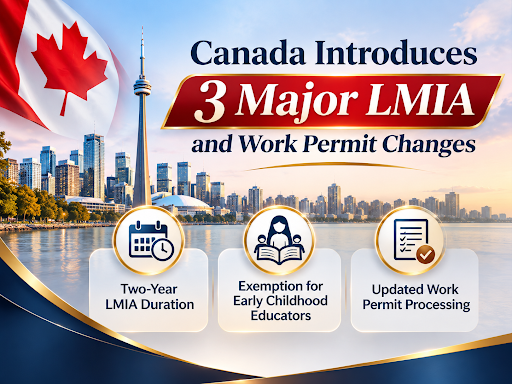


Canada has introduced three changes affecting low-wage employment periods, childcare hiring and the processing of eligible work permit applications.
Canada has introduced three changes to its Labour Market Impact Assessment (LMIA) and work permit procedures, bringing new rules for employers and temporary foreign workers.
Two measures took effect on November 6, 2026, following an announcement from Employment and Social Development Canada (ESDC). Immigration, Refugees and Citizenship Canada (IRCC) introduced the third change on October 28.
The updates extend employment periods, ease certain childcare hiring restrictions and change how eligible work permit applications are handled while LMIA decisions remain pending.
Employers submitting new low-wage LMIA applications from November 6 can now request employment periods of up to two years, compared with the previous one-year maximum.
The change applies only to applications submitted on or after that date. Previously approved or submitted LMIAs will not automatically receive extensions.
Longer employment periods could reduce repeated applications, recruitment costs and administrative delays.
Previously, employers sometimes needed to submit another LMIA each year, including paying a $1,000 processing fee.
However, a two-year LMIA employment period does not guarantee a two-year work permit. IRCC determines permit validity based on immigration requirements, including passport expiry dates.
Canada has also added early childhood educators to occupations exempt from a major low-wage LMIA processing restriction.
Since September 2024, authorities have generally refused to process low-wage applications in census metropolitan areas where unemployment reaches 6% or higher.
The restriction affects major urban areas, including Toronto, Vancouver, Calgary, Edmonton and Montreal during the current October 2026–January 2027 assessment period.
Employers hiring eligible early childhood educators can now submit applications for processing even in restricted metropolitan areas.
However, the exemption does not guarantee approval.
Employers must still satisfy recruitment, wage and workforce requirements. IRCC also independently assesses workers' eligibility for permits.
Other existing exemptions cover certain positions in agriculture, construction, food manufacturing, healthcare and caregiving.
A third change, effective October 28, affects certain workers applying to extend their permits while their employer awaits an LMIA decision.
Previously, IRCC generally held qualifying applications for up to 90 days, following an increase from 60 days in August.
If ESDC had not issued a decision within that period, applicants risked refusal.
Under the updated instructions, IRCC will instead wait until ESDC makes its final LMIA decision before assessing eligible applications.
Applicants must meet specific conditions, including:
Workers who apply for extensions before their permits expire may qualify for maintained status, allowing them to continue working under existing conditions while awaiting a decision.
Employers cannot assume last-minute LMIA submissions will qualify.
Canada is also considering additional low-wage LMIA changes beginning March 1, 2027, subject to provincial and territorial participation.
The proposals include occupation-based hiring access in certain regions and raising the standard workforce cap from 10% to 15% for eligible employers in designated communities.
Priority sectors would retain their existing 20% limit.
These proposals are not yet in effect.
Employers should review submission dates, employment durations and occupational exemptions before filing applications.
Workers approaching permit expiry should confirm their eligibility early, as none of these changes guarantees an approved LMIA or work permit.












Having an ‘Identity Verified’ badge or being ‘Identity Verified’ simply indicates that an individual has submitted information to complete our identity verification process or we have conducted internal verification using various authorized websites. While this process includes safeguards, it does not guarantee that the person is who they claim to be.
If you encounter any issues with this profile, please report them here. While all consultants who are verified have RCIC ID, we may not have the latest data in terms of their renewal/cancellation/discontinuation of their RCIC ID.
╳The “Verified Consultants” profiles on Immiperts.com are independently compiled using publicly available information from multiple sources, including the official CICC Public Register, consultants’ own websites, other public directories, and social media.
Immiperts.com is a completely independent platform and is not affiliated with, endorsed by, or connected to the College of Immigration and Citizenship Consultants (CICC), IRCC, or any immigration consultant.
All information is collected manually and is for educational and informational purposes only. Consultants may claim, update, or request removal of their profile by contacting us at hello@immiperts.com.
Users are strongly advised to always verify the latest authorization status directly on the official CICC Public Register at college-ic.ca.