
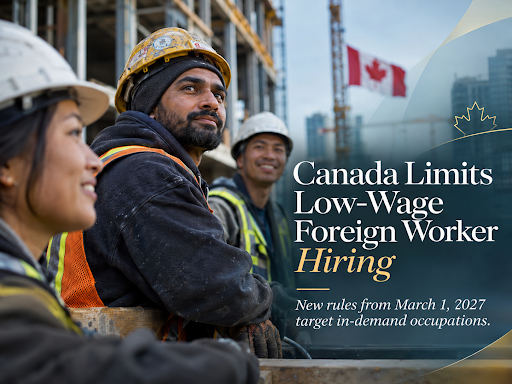


New hiring restrictions will prioritize occupations facing labour shortages across participating provinces and territories.
The Canadian government has announced plans to restrict the low-wage stream of the Temporary Foreign Worker Program (TFWP) to occupations experiencing labour shortages, starting March 1, 2027.
Employment and Social Development Canada (ESDC) announced the changes on November 6, 2026. The reforms will apply to provinces and territories that choose to participate.
The restrictions will affect jobs located within census metropolitan areas (CMAs) offering wages below 120% of the respective provincial or territorial median wage.
Under the revised system, ESDC will process low-wage Labour Market Impact Assessment (LMIA) applications only for occupations included on an approved list in affected areas.
The federal government will develop a base list using the Canadian Occupational Projection System (COPS). Participating provinces and territories will have the flexibility to add or remove occupations according to their regional labour market needs.
ESDC calls this approach “targeted access.”
However, the department has not clarified whether the list will rely on labour market conditions from 2023–2025, projections for 2026–2035, or both.
Questions also remain about whether moderate, severe or seasonal labour shortages will determine occupational eligibility.
In population centres within large metropolitan areas exceeding 250,000 residents, existing unemployment-based restrictions will continue alongside the new occupational requirements.
Authorities will refuse to process low-wage LMIA applications where unemployment reaches 6% or higher, even for approved occupations, unless employers qualify for priority sector exemptions.
In smaller metropolitan areas with populations between 100,000 and 250,000, and areas outside population centres within larger CMAs, the occupation-based system will replace existing unemployment-based restrictions in participating jurisdictions.
Until March 1, 2027, current processing rules will remain unchanged.
Thirty metropolitan areas will remain subject to low-wage LMIA restrictions through January 7, 2027. These include Toronto, Vancouver, Montreal, Calgary, Edmonton, Winnipeg, Regina, Halifax, Fredericton and St. John’s.
Priority sectors, including agriculture, hospitals and construction, continue to benefit from exemptions.
Ontario’s current low-wage threshold stands at $36.92 per hour, while British Columbia’s is $38.40.
Employers generally need a positive or neutral LMIA before foreign workers can obtain or renew TFWP work permits.
On November 6, 2026, ESDC increased the maximum duration of low-wage LMIAs from one year to two years. The LMIA’s end date determines the maximum validity of the corresponding work permit.
The reforms follow Prime Minister Mark Carney’s September 2025 announcement outlining plans to focus foreign worker recruitment on strategic sectors and regional labour needs.
Canada introduced its existing low-wage hiring restrictions in September 2024. Two months later, authorities increased the wage threshold from the provincial or territorial median wage to 120% of that figure.
Under Canada’s 2027–2029 Immigration Levels Plan, Ottawa aims to admit 50,000 temporary foreign workers through the TFWP in 2027, compared with the previous annual target of 82,000.
Meanwhile, the government plans to admit 170,000 workers through the International Mobility Program (IMP) in 2027.
Unlike the TFWP, the International Mobility Program allows eligible foreign nationals to obtain work permits without requiring their employers to secure an LMIA.
The changes reflect Ottawa’s efforts to address specific labour shortages while reducing reliance on temporary foreign labour.









Having an ‘Identity Verified’ badge or being ‘Identity Verified’ simply indicates that an individual has submitted information to complete our identity verification process or we have conducted internal verification using various authorized websites. While this process includes safeguards, it does not guarantee that the person is who they claim to be.
If you encounter any issues with this profile, please report them here. While all consultants who are verified have RCIC ID, we may not have the latest data in terms of their renewal/cancellation/discontinuation of their RCIC ID.
╳The “Verified Consultants” profiles on Immiperts.com are independently compiled using publicly available information from multiple sources, including the official CICC Public Register, consultants’ own websites, other public directories, and social media.
Immiperts.com is a completely independent platform and is not affiliated with, endorsed by, or connected to the College of Immigration and Citizenship Consultants (CICC), IRCC, or any immigration consultant.
All information is collected manually and is for educational and informational purposes only. Consultants may claim, update, or request removal of their profile by contacting us at hello@immiperts.com.
Users are strongly advised to always verify the latest authorization status directly on the official CICC Public Register at college-ic.ca.