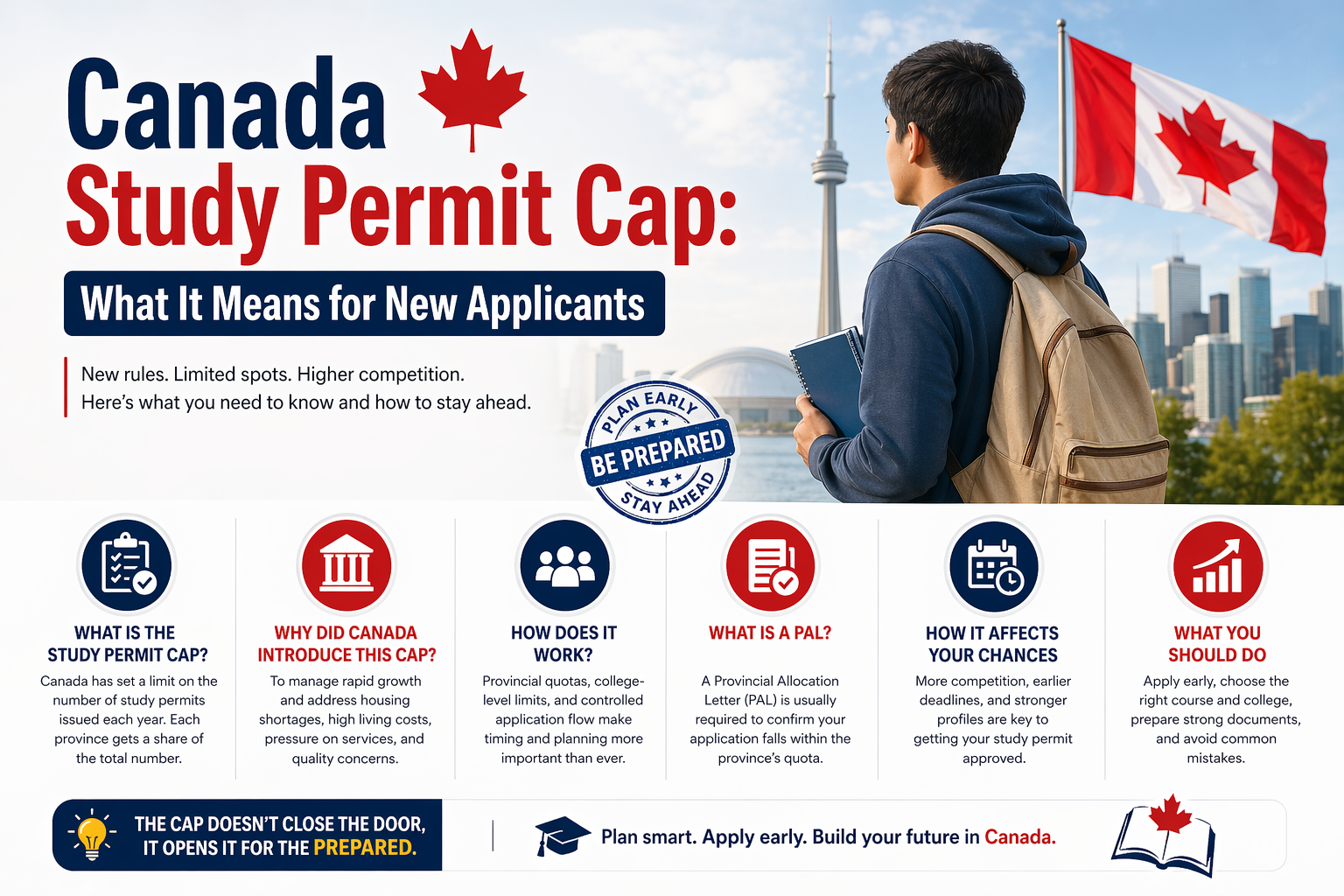


The Canada study permit cap has made many students pause their plans. You may feel unsure about your chances, confused about new rules, or worried that your dream of studying in Canada could slip away. Many applicants now face delays, rejections, or missed intakes simply because they did not understand how this cap works.
Let’s clear everything step by step so you can move forward with confidence.
Canada has set a limit on how many study permit applications it will accept and process each year. This means the system no longer works on unlimited intake.
Here’s what this means in simple terms:
So now, getting admission alone is not enough—you must also fit within the available quota.
Over the past few years, Canada saw a very sharp increase in international students. While this helped the economy, it also created serious challenges.
The government introduced the cap to slow things down and improve quality and balance.
The cap does not apply randomly. It works through a structured system.
Each province receives a fixed number of study permits it can support.
Colleges cannot admit unlimited international students anymore.
Even if you qualify, your application depends on whether slots are still available.
This makes timing and planning very important.
The Provincial Allocation Letter (PAL) is now one of the most important documents.
👉 No PAL = No processing (in most cases)
Not every student is affected. Some categories remain outside the cap.
Still, rules can change, so always confirm your category.
How the Cap Affects Your Chances
Earlier, meeting eligibility was enough. Now, you compete for limited spots.
Late applications may not even be considered if quotas fill up.
Visa officers now look more closely at:
Do not wait for deadlines. Early applicants have a clear advantage.
Pick a course that matches your past studies or career goals.
Avoid unknown or low-quality institutions.
Explain your goals clearly. Keep it real and simple.
Show proper proof of funds without errors.
Many students lose their chance due to avoidable errors:
Avoiding these mistakes can improve your chances significantly.
Yes, you absolutely can. The cap does not close the door—it just makes entry more selective.
Students who:
…still get approvals.
Canada continues to welcome genuine students.
Even with the cap, Canada remains one of the best destinations.
The opportunity is still strong—it just requires better preparation now.
The Canada study permit cap has changed the process, but not the goal. If you understand the system, act early, and avoid mistakes, you can still achieve your plan.
Focus on preparation instead of fear. That’s what makes the difference now.
The cap does reduce the total number of permits available, which means competition has increased. However, it does not eliminate your chances. If you apply early, choose the right course, and submit a strong and complete application, you still have a good chance of approval.
Most students applying for a study permit now need a PAL. This letter confirms that your application fits within the province’s limit. However, some students—such as those applying for master’s or PhD programs—may not need it. You should always check your specific category before applying.
If your category requires a PAL and you apply without it, your application may not be processed at all. This means your file could be returned or refused. That is why it is very important to confirm whether you need this document before submitting your application.
The best time to apply is as early as possible after you receive your admission offer. Since there is a cap, waiting too long can result in missing your chance if the quota fills up. Early applications have a higher chance of being considered within the limit.
Yes, Canada is still a strong option. The country continues to offer quality education, work opportunities, and clear pathways to permanent residence. The cap has only made the process more selective, not impossible. Students who plan properly can still succeed.
Having an ‘Identity Verified’ badge or being ‘Identity Verified’ simply indicates that an individual has submitted information to complete our identity verification process or we have conducted internal verification using various authorized websites. While this process includes safeguards, it does not guarantee that the person is who they claim to be.
If you encounter any issues with this profile, please report them here. While all consultants who are verified have RCIC ID, we may not have the latest data in terms of their renewal/cancellation/discontinuation of their RCIC ID.
╳The “Verified Consultants” profiles on Immiperts.com are independently compiled using publicly available information from multiple sources, including the official CICC Public Register, consultants’ own websites, other public directories, and social media.
Immiperts.com is a completely independent platform and is not affiliated with, endorsed by, or connected to the College of Immigration and Citizenship Consultants (CICC), IRCC, or any immigration consultant.
All information is collected manually and is for educational and informational purposes only. Consultants may claim, update, or request removal of their profile by contacting us at hello@immiperts.com.
Users are strongly advised to always verify the latest authorization status directly on the official CICC Public Register at college-ic.ca.