
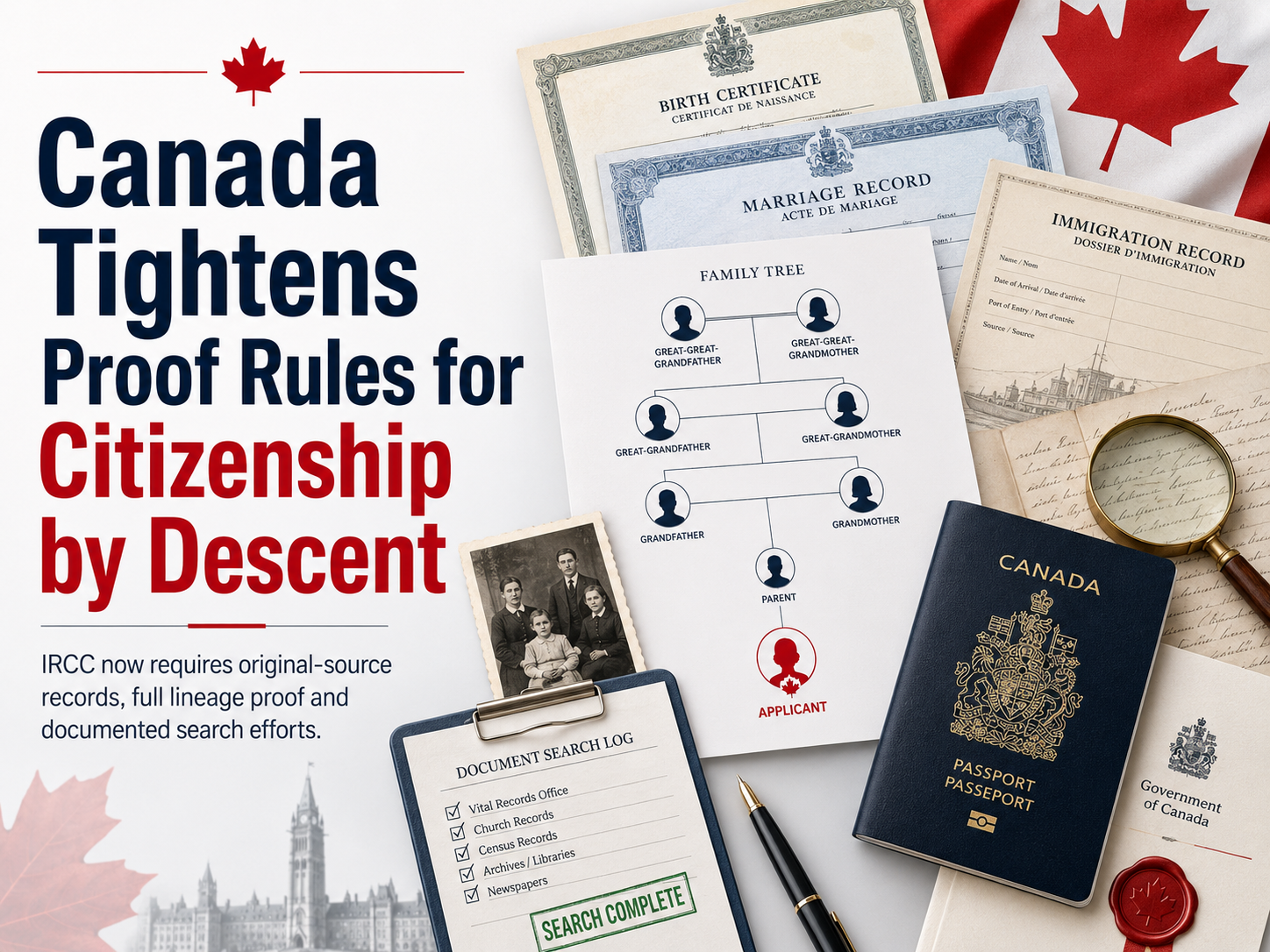


IRCC now expects applicants to prove family lineage with records from the original issuing authority.
Canada has updated its guidance for people applying for proof of citizenship by descent, placing a stronger focus on original records, complete family links and documented evidence when records cannot be found.
Immigration, Refugees and Citizenship Canada, known as IRCC, recently changed its public application instructions and its proof of citizenship document checklist, form CIT 0014. The update comes after several new Canadian citizens were asked to return their citizenship certificates because of concerns about the documents they had submitted.
One of the biggest changes is the type of document IRCC will accept to prove family lineage.
The department now says records must come from the “original” authority that created or keeps the record. This may include a civil registry, vital statistics office, provincial archive or federal record-keeping office.
Previously, the checklist referred to documents from the “appropriate” authority. That wording left more room for applicants to rely on secondary sources, such as subscription genealogy websites.
Under the new guidance, printouts from platforms such as Ancestry or FamilySearch may help applicants locate a record, but they are not enough on their own. IRCC now treats these sites as research tools, not official issuing authorities.
For many applicants, this means ordering certified birth, marriage or other civil records directly from the province, state, country or federal office where the event was originally registered.
IRCC has also made it clearer that applicants must prove the full family chain, generation by generation.
A new section on the department’s webpage says applicants must provide authentic, reliable and verifiable documents for the Canadian parent, grandparent or other parental ancestor, depending on the claim.
The updated checklist also reflects this change. Instead of asking only for proof that at least one parent is Canadian, the guidance now asks for proof of both parentage and Canadian citizenship through each relevant generation.
For someone claiming citizenship through a great-grandparent, this may require a continuous set of records connecting one generation to the next. Marriage certificates may also be needed when names changed over time.
IRCC has also clarified what applicants must do when an official record cannot be found.
Applicants must now explain in writing why they cannot provide the document. They must also show proof that they tried to get it. This could include correspondence with the issuing authority or confirmation that a record is unavailable.
If a vital records office searches and finds no record, it may issue a no-record letter. That letter, combined with other evidence, can help explain the gap more clearly than an unsupported statement.
The updated instructions also say applicants should submit clear, legible colour copies of all documents. Earlier guidance focused mainly on colour copies for translated documents.
A black-and-white scan may now lead IRCC to flag an application for review, even if the document itself is valid.
People who already applied, or who received a review or surrender letter, may still submit more evidence. IRCC’s web form allows applicants to add missing documents and notes of explanation without withdrawing the application.
In many cases, applicants may need to replace genealogy-site printouts with records from the original authority. They may also need to document any missing records with both a written explanation and proof that they tried to obtain them.
The broader issue is still unfolding. Some experts, including long-time immigration lawyer Ala Bujac, argue that forcing a person to surrender a citizenship certificate may be unconstitutional. Canada has also paused some descent applications while it clarifies how files under review should be handled.




Having an ‘Identity Verified’ badge or being ‘Identity Verified’ simply indicates that an individual has submitted information to complete our identity verification process or we have conducted internal verification using various authorized websites. While this process includes safeguards, it does not guarantee that the person is who they claim to be.
If you encounter any issues with this profile, please report them here. While all consultants who are verified have RCIC ID, we may not have the latest data in terms of their renewal/cancellation/discontinuation of their RCIC ID.
╳The “Verified Consultants” profiles on Immiperts.com are independently compiled using publicly available information from multiple sources, including the official CICC Public Register, consultants’ own websites, other public directories, and social media.
Immiperts.com is a completely independent platform and is not affiliated with, endorsed by, or connected to the College of Immigration and Citizenship Consultants (CICC), IRCC, or any immigration consultant.
All information is collected manually and is for educational and informational purposes only. Consultants may claim, update, or request removal of their profile by contacting us at hello@immiperts.com.
Users are strongly advised to always verify the latest authorization status directly on the official CICC Public Register at college-ic.ca.