
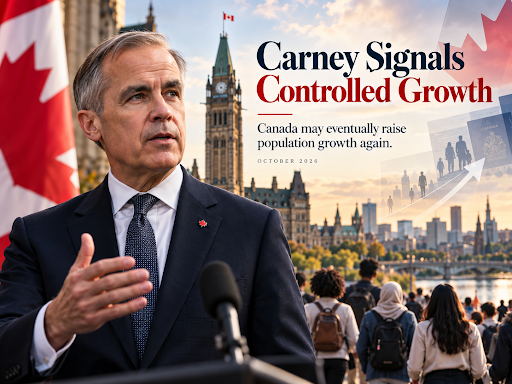


Prime Minister Mark Carney says Canada may eventually resume controlled population growth, but no new immigration targets have been announced.
Prime Minister Mark Carney has suggested Canada could eventually allow its population to grow faster again, raising questions about whether immigration levels could increase in the coming years.
But for prospective immigrants, one point is important: Canada has not announced higher immigration targets.
Carney’s remarks signal a possible change in direction rather than an immediate policy change.
In a recent interview with The New York Times, Carney said the government had taken steps to bring immigration numbers under control following several years of rapid population growth.
He said the next question is when Canada should resume a “controlled increase” in its population.
“So that will happen, and we just want to make sure that we’ve got it under control,” Carney said.
The remarks come shortly before Ottawa must release its next multi-year Immigration Levels Plan.
That plan will provide a much clearer indication of whether the federal government intends to increase, reduce or maintain immigration targets.
Canada’s current 2026–2028 Immigration Levels Plan remains in effect.
The federal government plans to admit 380,000 permanent residents each year in 2026, 2027 and 2028.
Temporary resident arrivals are being reduced more sharply.
Current targets are:
These figures cover new international students and temporary workers rather than every temporary resident already living in Canada.
Ottawa has also committed to reducing temporary residents to less than five per cent of Canada’s population by the end of 2027.
Not yet.
Carney’s comments do not create:
Those changes would require formal government announcements.
Carney’s remarks instead suggest that the government may believe Canada is approaching the point where population growth can be reconsidered after a period of tighter immigration controls.
Canada is required to publish its next immigration plan by November 1, 2026. The upcoming plan is expected to cover 2027 through 2029.
That announcement will matter far more to applicants than speculation about Carney’s comments.
The plan could determine how many permanent residents Canada intends to admit and how those spaces are divided among economic immigration, family reunification and humanitarian programs.
It could also provide updated targets for temporary workers and international students.
Possibly, but higher immigration numbers would not automatically mean lower Comprehensive Ranking System scores.
Express Entry results depend on several factors, including:
Canada could increase overall immigration while continuing to focus heavily on particular occupations, language abilities or economic priorities.
The current plan already places a strong emphasis on economic immigration. Economic admissions are expected to make up about 64 per cent of permanent resident admissions in 2027 and 2028.
Provincial Nominee Programs may also be influenced if Ottawa eventually changes permanent residence levels.
However, a higher national target does not guarantee that every province will receive more nomination spaces.
Provinces can continue choosing workers based on local labour shortages, occupations, employer needs and regional priorities.
Applicants should therefore follow both federal immigration changes and the rules of individual provincial programs.
Carney’s comments are notable because the federal government’s recent focus has been on slowing population growth and reducing temporary immigration.
Current policy still aims to stabilize permanent residence admissions while lowering the number of new temporary residents entering Canada.
The Prime Minister’s latest remarks suggest Ottawa may eventually move from that correction period toward more controlled population growth.
For now, however, applicants should work with existing immigration rules rather than assuming that higher targets are coming.
The next Immigration Levels Plan will provide the clearest answer.








Having an ‘Identity Verified’ badge or being ‘Identity Verified’ simply indicates that an individual has submitted information to complete our identity verification process or we have conducted internal verification using various authorized websites. While this process includes safeguards, it does not guarantee that the person is who they claim to be.
If you encounter any issues with this profile, please report them here. While all consultants who are verified have RCIC ID, we may not have the latest data in terms of their renewal/cancellation/discontinuation of their RCIC ID.
╳The “Verified Consultants” profiles on Immiperts.com are independently compiled using publicly available information from multiple sources, including the official CICC Public Register, consultants’ own websites, other public directories, and social media.
Immiperts.com is a completely independent platform and is not affiliated with, endorsed by, or connected to the College of Immigration and Citizenship Consultants (CICC), IRCC, or any immigration consultant.
All information is collected manually and is for educational and informational purposes only. Consultants may claim, update, or request removal of their profile by contacting us at hello@immiperts.com.
Users are strongly advised to always verify the latest authorization status directly on the official CICC Public Register at college-ic.ca.