
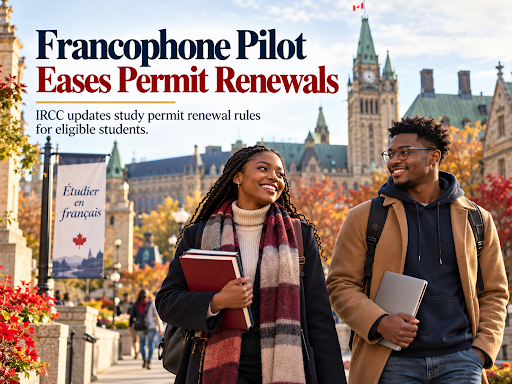


Updated IRCC guidance clarifies how Francophone pilot students and their families can maintain their temporary status in Canada.
Immigration, Refugees and Citizenship Canada has updated guidance affecting students taking part in the Francophone Minority Communities Student Pilot, or FMCSP.
The program is designed for eligible French-speaking international students studying at participating post-secondary institutions outside Quebec. It also supports Canada’s broader goal of strengthening Francophone minority communities.
Students in the pilot may receive benefits not available through the regular study permit process, including an exemption from the provincial or territorial attestation letter requirement.
Students seeking to maintain their status must continue meeting the conditions attached to the FMCSP.
Their program must generally be offered by a participating designated learning institution, be full-time and post-secondary, last at least two years and lead to a degree or diploma.
More than half of the program’s classes must be taught in French.
Students should also make sure their school documentation clearly identifies their participation in the FMCSP.
IRCC says a letter of acceptance from a participating institution must state that the student is applying under the pilot and confirm that the program meets FMCSP requirements.
Applicants must continue showing that they have enough money to cover their education and living expenses.
IRCC requires proof that students can pay tuition as well as living and travel expenses for themselves and any family members accompanying them to Canada.
The required financial amount varies depending on where the participating institution is located and the number of family members involved.
Students should use recent and clearly documented financial records when preparing an application.
The FMCSP also provides options for eligible family members.
A spouse or common-law partner may qualify for an open work permit, while dependent children may be eligible for a study permit or visitor status.
Family members must provide evidence connecting them to the principal FMCSP participant, such as the student’s qualifying letter of acceptance or study permit.
IRCC’s current guidance also confirms that eligible family members may later renew their status under the pilot or accompany graduates as workers, students or visitors.
One important benefit remains unchanged.
FMCSP applicants are exempt from the requirement to submit a provincial attestation letter or territorial attestation letter.
When applying online, applicants must identify that they qualify for an exception from the PAL or TAL requirement.
The pilot is also connected to a future pathway to permanent residence.
IRCC currently says the immigration pathway for eligible FMCSP graduates is expected to open in winter 2027.
To qualify, graduates will generally need to live outside Quebec, have a study permit issued under the pilot, maintain valid temporary status and complete an eligible two-year or longer program taught mainly in French.
Participants and eligible family members can also access settlement services while studying in Canada.











Having an ‘Identity Verified’ badge or being ‘Identity Verified’ simply indicates that an individual has submitted information to complete our identity verification process or we have conducted internal verification using various authorized websites. While this process includes safeguards, it does not guarantee that the person is who they claim to be.
If you encounter any issues with this profile, please report them here. While all consultants who are verified have RCIC ID, we may not have the latest data in terms of their renewal/cancellation/discontinuation of their RCIC ID.
╳The “Verified Consultants” profiles on Immiperts.com are independently compiled using publicly available information from multiple sources, including the official CICC Public Register, consultants’ own websites, other public directories, and social media.
Immiperts.com is a completely independent platform and is not affiliated with, endorsed by, or connected to the College of Immigration and Citizenship Consultants (CICC), IRCC, or any immigration consultant.
All information is collected manually and is for educational and informational purposes only. Consultants may claim, update, or request removal of their profile by contacting us at hello@immiperts.com.
Users are strongly advised to always verify the latest authorization status directly on the official CICC Public Register at college-ic.ca.