
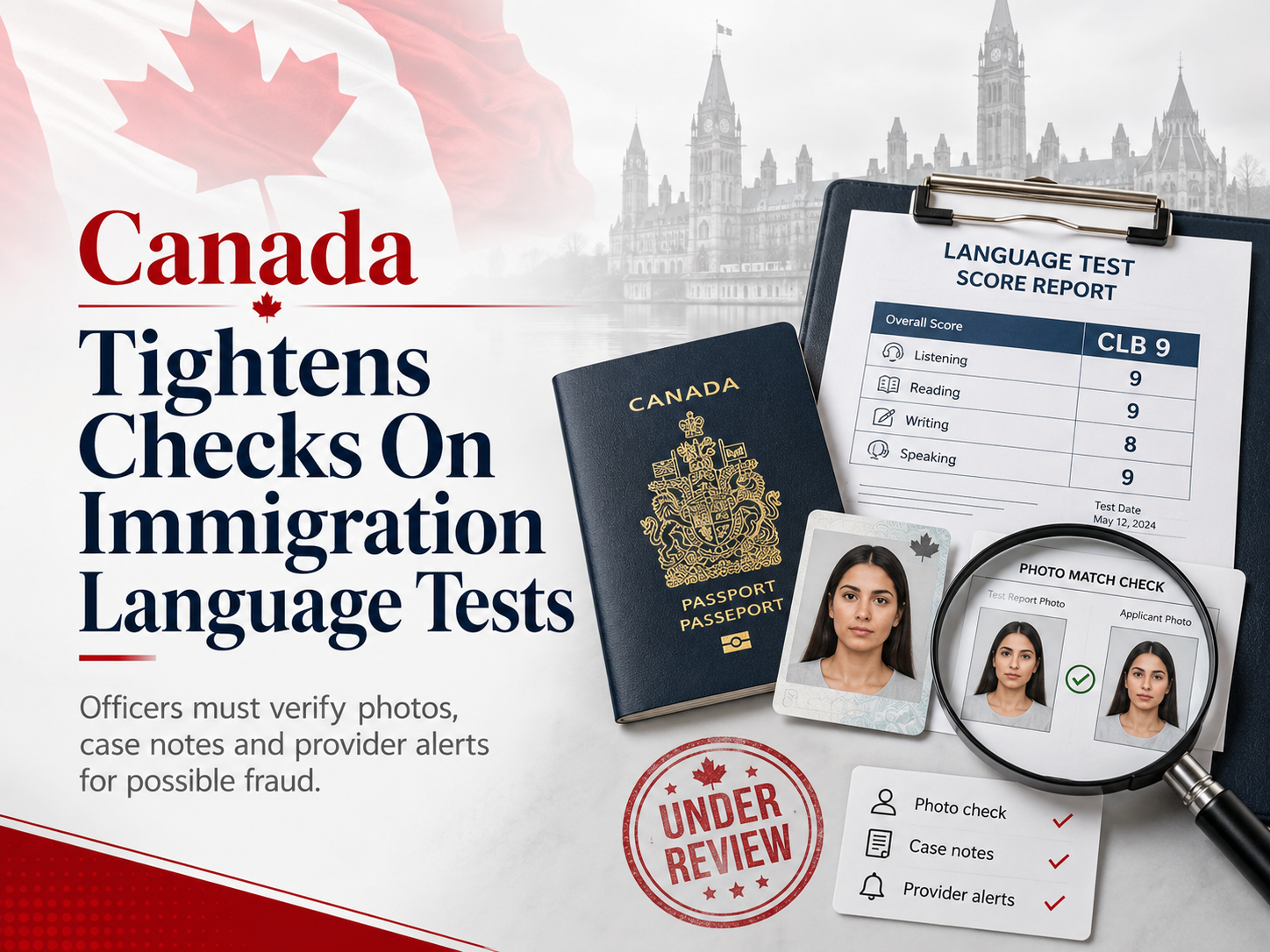


Immigration officers must now complete deeper checks before deciding applications involving language test results.
Canada has introduced tougher checks for immigration language test results as part of new instructions aimed at detecting possible fraud.
The updated guidance for immigration officers was published online on June 23, 2026. It tells officers to compare applicants’ photographs when validating language test results. Officers must also review case notes and Info-Alerts issued by testing providers for any signs that may point to fraudulent results.
The new instructions require officers to carry out these checks “at all stages of application processing and prior to rendering a decision.”
If officers find possible concerns, they must record the issue and forward it to the Tips and Reports Management Unit, known as TMRU. This unit handles fraud-related investigations for further review.
These steps were not listed in the earlier version of the instructions. The updated guidance also removes a previous reference to applicants being allowed to take a second language test under the supervision of a visa office.
If officials conclude that fraud occurred, the instructions say “the application may be refused for misrepresentation, in accordance with procedural fairness requirements.”
Canada has long required many economic immigration applicants to prove their ability in English or French through a government-approved third-party language test.
The results are converted into a standard 12-point scale. English results are measured through the Canadian Language Benchmark, or CLB. French results are measured through the Niveau de compétence linguistique canadien, or NCLC.
In many immigration programs, workers in management jobs or jobs requiring university education need at least level 7. Workers in skilled trades or jobs usually requiring college education often need at least level 5.
Proposed changes to Express Entry, Canada’s main system for selecting permanent residents, would set a minimum score of 6 for candidates in all occupations.
Higher language scores can also improve a candidate’s chance of selection because many programs award extra points for stronger results.
Language test results are valid for two years from the date of the test. In most cases, the results must still be valid when Immigration, Refugees and Citizenship Canada receives the application.
The accepted tests currently listed for immigration purposes are CELPIP, IELTS, PTE Core, TEF and TCF.
Last August, officials announced plans to add the Test of English as a Foreign Language in the future. However, the updated IRCC instructions confirm that it is still not accepted for immigration applications at this time.
In late 2024, Canada expanded language test requirements to some international graduates applying for post-graduation work permits. The required language level depends on the applicant’s level of study.
A post-graduation work permit is an open work permit that can last up to three years. It allows eligible international graduates to work in Canada after completing studies at a Canadian institution.
Despite the new language rules, the PGWP application portal still does not include a separate field for language test results because of “system limitations.”
In May 2025, the government said it was working on a dedicated field, but no launch date has been announced. For now, PGWP applicants must upload their language test results under the “Client Information” section of their online account.




Having an ‘Identity Verified’ badge or being ‘Identity Verified’ simply indicates that an individual has submitted information to complete our identity verification process or we have conducted internal verification using various authorized websites. While this process includes safeguards, it does not guarantee that the person is who they claim to be.
If you encounter any issues with this profile, please report them here. While all consultants who are verified have RCIC ID, we may not have the latest data in terms of their renewal/cancellation/discontinuation of their RCIC ID.
╳The “Verified Consultants” profiles on Immiperts.com are independently compiled using publicly available information from multiple sources, including the official CICC Public Register, consultants’ own websites, other public directories, and social media.
Immiperts.com is a completely independent platform and is not affiliated with, endorsed by, or connected to the College of Immigration and Citizenship Consultants (CICC), IRCC, or any immigration consultant.
All information is collected manually and is for educational and informational purposes only. Consultants may claim, update, or request removal of their profile by contacting us at hello@immiperts.com.
Users are strongly advised to always verify the latest authorization status directly on the official CICC Public Register at college-ic.ca.