
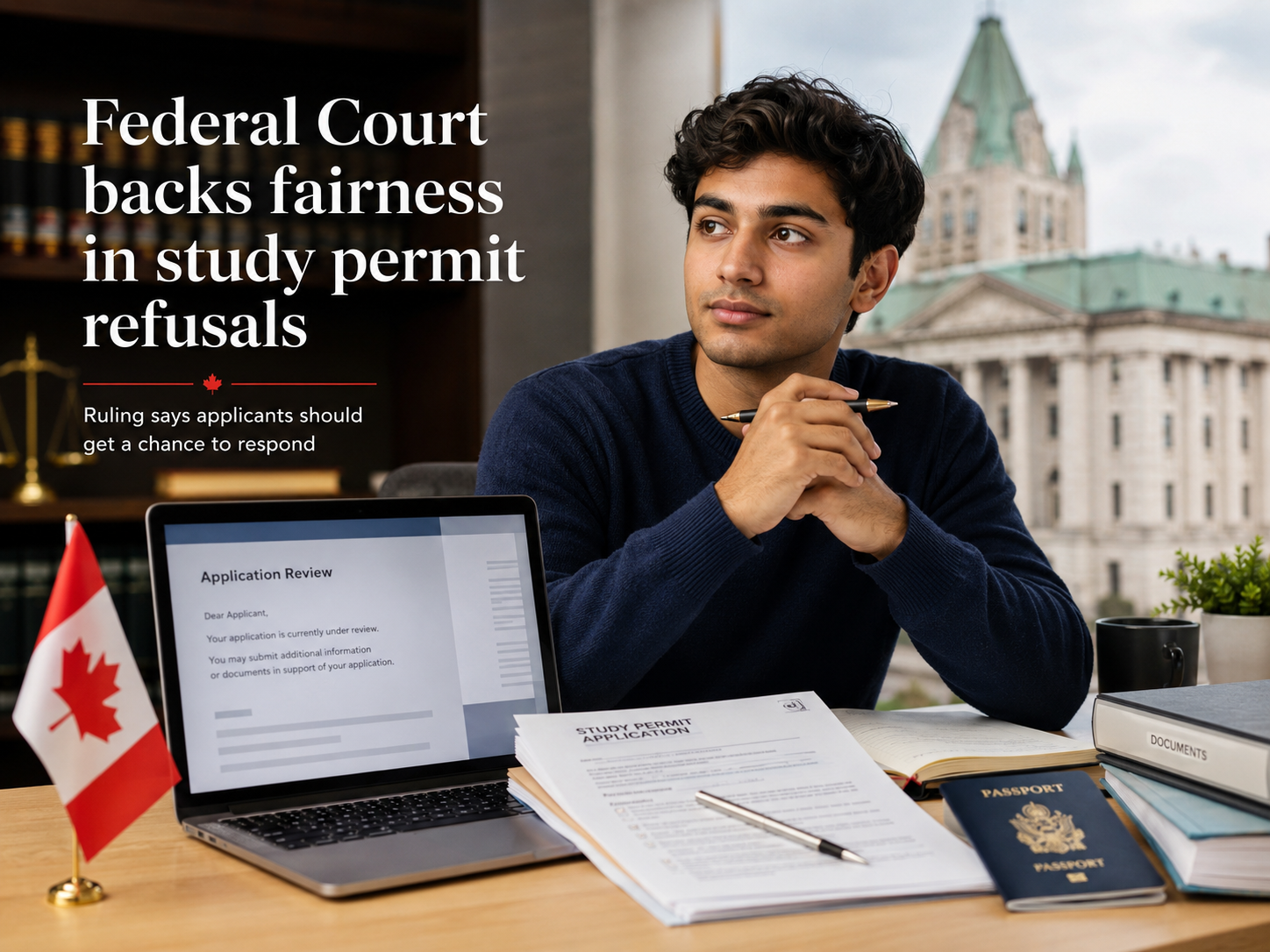


A new ruling says applicants may deserve a chance to answer key credibility concerns.
A recent Federal Court decision has highlighted the need for fairness when Canadian immigration officers refuse study permit applications.
In Akaya v. Canada (MCI), 2026 FC 546, the Court found that an Immigration, Refugees and Citizenship Canada officer acted unfairly by refusing a study permit without first giving the applicant a chance to respond to concerns about important evidence.
The applicant had applied for a Canadian study permit and said her brother would help pay for her education.
To support the application, she submitted financial documents, a signed letter from her brother, photographs, and information explaining their family relationship.
Despite this, the officer was not satisfied that the person providing financial support was truly her brother. Because of that doubt, the officer also found that the applicant had not shown enough available money to support her studies in Canada.
The study permit was refused.
The applicant took the refusal to the Federal Court through a process called Judicial Review.
Justice Tsimberis found that the officer’s concern was not only about missing documents. The Court said the officer had questioned the credibility and authenticity of the family relationship.
That issue was central to the refusal. Since the officer relied on that concern to make the decision, the Court found that the applicant should have been told about the concern and given a chance to respond before the refusal was finalized.
In simple terms, if an officer doubts whether key evidence is genuine, fairness may require the officer to give the applicant an opportunity to explain.
Procedural fairness is a basic principle in Canadian law. In immigration decisions, it means applicants should receive a fair process.
This can include a decision based on relevant evidence, an unbiased review, clear reasons for the decision, and a chance to respond when serious credibility concerns arise.
However, IRCC does not have to contact applicants about every concern. Officers can refuse applications when documents are missing or when applicants have not met the rules. The fairness issue becomes more important when the officer doubts the truth or authenticity of evidence that the applicant may not have known was being questioned.
The ruling does not create new study permit rules. It also does not mean every refused study permit can be overturned.
Applicants still need to meet all eligibility requirements. They must show clear financial support, explain their study plans, and provide complete and consistent documents.
The decision instead gives guidance on how officers should handle serious doubts about evidence. When those doubts become a major reason for refusal, the applicant may need to be given a fair chance to answer.
The case offers useful lessons for students applying to Canada.
Applicants should clearly explain who is paying for their studies. If a relative is providing financial support, it may help to include documents that prove the family relationship.
Names, dates, addresses, letters, bank records, and supporting documents should be consistent. If family circumstances are complex, applicants should include a written explanation at the beginning rather than leaving the officer to guess.
Applicants who believe IRCC made a legal or fairness error may consider Judicial Review at the Federal Court.
This is not the same as a regular appeal. The Court does not simply replace IRCC’s decision with its own. Instead, it reviews whether the decision-making process followed Canadian law.
The article notes that applicants inside Canada generally have 15 days from receiving a refusal to seek Judicial Review. Applicants outside Canada generally have 60 days.












Having an ‘Identity Verified’ badge or being ‘Identity Verified’ simply indicates that an individual has submitted information to complete our identity verification process or we have conducted internal verification using various authorized websites. While this process includes safeguards, it does not guarantee that the person is who they claim to be.
If you encounter any issues with this profile, please report them here. While all consultants who are verified have RCIC ID, we may not have the latest data in terms of their renewal/cancellation/discontinuation of their RCIC ID.
╳The “Verified Consultants” profiles on Immiperts.com are independently compiled using publicly available information from multiple sources, including the official CICC Public Register, consultants’ own websites, other public directories, and social media.
Immiperts.com is a completely independent platform and is not affiliated with, endorsed by, or connected to the College of Immigration and Citizenship Consultants (CICC), IRCC, or any immigration consultant.
All information is collected manually and is for educational and informational purposes only. Consultants may claim, update, or request removal of their profile by contacting us at hello@immiperts.com.
Users are strongly advised to always verify the latest authorization status directly on the official CICC Public Register at college-ic.ca.