
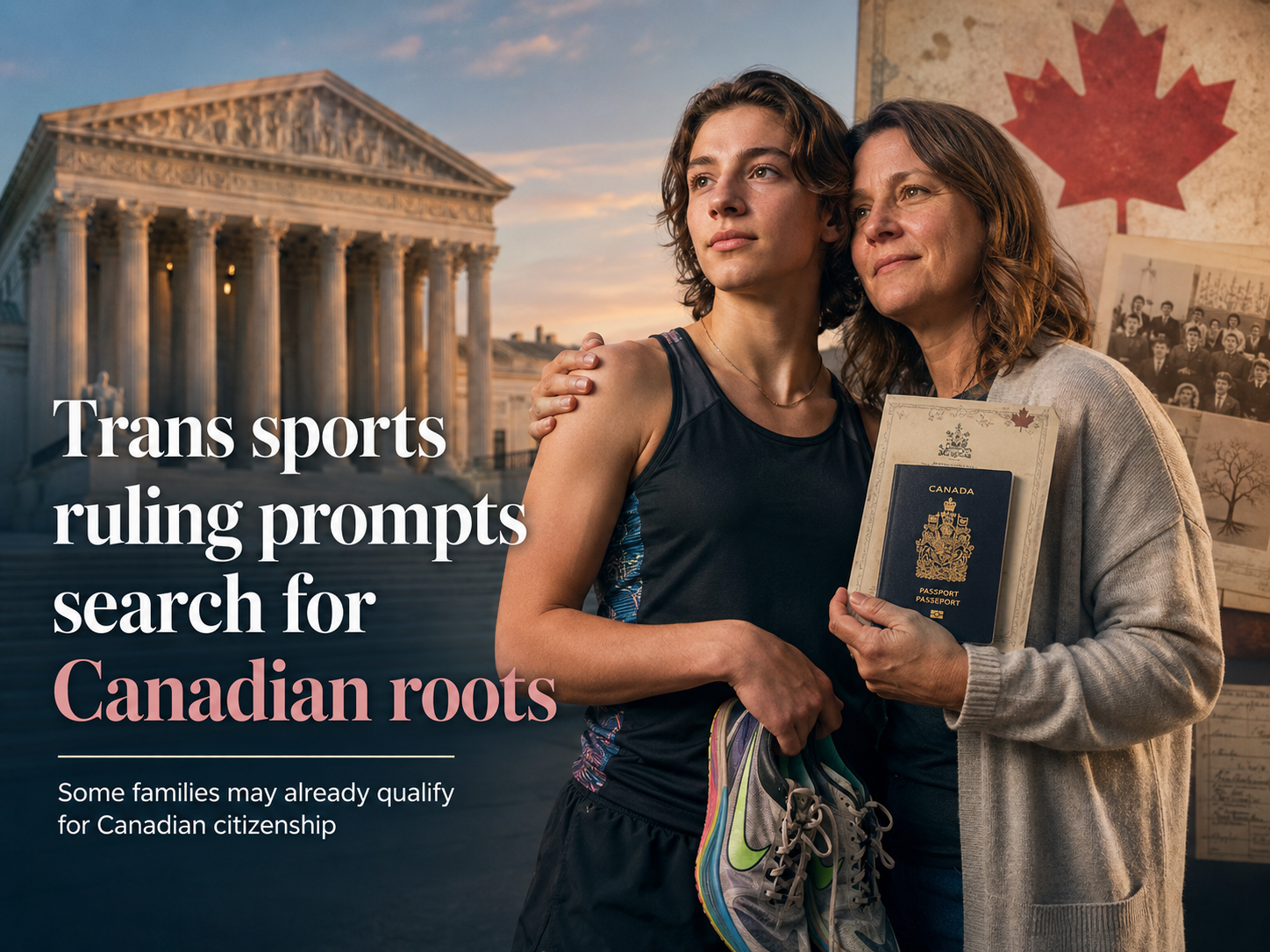


A Supreme Court decision has led some families to look again at possible Canadian citizenship by descent.
The U.S. Supreme Court’s latest decision on transgender student athletes has left some families searching for new options, including a possible legal connection to Canada.
On June 30, the court upheld state bans that stop transgender student athletes from playing in girls’ and women’s sports. The 6-3 ruling in West Virginia v. B.P.J. and Little v. Hecox kept laws in West Virginia and Idaho in place. It also strengthened similar laws in more than two dozen U.S. states.
The decision follows other recent rulings and policy changes affecting transgender Americans, including matters involving gender-affirming care, military service and passport gender markers.
For parents of transgender children living in states with such laws, the issue is no longer only political or legal. It has become a practical family question: where can their child live with more security and recognition?
For some American families, an answer may already exist in old family records. A Canadian parent, grandparent or more distant ancestor could now matter more than many people realize.
Canada changed its citizenship rules through Bill C-3, which took effect in December 2025. The law removed the former generational limit on citizenship by descent. That old rule often stopped citizenship from passing beyond the first generation born outside Canada.
Under the newer rules, people born before December 15, 2025, may have a claim to Canadian citizenship if they can trace an unbroken line back to a Canadian-born ancestor.
This does not mean applying to become Canadian in the usual immigration sense. If a person qualifies, they may already be Canadian. The process is to apply for a citizenship certificate that proves that status.
There is no language test, residency requirement or citizenship exam for this type of claim.
Canada has a different legal approach to gender identity and expression. These are protected grounds in human rights law across all Canadian provinces.
In sport, U Sports, which oversees university athletics in Canada, allows athletes to compete according to their gender identity. Many provincial school sport organizations also have inclusion policies.
Still, the larger value of Canadian citizenship may go beyond sport. For families facing repeated legal changes in their home state, a second passport can provide choice. Some Americans who apply for proof of Canadian citizenship may never plan to move. But having the option can bring peace of mind.
Many Americans may not know they have Canadian ancestry. The clues can appear in surnames, old documents or family stories.
French Canadian names were often changed after families moved south. Roy sometimes became King, while La Rivière could become Rivers. Some families also carried dit names that changed over time in English-speaking communities.
Maine has a strong French ancestry connection, with nearly one in five residents having French roots and higher shares in some northern counties. Between 1840 and 1930, almost 900,000 people moved from Quebec to work in textile mills and built communities known as Little Canadas.
Canadian roots may also appear in Louisiana, Michigan, Minnesota and Wisconsin. Cajun families may trace ancestry to Acadians expelled from Nova Scotia in 1755.
The hardest part is often collecting birth and marriage certificates across generations. A small mismatch between records can delay an application.
Proof of citizenship applications were taking about 19 months to process at the time of writing, although urgent files may be expedited in some cases.
For families now looking for safety, stability and choice, an old family name or forgotten record may open a door that was always there.










Having an ‘Identity Verified’ badge or being ‘Identity Verified’ simply indicates that an individual has submitted information to complete our identity verification process or we have conducted internal verification using various authorized websites. While this process includes safeguards, it does not guarantee that the person is who they claim to be.
If you encounter any issues with this profile, please report them here. While all consultants who are verified have RCIC ID, we may not have the latest data in terms of their renewal/cancellation/discontinuation of their RCIC ID.
╳The “Verified Consultants” profiles on Immiperts.com are independently compiled using publicly available information from multiple sources, including the official CICC Public Register, consultants’ own websites, other public directories, and social media.
Immiperts.com is a completely independent platform and is not affiliated with, endorsed by, or connected to the College of Immigration and Citizenship Consultants (CICC), IRCC, or any immigration consultant.
All information is collected manually and is for educational and informational purposes only. Consultants may claim, update, or request removal of their profile by contacting us at hello@immiperts.com.
Users are strongly advised to always verify the latest authorization status directly on the official CICC Public Register at college-ic.ca.