


Canada’s latest CMA unemployment update changes where low-wage LMIA applications can be processed.
Canada has updated the unemployment rates used to decide whether certain low-wage Labour Market Impact Assessment applications can be processed under the Temporary Foreign Worker Program.
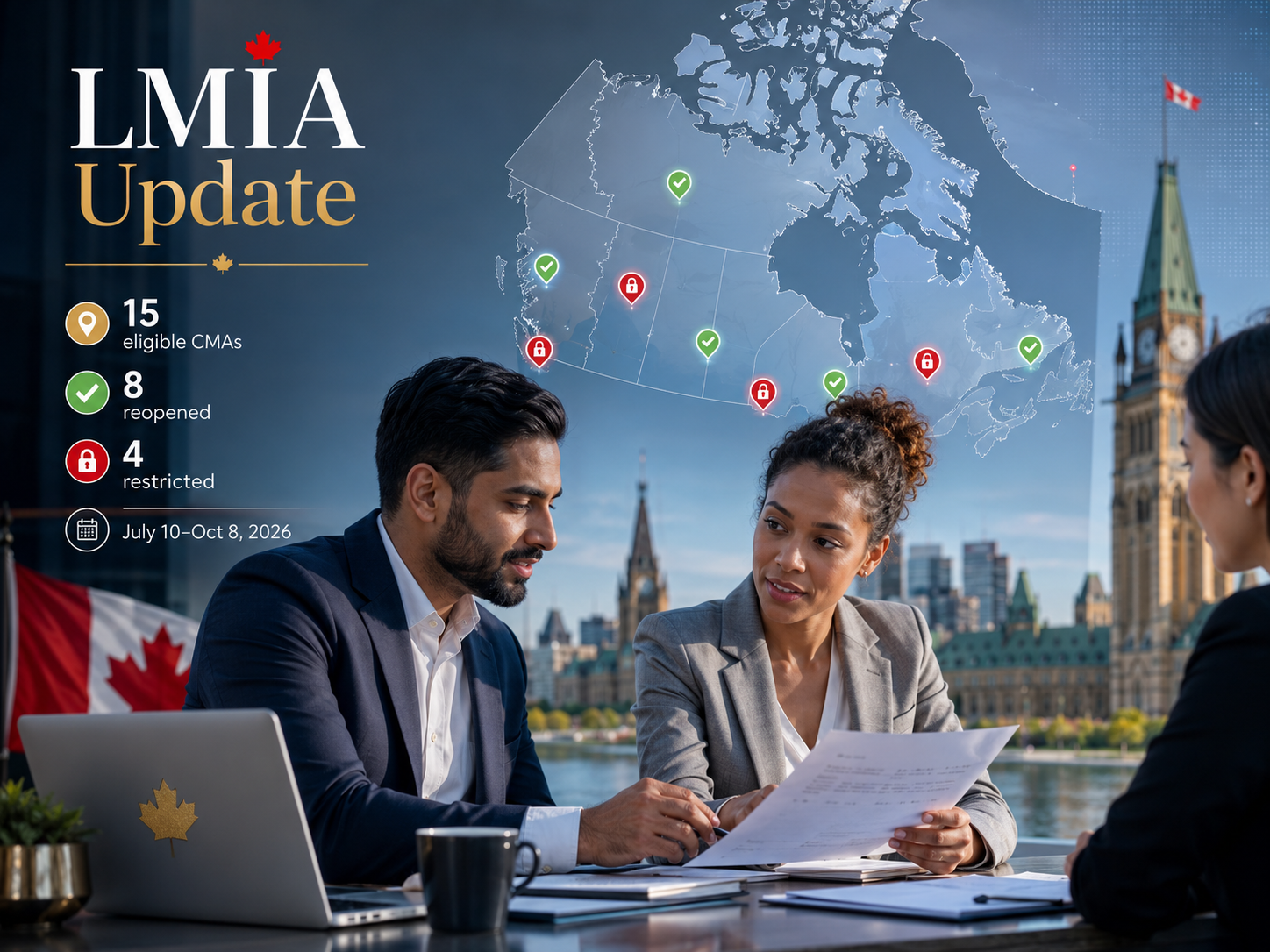
The new rates apply to applications submitted from July 10, 2026, to October 8, 2026. They affect work locations inside Census Metropolitan Areas, commonly called CMAs.
Under federal rules, Service Canada will not process a low-wage LMIA application if the offered wage is below the provincial or territorial median wage and the worksite is in a CMA with an unemployment rate of 6 per cent or higher.
This rule has been in place since September 26, 2024. It is not a case-by-case decision. If the CMA rate is at or above the limit when the application is submitted, the application is blocked.
The July update brings some relief for employers. Fifteen CMAs are now below the 6 per cent threshold, compared with 11 in the previous April cycle.
Eight CMAs that were restricted last quarter have moved back below 6 per cent. They are Halifax, Saint John, Fredericton, Drummondville, Kingston, St. Catharines-Niagara, Winnipeg, and Regina.
St. Catharines-Niagara saw one of the sharpest improvements, falling from 7.2 per cent to 5.8 per cent. Drummondville also dropped strongly, moving from 7.3 per cent to 5.7 per cent.
Halifax returned to eligibility at 5.9 per cent, while Winnipeg fell to 5.6 per cent. Regina also reopened at 5.9 per cent, though it remains close to the cutoff.
At the same time, four CMAs moved above the 6 per cent line and are now restricted for low-wage LMIA processing.
These areas are Saskatoon, Red Deer, Kamloops, and Chilliwack. Chilliwack recorded the steepest jump, rising from 5.7 per cent to 7.9 per cent. Kamloops increased from 5.2 per cent to 7.0 per cent, while Red Deer moved from 5.9 per cent to 7.2 per cent.
Saskatoon’s move to 6.5 per cent is notable because it had stayed below the limit for several earlier quarters.
Employers should confirm the exact CMA of every work location before filing. Municipal boundaries do not always match CMA boundaries.
They should use the full postal code of the worksite in Statistics Canada’s geography search tool. If the location is not inside a CMA, or is only in a Census Agglomeration, the CMA unemployment block does not apply.
Employers should also check whether the job is low-wage or high-wage. The 6 per cent rule applies only to the low-wage stream.
Foreign workers with job offers tied to low-wage LMIAs should pay close attention to timing. The rate used is the one in effect when the employer submits the LMIA, not when the job offer is made.
Workers with valid permits are not directly affected by this update. The rule applies to new low-wage LMIA applications.
Some sectors remain exempt, including primary agriculture, construction, food manufacturing, hospitals, nursing and residential care, certain in-home caregiver roles, short-term mobile positions, and permanent-residence-only applications.
The next update is scheduled for October 9, 2026.









Having an ‘Identity Verified’ badge or being ‘Identity Verified’ simply indicates that an individual has submitted information to complete our identity verification process or we have conducted internal verification using various authorized websites. While this process includes safeguards, it does not guarantee that the person is who they claim to be.
If you encounter any issues with this profile, please report them here. While all consultants who are verified have RCIC ID, we may not have the latest data in terms of their renewal/cancellation/discontinuation of their RCIC ID.
╳The “Verified Consultants” profiles on Immiperts.com are independently compiled using publicly available information from multiple sources, including the official CICC Public Register, consultants’ own websites, other public directories, and social media.
Immiperts.com is a completely independent platform and is not affiliated with, endorsed by, or connected to the College of Immigration and Citizenship Consultants (CICC), IRCC, or any immigration consultant.
All information is collected manually and is for educational and informational purposes only. Consultants may claim, update, or request removal of their profile by contacting us at hello@immiperts.com.
Users are strongly advised to always verify the latest authorization status directly on the official CICC Public Register at college-ic.ca.