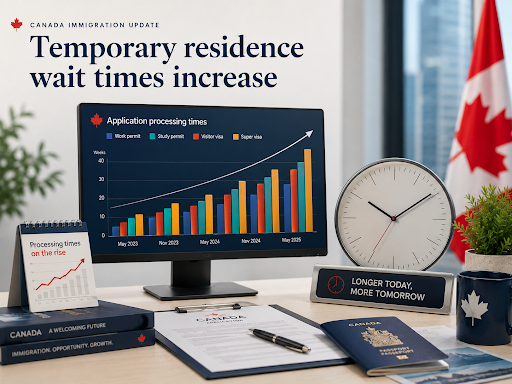


IRCC’s latest update brings longer waits for many work permit, study permit, visitor visa and super visa applicants.
Immigration, Refugees and Citizenship Canada has reported longer processing estimates for most temporary residence applications in its latest weekly update.
The figures, released August 5, compare expected wait times with those published July 28. The largest change affected work permit applicants in Pakistan, while students and super visa applicants from several countries also faced longer estimates.
IRCC is expected to publish its next update around August 12, 2026.
The estimated processing time for work permit applications from Pakistan rose from 11 weeks to 25 weeks, an increase of 14 weeks. This was the sharpest change among the countries and application types reviewed.
Wait times stayed at nine weeks for India, seven weeks for Nigeria, three weeks for the United States and six weeks for the Philippines. Applications submitted from inside Canada improved slightly, falling from 120 days to 119 days.
IRCC’s service standard is 120 days for work permits submitted in Canada and 60 days for applications made from outside the country.
Study permit estimates increased by one week for applicants in Nigeria and the Philippines. Nigeria’s wait rose from six to seven weeks, while the Philippines increased from four to five weeks.
The estimates remained unchanged at five weeks for India and the United States and seven weeks for Pakistan. Applications submitted from within Canada also stayed at seven weeks.
Visitor visa estimates moved in both directions. India’s wait increased from 22 to 27 days, while Pakistan rose from 43 to 48 days. Nigeria increased from 64 to 68 days.
Applicants in the United States saw an improvement from 26 to 21 days. Canada-based applications fell from 24 to 21 days, while the Philippines declined slightly from 17 to 16 days.
The Philippines recorded the largest super visa increase, with the estimate rising from 73 to 100 days. India increased from 52 to 56 days, Nigeria from 41 to 43 days and the United States from 124 to 126 days.
Pakistan was the only country in the group to record an improvement. Its estimated wait dropped by 11 days, from 196 to 185 days.
The service standard for super visa applications is 112 days. These applications can only be submitted from outside Canada.
IRCC says processing times are general estimates, not promises or maximum waiting periods. They can reflect past results or current application volumes and available resources.
Service standards are separate benchmarks showing how quickly IRCC aims to complete most applications under normal conditions. A specific case can take more or less time because of complexity, backlogs, document requests or additional reviews.
IRCC processed more than 1.2 million temporary residence applications during the first five months of 2026. More than 404,000 applications remained pending as of May 31, showing the continuing pressure on Canada’s temporary immigration system.
Applicants should check estimates before planning travel, work or study, since weekly figures can change without warning.









Having an ‘Identity Verified’ badge or being ‘Identity Verified’ simply indicates that an individual has submitted information to complete our identity verification process or we have conducted internal verification using various authorized websites. While this process includes safeguards, it does not guarantee that the person is who they claim to be.
If you encounter any issues with this profile, please report them here. While all consultants who are verified have RCIC ID, we may not have the latest data in terms of their renewal/cancellation/discontinuation of their RCIC ID.
╳The “Verified Consultants” profiles on Immiperts.com are independently compiled using publicly available information from multiple sources, including the official CICC Public Register, consultants’ own websites, other public directories, and social media.
Immiperts.com is a completely independent platform and is not affiliated with, endorsed by, or connected to the College of Immigration and Citizenship Consultants (CICC), IRCC, or any immigration consultant.
All information is collected manually and is for educational and informational purposes only. Consultants may claim, update, or request removal of their profile by contacting us at hello@immiperts.com.
Users are strongly advised to always verify the latest authorization status directly on the official CICC Public Register at college-ic.ca.