
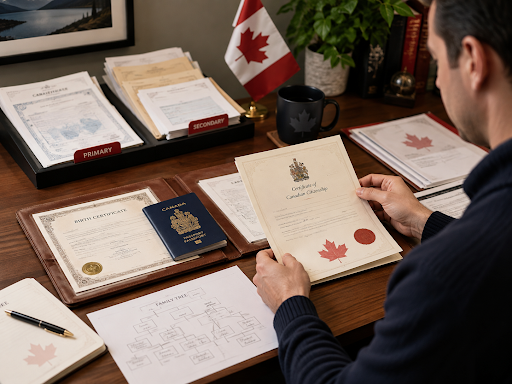


New IRCC guidance shows why some family records carry more weight than others in citizenship-by-descent applications.
Immigration, Refugees and Citizenship Canada (IRCC) weighs documents differently when reviewing citizenship-by-descent claims, and applicants may weaken their case if one generation relies only on lower-tier evidence.
A 2026 IRCC presentation to the Association of Canadian Archivists divided supporting records into two groups: primary documents that applicants must provide and secondary documents that officers may consider. IRCC says officers must assess all relevant evidence submitted with an application.
Primary evidence carries the strongest weight in proving each link between an applicant and a Canadian ancestor. Examples include Canadian provincial or territorial birth certificates, foreign birth certificates showing the parent-child relationship, Canadian citizenship or naturalization certificates, Certificates of Registration of Birth Abroad, and certain historical records proving British subject or landed immigrant status.
Secondary evidence can support a claim but does not carry the same weight. IRCC’s examples include hospital birth records, physician or midwife records, baptismal certificates, census records, marriage and death records, immigration files, military records, boat manifests and passports. The department says this list is not exhaustive.
The source of a record also matters. This distinction can be especially important for Quebec family histories, where parish registers served as civil records until 1994, depending on the generation being documented.
IRCC tightened its citizenship-by-descent guidance in June 2026 to emphasize that records should come from the original authority that created or maintains them. A baptismal record issued by the church authority holding the register may still be secondary evidence, while a screenshot from a genealogy website is considered third-party material.
Applicants who cannot obtain a primary document should explain the gap and show that they tried to locate the record. IRCC told the archivists’ association that a formal “No Record Found” letter is not mandatory. Emails with an archive or evidence of an unsuccessful search can help demonstrate those efforts.
Secondary documents from original authorities may strengthen a file when primary evidence is unavailable, but IRCC does not treat them as automatic substitutes. Multiple records that support the same family relationship can give an officer more evidence to weigh.
IRCC decides citizenship-by-descent claims on a balance of probabilities. Officers consider whether the claim is more likely than not to be valid and whether the submitted documents support each generation in the family chain.
Applicants should review their records generation by generation. Files are strongest when each link is supported by primary evidence from the original authority and names and dates remain consistent. Genealogy-site printouts, unexplained gaps, or conflicting names and birth dates can require additional records or written explanations.
IRCC also says documents do not normally need certification, although an officer can request a certified copy if authenticity is questioned. That distinction separates document source from certification.
Applicants may submit a complete application before obtaining every primary document if it passes completeness checks, but the approach carries risks if missing evidence cannot be added before processing starts.
The Association of Canadian Archivists has cautioned that information from IRCC’s presentation may change. Applicants should review current IRCC requirements before filing.











Having an ‘Identity Verified’ badge or being ‘Identity Verified’ simply indicates that an individual has submitted information to complete our identity verification process or we have conducted internal verification using various authorized websites. While this process includes safeguards, it does not guarantee that the person is who they claim to be.
If you encounter any issues with this profile, please report them here. While all consultants who are verified have RCIC ID, we may not have the latest data in terms of their renewal/cancellation/discontinuation of their RCIC ID.
╳The “Verified Consultants” profiles on Immiperts.com are independently compiled using publicly available information from multiple sources, including the official CICC Public Register, consultants’ own websites, other public directories, and social media.
Immiperts.com is a completely independent platform and is not affiliated with, endorsed by, or connected to the College of Immigration and Citizenship Consultants (CICC), IRCC, or any immigration consultant.
All information is collected manually and is for educational and informational purposes only. Consultants may claim, update, or request removal of their profile by contacting us at hello@immiperts.com.
Users are strongly advised to always verify the latest authorization status directly on the official CICC Public Register at college-ic.ca.