



Canada’s revised citizenship laws could open a path to citizenship for descendants of British children who arrived more than a century ago.
More than 100,000 children travelled from Britain to Canada through assisted immigration between 1869 and the late 1930s. Their descendants, including families living abroad, may now have a route to recognition as Canadian citizens under changes to citizenship law.
Library and Archives Canada records these migrants as British Home Children. A 2010 federal estimate suggested that three to four million Canadians descend directly from them. The UK’s National Archives counts approximately 80,000 arrivals through 1930, a shorter period than Canada’s estimate.
Charities, churches and poor-relief organizations arranged the journeys. Some children had lost their parents; others came from families unable to support them. After arriving, many boys went to farms while girls worked in domestic service. Critics accused organizers of providing cheap labour without enough oversight. In 2018, Canadian MPs designated September 28 British Home Child Day to recognize their history across Canada.
Rob Greenhorn’s story shows how such placements unfolded. Orphaned in Scotland, he sailed aboard the S.S. Siberian in March 1889 at age nine, alongside his older brother and 128 other boys. They arrived in Halifax on March 26 and travelled to Fairknowe Home in Brockville, Ontario, before being placed on separate farms.
His granddaughter Beth Greenhorn joined Library and Archives Canada in 2003 but did not discover his Home Child history until 2012.
Canadian citizenship became a separate legal status on January 1, 1947. Before that, Home Children and other Canadians generally held British subject status.
A Home Child living in Canada in 1947 may have become a citizen under the original law. Amendments in 2015 also recognized certain British subjects who were ordinarily resident in Canada that day but had not obtained citizenship. Their citizenship is treated as dating from 1947, subject to exclusions.
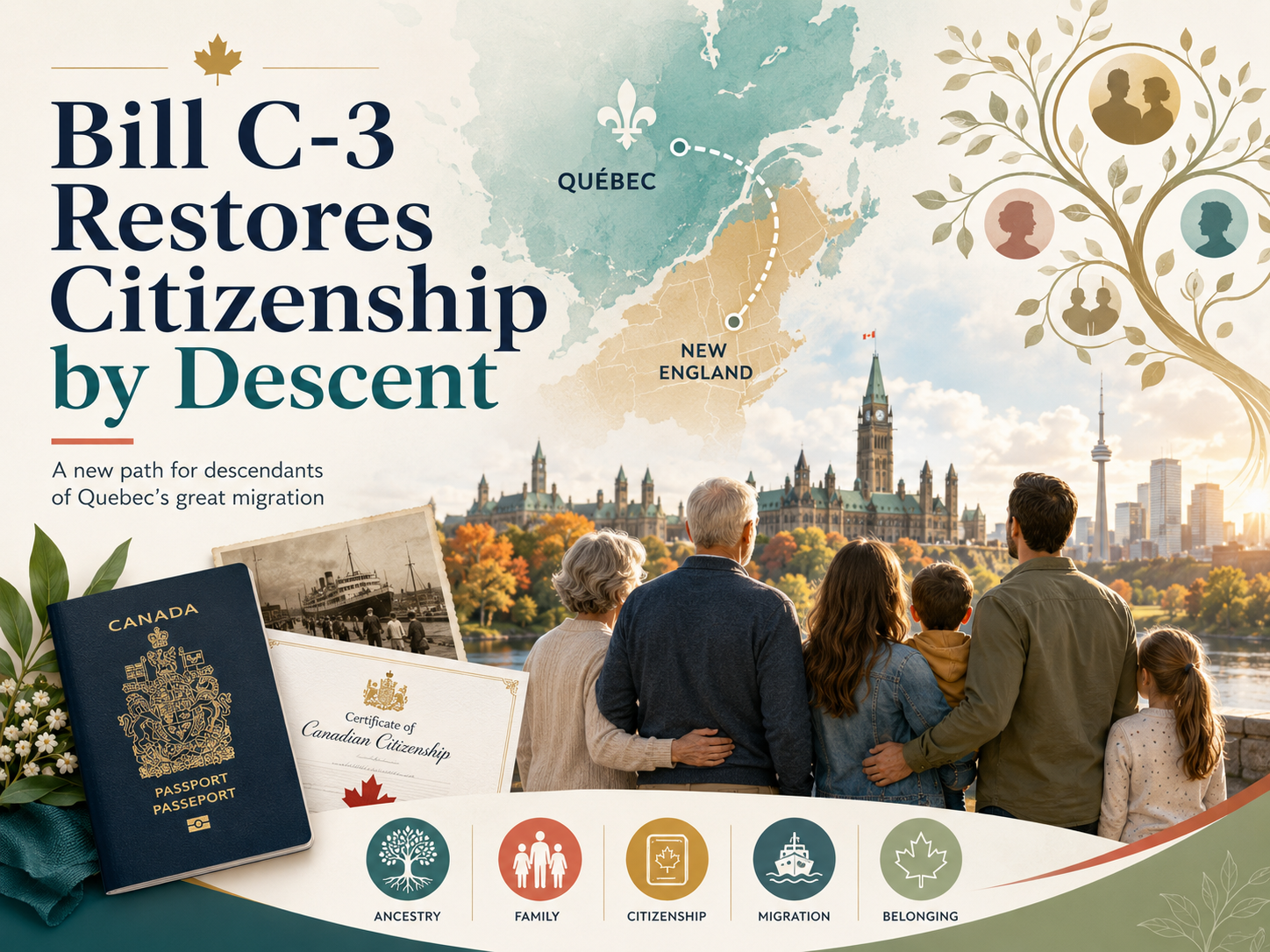
For years, Canada generally stopped citizenship by descent after the first generation born abroad. Bill C-3 changed that rule on December 15, 2025, potentially recognizing people born abroad before that date through a Canadian parent, even where multiple generations were born outside Canada.
Consider a Home Child living in Ontario in 1947 whose Canadian-born son later moved to the United States. His American-born granddaughter might have qualified under earlier rules; her American-born son may now qualify too.
Citizenship is not guaranteed by family history alone. Renunciation, older birth dates, an ancestor’s death and gaps in the legal family chain may change the outcome.
Start with older relatives’ memories of British orphanages, Atlantic crossings or Canadian farm placements. Names such as Barnardo, Macpherson and Fairknowe may offer clues.
Search Library and Archives Canada’s Home Children collection using possible spellings and arrival dates. Passenger lists may identify a ship and sending organization. Census and other historical documents can help establish where the ancestor lived in 1947.
Then gather birth and other records linking each generation. An agency placement record alone cannot prove citizenship. People recognized as citizens may still need a citizenship certificate before applying for a Canadian passport.
For some families, researching a forgotten journey could uncover a present-day legal connection to Canada.











Having an ‘Identity Verified’ badge or being ‘Identity Verified’ simply indicates that an individual has submitted information to complete our identity verification process or we have conducted internal verification using various authorized websites. While this process includes safeguards, it does not guarantee that the person is who they claim to be.
If you encounter any issues with this profile, please report them here. While all consultants who are verified have RCIC ID, we may not have the latest data in terms of their renewal/cancellation/discontinuation of their RCIC ID.
╳The “Verified Consultants” profiles on Immiperts.com are independently compiled using publicly available information from multiple sources, including the official CICC Public Register, consultants’ own websites, other public directories, and social media.
Immiperts.com is a completely independent platform and is not affiliated with, endorsed by, or connected to the College of Immigration and Citizenship Consultants (CICC), IRCC, or any immigration consultant.
All information is collected manually and is for educational and informational purposes only. Consultants may claim, update, or request removal of their profile by contacting us at hello@immiperts.com.
Users are strongly advised to always verify the latest authorization status directly on the official CICC Public Register at college-ic.ca.