
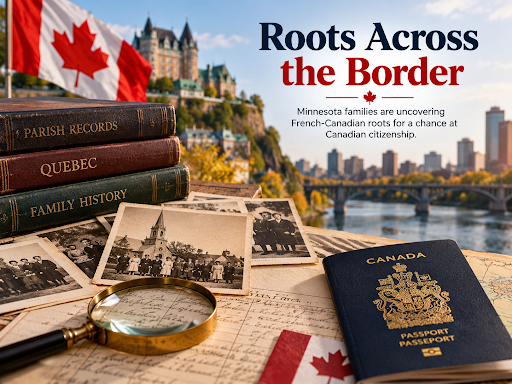


Minnesota families are tracing their Canadian roots after new citizenship rules opened opportunities for eligible descendants.
A change to Canada's citizenship law has sent people across Minnesota searching through family records, church archives and old certificates to find out whether they may already be Canadian citizens.
In Little Canada, north of St. Paul, the local historical society has become a gathering place for residents tracing their family roots to Quebec. Society president Jon Tremblay organized workshops after receiving growing numbers of inquiries about Canadian ancestry.
The Little Canada Historical Society has since developed a starter kit for members beginning their research.
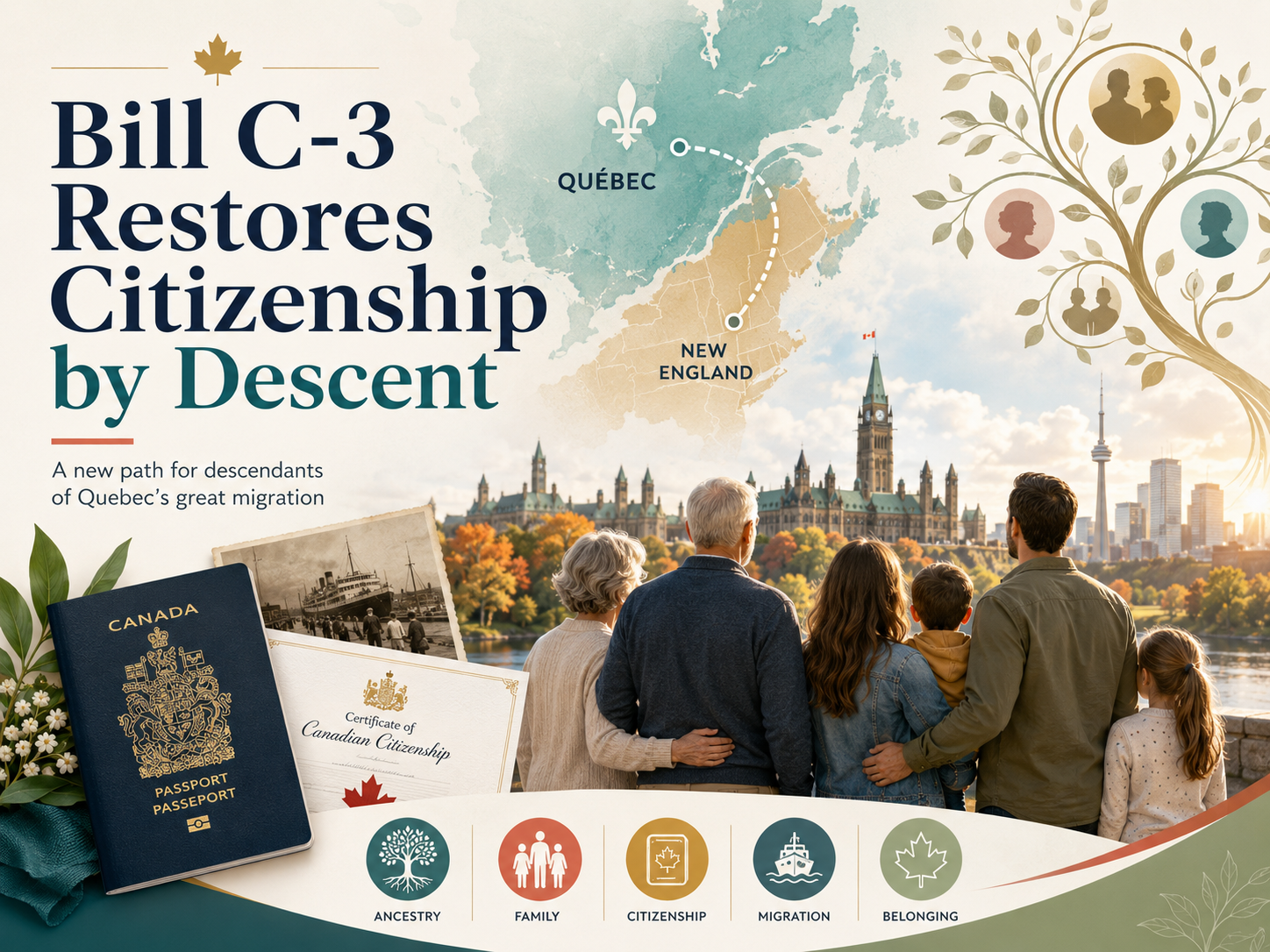
Bill C-3 took effect on December 15, 2025, removing the first-generation limit on citizenship by descent in certain cases.
Previously, Canadians born abroad generally could not pass citizenship to children also born outside Canada. That restriction no longer applies to people born before the law changed.
Some Americans with qualifying Canadian grandparents or great-grandparents may therefore already hold Canadian citizenship. They can apply for a citizenship certificate to establish proof, although family connections alone do not guarantee eligibility.
The change has prompted tens of thousands of ancestry-based certificate applications from Americans each month, according to the original report.
French-Canadian and Métis families founded Little Canada, leaving connections that remain visible throughout the region.
Minnesota historian John Vanek has researched those communities for his book, The Long Road to Little Canada, currently under review by the University of Minnesota Press.
Tremblay spent two months gathering records, exchanging emails and visiting county courthouses before submitting his own citizenship application earlier this year.
He believes more than half of Little Canada's population may have a family connection, although later migration and population growth make an exact figure difficult to establish.
Some residents are discovering links through grandmothers whose French-Canadian surnames disappeared after marriage.
The historical society has held four workshops, attracting between 12 and 50 participants each. Most attendees are looking for ancestors from Quebec.
Its parish records can help families identify relatives, though the society cannot issue certified copies of the documents needed for official applications.
Vanek recommends starting with parents and grandparents, then checking birth certificates, marriage records and documents already kept by relatives.
He also advises choosing a clearly documented family line. Fewer generations can mean less paperwork, but a longer line with stronger records may be easier to prove.
The workshops do not determine anyone's legal status. Instead, they help participants identify missing records and understand where to search next. Certified evidence and a complete family history are important when requesting formal proof from Canada.
The society maintains French-Canadian family binders and Catholic parish records. The Minnesota Genealogical Society also holds extensive Canadian material, including records from provinces beyond Quebec.
Volunteers at both organizations can guide researchers towards archives and historical resources.
The Little Canada Historical Society also serves as Minnesota's French-Canadian centre and helps people beyond the city.
For descendants seeking citizenship proof, careful research and an uninterrupted chain of family documents remain essential.







Having an ‘Identity Verified’ badge or being ‘Identity Verified’ simply indicates that an individual has submitted information to complete our identity verification process or we have conducted internal verification using various authorized websites. While this process includes safeguards, it does not guarantee that the person is who they claim to be.
If you encounter any issues with this profile, please report them here. While all consultants who are verified have RCIC ID, we may not have the latest data in terms of their renewal/cancellation/discontinuation of their RCIC ID.
╳The “Verified Consultants” profiles on Immiperts.com are independently compiled using publicly available information from multiple sources, including the official CICC Public Register, consultants’ own websites, other public directories, and social media.
Immiperts.com is a completely independent platform and is not affiliated with, endorsed by, or connected to the College of Immigration and Citizenship Consultants (CICC), IRCC, or any immigration consultant.
All information is collected manually and is for educational and informational purposes only. Consultants may claim, update, or request removal of their profile by contacting us at hello@immiperts.com.
Users are strongly advised to always verify the latest authorization status directly on the official CICC Public Register at college-ic.ca.