
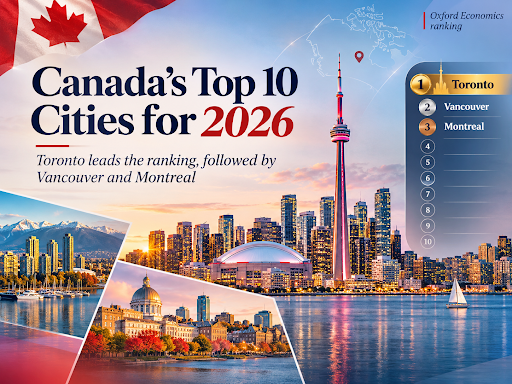


Toronto leads Oxford Economics' 2026 Canadian city rankings, followed by Vancouver and Montreal, based on economic performance, quality of life and other key measures.
Toronto has secured first place among Canada's leading cities in 2026, according to a new ranking published by Oxford Economics on November 10. Vancouver and Montreal followed in second and third place, while cities across six provinces appeared in the top 10.
The rankings compare urban areas using economic performance, workforce characteristics, living conditions, environmental measures and governance. They form part of Oxford Economics' 2026 Global Cities Index, released on September 16, which evaluates 1,000 cities worldwide.
Toronto, Ontario, leads the Canadian list, followed by Vancouver, British Columbia, and Montreal, Quebec. Calgary, Alberta, takes fourth place, with Ottawa–Gatineau, spanning Ontario and Quebec, in fifth.
Edmonton, Alberta, ranks sixth. Kitchener–Cambridge–Waterloo, Ontario, places seventh, followed by Halifax, Nova Scotia, in eighth. Quebec City, Quebec, holds ninth place, while Winnipeg, Manitoba, completes the top 10.
The report examines functional urban areas rather than city limits alone. This means each ranking covers a central city and its surrounding communities connected through daily commuting.
Toronto also leads Canada's international showing, placing 20th worldwide. It received an overall score of 84.9, including 77.7 for Economics and 79.0 for Human Capital.
Vancouver ranks 24th globally, with an overall score of 83.3. It recorded an Environment score of 88.0 and a Quality of Life score of 72.0.
Montreal places 62nd worldwide, scoring 75.9 overall. Its Quality of Life score reached 75.4, higher than those of Toronto, Vancouver and Calgary.
Calgary rounds out Canada's global top 100 in 69th place. Its overall score was 74.9, including 74.0 for Human Capital and 70.4 for Quality of Life.
All Canadian cities received the same Governance score of 90.0 because Oxford Economics measures that category nationally.
Oxford Economics assesses cities in five areas. Economics considers economic output, income per person, employment forecasts, stability and the variety of industries.
Human Capital examines population trends, education, universities, company headquarters and the proportion of residents born outside Canada.
Quality of Life covers income, inequality, housing and utility costs, life expectancy, safety and access to cultural and recreational spaces.
The environment measures air quality, emissions, weather patterns and exposure to natural hazards, including flooding and wildfires. Governance considers political stability, legal institutions, civil liberties, business conditions and corruption control.
Each indicator receives a score between zero and 100, based on how cities compare internationally. The firm combines these results into category scores and then calculates an overall weighted score.
Economics carries 30% of the total. Human Capital and Quality of Life each account for 25%, while Environment and Governance contribute 10% each.
The findings offer a broad comparison of Canadian urban areas, showing how economic opportunities, living conditions and environmental risks can influence a city's standing. They do not measure any single person's experience of living there.
Oxford Economics is an independent economic advisory firm. Its research and forecasts cover more than 200 countries, 100 industries and 8,000 cities, providing context for comparisons between Canadian centres and their international counterparts this year.












Having an ‘Identity Verified’ badge or being ‘Identity Verified’ simply indicates that an individual has submitted information to complete our identity verification process or we have conducted internal verification using various authorized websites. While this process includes safeguards, it does not guarantee that the person is who they claim to be.
If you encounter any issues with this profile, please report them here. While all consultants who are verified have RCIC ID, we may not have the latest data in terms of their renewal/cancellation/discontinuation of their RCIC ID.
╳The “Verified Consultants” profiles on Immiperts.com are independently compiled using publicly available information from multiple sources, including the official CICC Public Register, consultants’ own websites, other public directories, and social media.
Immiperts.com is a completely independent platform and is not affiliated with, endorsed by, or connected to the College of Immigration and Citizenship Consultants (CICC), IRCC, or any immigration consultant.
All information is collected manually and is for educational and informational purposes only. Consultants may claim, update, or request removal of their profile by contacting us at hello@immiperts.com.
Users are strongly advised to always verify the latest authorization status directly on the official CICC Public Register at college-ic.ca.