
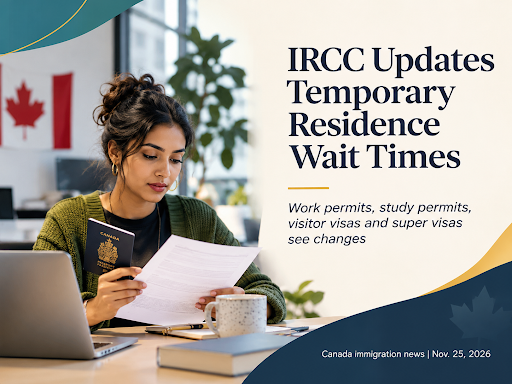


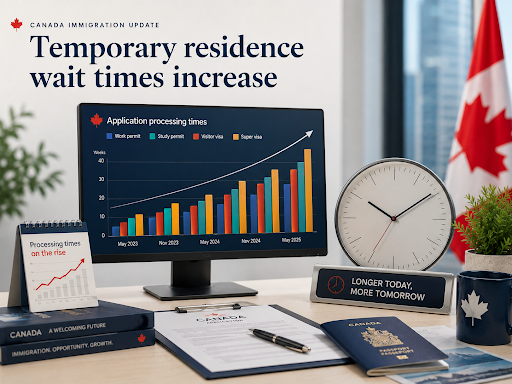
Canada revises processing estimates for work permits, study permits, visitor visas, super visas and extensions.
Immigration, Refugees and Citizenship Canada (IRCC) released updated temporary residence processing times on November 25, 2026, revealing changes across several application categories. While some applicants may benefit from shorter waiting periods, others face longer processing timelines.
The latest figures show notable changes for study permits, work permits, super visas and visitor records. IRCC’s next update is expected around December 2, 2026.
Work permit processing times remained largely stable compared with November 18.
Applicants from India now face an estimated nine-week wait, down from 10 weeks. However, processing times for applicants from the United States increased from three to four weeks.
Applications from Pakistan, Nigeria and the Philippines remain at 10 weeks, while applications from within Canada remain at 16 weeks.
IRCC maintains a service standard of 120 days for in-Canada work permit extensions and 60 days for initial overseas applications.
International students applying from several countries face slightly longer waiting periods.
Processing times for applications submitted within Canada increased to seven weeks. Pakistan recorded an increase to four weeks, Nigeria to 12 weeks and the Philippines to six weeks.
Processing estimates remain unchanged at seven weeks for India and four weeks for the United States.
The service standard remains 120 days for domestic applications and 60 days for overseas submissions.
Visitor visa applicants from Pakistan, Nigeria and the Philippines experienced shorter processing estimates.
Pakistan’s waiting period decreased to 42 days, Nigeria’s to 95 days and the Philippines’ to 22 days.
Meanwhile, India recorded an increase to 33 days, while the United States rose to 21 days. Applications submitted within Canada remain at 12 days.
The service standard for initial overseas visitor visa applications is 14 days.
The Philippines recorded the biggest improvement in super visa processing, with waiting times falling from 97 to 80 days.
Nigeria’s estimate decreased to 26 days. However, processing times increased to 91 days for India, 111 days for Pakistan and 86 days for the United States.
Super visas must be applied for from outside Canada and have a service standard of 112 days.
In-Canada work permit extension processing decreased from 13 to 12 weeks between November 14 and 21. Study permit extensions remained unchanged at eight weeks.
Visitor record processing times dropped from 296 to 280 days between November 18 and 25.
As of November 21, IRCC’s inventory included 180,000 work permit extension applications and 24,700 study permit extension applications, representing decreases of 7,900 and 200, respectively.
Processing times provide approximate waiting periods rather than guaranteed decision dates. IRCC calculates these estimates using historical application data or projections based on existing inventories and available resources.
Service standards represent the department’s target for processing 80% of applications under normal conditions.
Application complexity, additional documentation, processing volumes and verification requirements can affect actual waiting periods.
IRCC finalized 2,292,410 temporary residence applications during the first nine months of 2026, while 347,935 applications remained in its inventory at the end of September.








Having an ‘Identity Verified’ badge or being ‘Identity Verified’ simply indicates that an individual has submitted information to complete our identity verification process or we have conducted internal verification using various authorized websites. While this process includes safeguards, it does not guarantee that the person is who they claim to be.
If you encounter any issues with this profile, please report them here. While all consultants who are verified have RCIC ID, we may not have the latest data in terms of their renewal/cancellation/discontinuation of their RCIC ID.
╳The “Verified Consultants” profiles on Immiperts.com are independently compiled using publicly available information from multiple sources, including the official CICC Public Register, consultants’ own websites, other public directories, and social media.
Immiperts.com is a completely independent platform and is not affiliated with, endorsed by, or connected to the College of Immigration and Citizenship Consultants (CICC), IRCC, or any immigration consultant.
All information is collected manually and is for educational and informational purposes only. Consultants may claim, update, or request removal of their profile by contacting us at hello@immiperts.com.
Users are strongly advised to always verify the latest authorization status directly on the official CICC Public Register at college-ic.ca.