
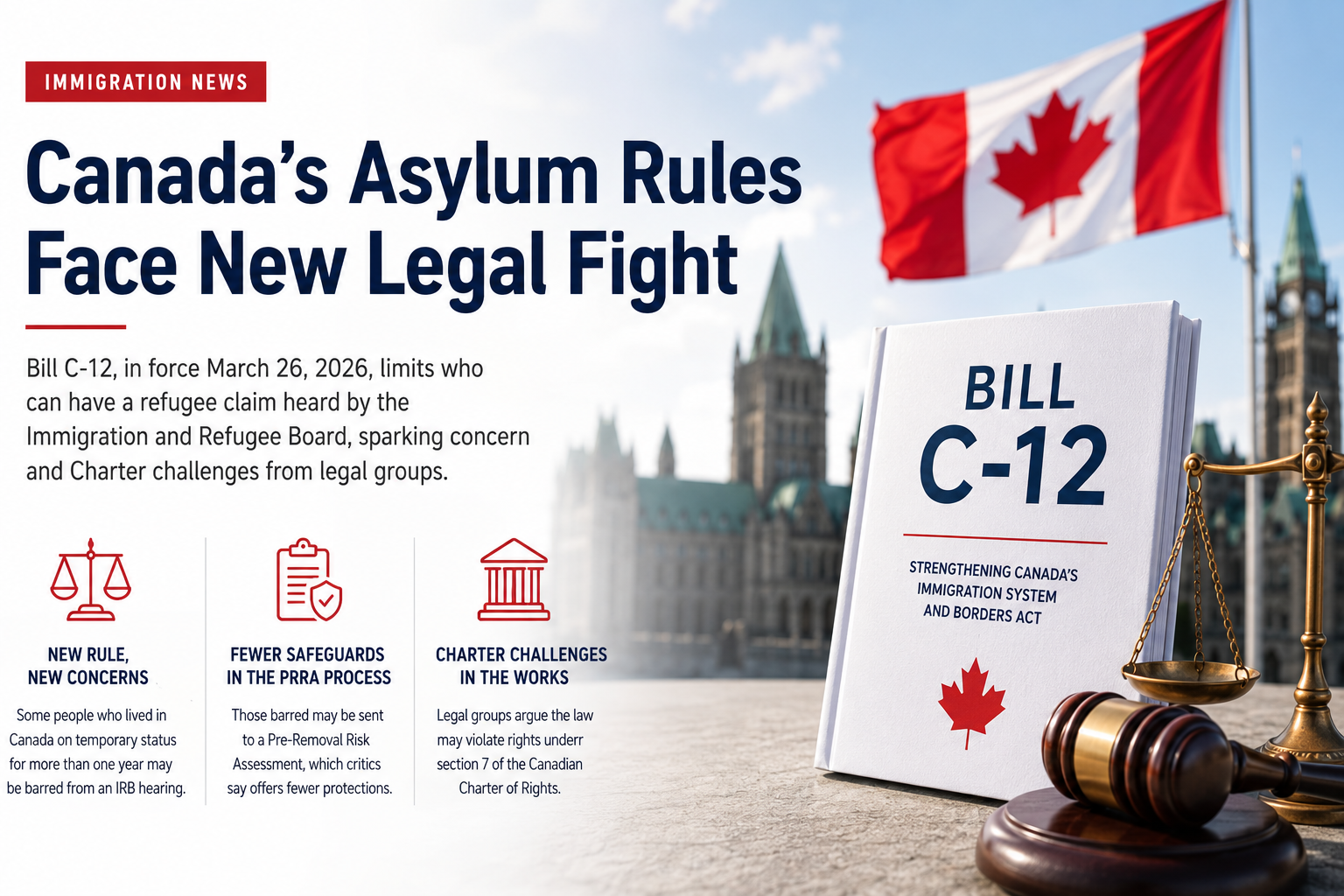


A new refugee rule is drawing legal challenges from lawyers and advocacy groups across Canada.
Canada’s reputation as a safe place for refugees is facing fresh debate after a new immigration law came into force on March 26, 2026. The law, known as Bill C-12 or the Strengthening Canada’s Immigration System and Borders Act, includes a rule that limits who can have a refugee claim heard by the Immigration and Refugee Board.
The measure, often called the Bill C-12 Canada asylum bar, affects some people who have lived in Canada on temporary status for more than one year before making a refugee claim. Under the new rule, they may be found ineligible to have their case sent to the Refugee Protection Division of the IRB.
That marks a major shift from the previous system, which gave broader access to refugee hearings for people already in Canada. An IRB hearing allows claimants to speak before an independent decision-maker, present evidence and make legal arguments.
People barred from an IRB hearing may instead be directed to a Pre-Removal Risk Assessment, or PRRA. This is a written process handled by Immigration, Refugees and Citizenship Canada officers.
Lawyers say the PRRA offers fewer protections because it does not provide the same independent oral hearing as the IRB process. They also point to historically low approval rates for PRRA applications.
Critics argue the change creates a two-level refugee system. They say people facing similar danger could receive different levels of protection simply because one person waited longer than another before making a claim.
Immigration lawyers and refugee advocates are preparing court challenges against the law. Groups involved include the Refugee Lawyers Association of Ontario, the Canadian Association of Refugee Lawyers and the Canadian Immigration Lawyers Association.
Their concerns focus on section 7 of the Canadian Charter of Rights and Freedoms, which protects life, liberty and security of the person. Lawyers argue that denying a full hearing to someone who may face persecution or serious harm could put those rights at risk.
The law has also drawn concern because of how far back it reaches. The one-year calculation applies to people who entered Canada after June 24, 2020, when Canada began formally tracking air and land entries and exits.
This means someone who visited Canada years ago, left, later faced danger at home and returned to seek protection could be blocked from a full IRB hearing because of that earlier stay.
Legal experts say people often delay refugee claims for real and understandable reasons. Some fear losing their student or work status. Others hope conditions in their home country will improve. Many do not know their rights or cannot quickly find legal advice.
An international student, for example, may build a life in Canada before realizing they cannot safely return home because of their identity, beliefs or personal situation. Under the old system, that person could seek a full refugee hearing. Under the new rule, a delay of more than one year may lead to a more limited process.
The legal fight over Bill C-12 may take time. Charter challenges can move slowly through Canadian courts, and a final decision may be years away.
For now, people who receive ineligibility notices may still have options. These can include a PRRA, a Federal Court judicial review, or, in some cases, an application on humanitarian and compassionate grounds.









Having an ‘Identity Verified’ badge or being ‘Identity Verified’ simply indicates that an individual has submitted information to complete our identity verification process or we have conducted internal verification using various authorized websites. While this process includes safeguards, it does not guarantee that the person is who they claim to be.
If you encounter any issues with this profile, please report them here. While all consultants who are verified have RCIC ID, we may not have the latest data in terms of their renewal/cancellation/discontinuation of their RCIC ID.
╳The “Verified Consultants” profiles on Immiperts.com are independently compiled using publicly available information from multiple sources, including the official CICC Public Register, consultants’ own websites, other public directories, and social media.
Immiperts.com is a completely independent platform and is not affiliated with, endorsed by, or connected to the College of Immigration and Citizenship Consultants (CICC), IRCC, or any immigration consultant.
All information is collected manually and is for educational and informational purposes only. Consultants may claim, update, or request removal of their profile by contacting us at hello@immiperts.com.
Users are strongly advised to always verify the latest authorization status directly on the official CICC Public Register at college-ic.ca.