
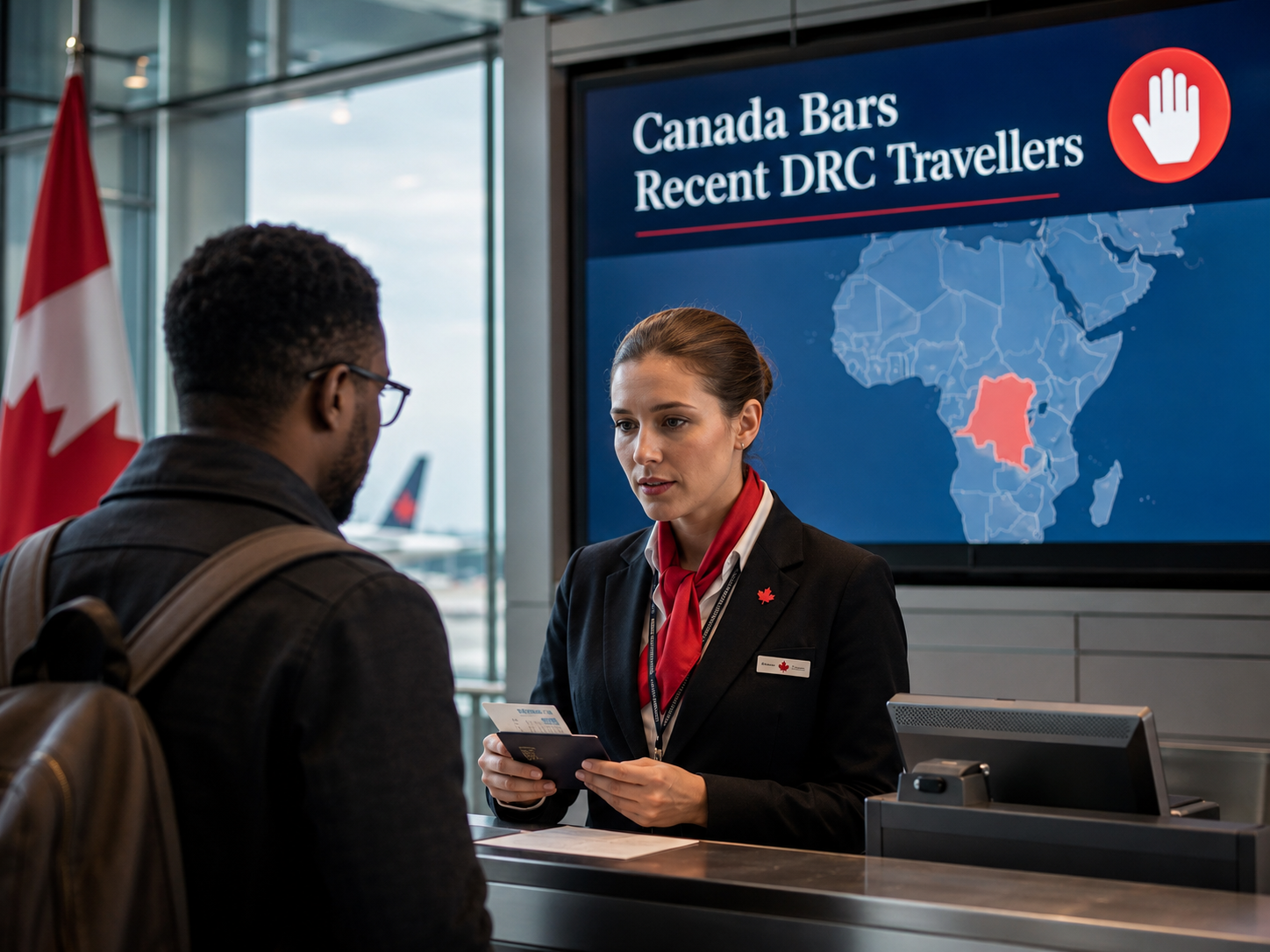


Foreign nationals who recently visited the DRC cannot board flights to Canada under temporary Ebola controls.
Canada will temporarily deny entry to foreign nationals who have been in the Democratic Republic of the Congo within the previous 21 days as it responds to a growing Ebola outbreak.
The restriction took effect at 11:59 p.m. EDT on July 20, 2026. Commercial and private air carriers must prevent affected foreign nationals from boarding flights bound for Canada under an interim order issued through the Aeronautics Act.
The Public Health Agency of Canada announced the measure on July 19. It is scheduled to remain in place until August 29, alongside other temporary border and immigration controls.
The entry ban does not apply to Canadian citizens, permanent residents or people registered under the Indian Act. Those travellers may still enter Canada after recent travel to the DRC, Uganda or South Sudan.
However, they must undergo a health assessment when they arrive and quarantine for 21 days if they do not have Ebola symptoms. Travellers who show symptoms will receive an immediate medical examination and be placed in isolation at a hospital or another suitable facility.
The government introduced the broader quarantine rules on May 30. They apply to eligible travellers who were in any of the three countries during the 21 days before arriving in Canada, although limited exemptions exist for certain workers and officials.
Canada has also temporarily suspended certain immigration documents held by foreign nationals whose applications listed the DRC, Uganda or South Sudan as their last country of residence.
Affected documents include temporary resident visas, permanent resident visas, electronic travel authorizations and some temporary resident permits. Immigration officials continue to process applications, but they are not finalizing affected cases while the measures remain active.
Those immigration restrictions began in late May and are set to end at 11:59 p.m. ET on August 28. The broader health controls remain in effect until August 29.
The powers to suspend or change immigration documents were added to the Immigration and Refugee Protection Act through Bill C-12. The legislation received royal assent on March 26, 2026.
The World Health Organization reported 2,124 confirmed Ebola cases and 828 deaths in the DRC as of July 15. That equals a reported fatality rate of 39 per cent. The outbreak had reached 46 health zones across five provinces.
Uganda had recorded 20 confirmed cases and two deaths by July 14. WHO said the country had reported no new confirmed case since June 21. South Sudan had not reported a confirmed case in the figures cited when Canada introduced its measures.
PHAC said the health risk to Canadians remains low and that Canada has not reported a travel-related Ebola case. The agency described the controls as precautionary measures intended to reduce the chance of the virus entering and spreading in the country.
Officials said the rules may change as new evidence becomes available, and travellers should review current federal health and entry guidance before making international travel plans.






Having an ‘Identity Verified’ badge or being ‘Identity Verified’ simply indicates that an individual has submitted information to complete our identity verification process or we have conducted internal verification using various authorized websites. While this process includes safeguards, it does not guarantee that the person is who they claim to be.
If you encounter any issues with this profile, please report them here. While all consultants who are verified have RCIC ID, we may not have the latest data in terms of their renewal/cancellation/discontinuation of their RCIC ID.
╳The “Verified Consultants” profiles on Immiperts.com are independently compiled using publicly available information from multiple sources, including the official CICC Public Register, consultants’ own websites, other public directories, and social media.
Immiperts.com is a completely independent platform and is not affiliated with, endorsed by, or connected to the College of Immigration and Citizenship Consultants (CICC), IRCC, or any immigration consultant.
All information is collected manually and is for educational and informational purposes only. Consultants may claim, update, or request removal of their profile by contacting us at hello@immiperts.com.
Users are strongly advised to always verify the latest authorization status directly on the official CICC Public Register at college-ic.ca.