
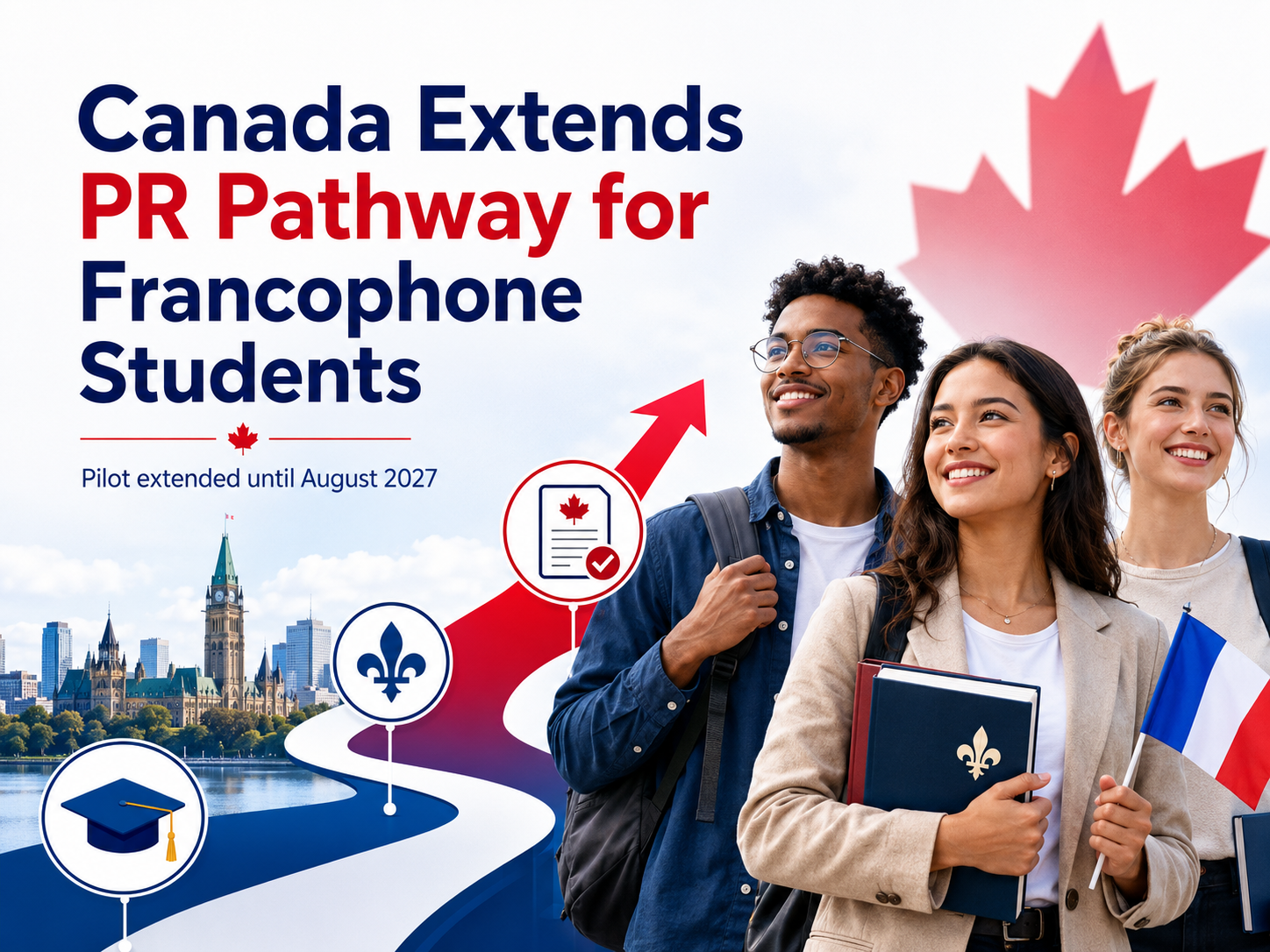


Eligible French-speaking students can now use the pilot until August 2027.
Canada has extended a special study-to-permanent-residence pathway for eligible French-speaking international students who want to settle outside Quebec.
The Francophone Minority Communities Student Pilot, known as the FMCSP, will now remain open until August 2027. The program allows qualifying foreign students to apply for permanent residence without needing a job offer after graduation, provided they meet the required conditions.
The pilot was previously set to close on August 25, 2026, or earlier if its study permit cap was reached. Immigration Minister Lena Metlege Diab announced the extension on July 6 during a press conference in Winnipeg, Manitoba.
The federal government has not yet released the study permit cap for the extended period from August 2026 to August 2027.
The FMCSP gives eligible French-speaking students a more direct path to permanent residence than the usual student route. Many international students normally move from a study permit to a post-graduation work permit, and then try to qualify through Canadian Experience Class.
Under this pilot, students who complete an eligible program in Canada may apply for permanent residence through the FMCSP if they meet the rules.
The language requirement is also lower than the level required in Express Entry French category draws. FMCSP applicants need French ability at NCLC level 5, while Express Entry French category draws require NCLC level 7.
The extension supports Ottawa’s wider goal of increasing the number of French-speaking permanent residents outside Quebec to 12 per cent by 2029.
To use the pathway, students must first receive an FMCSP-specific study permit. Applicants must live outside Canada when they apply and must be citizens of an eligible country.
They also need a letter of acceptance from a participating designated learning institution outside Quebec. The letter must confirm that the student is applying through the FMCSP.
The study program must be full-time, last at least two years, be at the post-secondary level, and lead to a diploma or degree. More than half of the instruction must be in French.
Applicants must also show NCLC 5 French ability in all four language skills and prove they have enough money for tuition and living costs. The required living expense amount depends on the size of the community where the main campus is located.
Some applicants may also need a police certificate or medical exam.
IRCC launched the FMCSP on August 26, 2024, with a first-year cap of 2,300 study permit applications. For the second year, from August 26, 2025, to August 25, 2026, the cap increased to 2,970 applications.
There are currently 17 participating institutions, including Collège Boréal, Collège La Cité, Université de Moncton, Université de Saint-Boniface, University of Alberta, University of Ottawa, University of Regina, York University’s Glendon campus, and others across several provinces. More schools may be added later.
Most applicants must apply online through an IRCC Secure Account. During the application, they must indicate that they meet an exception from submitting a provincial or territorial attestation letter.
Successful applicants receive a port of entry letter of introduction. Depending on their situation, they may also receive an electronic Travel Authorization or visitor visa. The study permit is issued at the port of entry after an officer confirms they can enter Canada.
Graduates may apply for permanent residence if they live in Canada outside Quebec, hold valid temporary resident status, and earned an eligible diploma or degree while studying on an FMCSP study permit.
Those who finish their program and apply for permanent residence may also apply for an FMCSP-specific work permit. This allows them to work outside Quebec while they wait for a decision.












Having an ‘Identity Verified’ badge or being ‘Identity Verified’ simply indicates that an individual has submitted information to complete our identity verification process or we have conducted internal verification using various authorized websites. While this process includes safeguards, it does not guarantee that the person is who they claim to be.
If you encounter any issues with this profile, please report them here. While all consultants who are verified have RCIC ID, we may not have the latest data in terms of their renewal/cancellation/discontinuation of their RCIC ID.
╳The “Verified Consultants” profiles on Immiperts.com are independently compiled using publicly available information from multiple sources, including the official CICC Public Register, consultants’ own websites, other public directories, and social media.
Immiperts.com is a completely independent platform and is not affiliated with, endorsed by, or connected to the College of Immigration and Citizenship Consultants (CICC), IRCC, or any immigration consultant.
All information is collected manually and is for educational and informational purposes only. Consultants may claim, update, or request removal of their profile by contacting us at hello@immiperts.com.
Users are strongly advised to always verify the latest authorization status directly on the official CICC Public Register at college-ic.ca.