



Forgotten maiden names could help Americans uncover their eligibility for Canadian dual citizenship.
Americans searching for Canadian ancestry may find an important clue in their grandmother’s maiden name. Surnames such as King, White, Tremblay and Desjardins could point to family connections with Canada.
Under Bill C-3, which took effect on December 15, 2025, people born before that date may qualify for Canadian citizenship by descent through a Canadian ancestor, even several generations back. A surname alone, however, does not establish citizenship.
Women who adopted their spouses’ surnames after marriage often left behind family names that disappeared from later generations. A 2007 Ancestry.com survey found that fewer than half of Americans knew both their grandmothers’ maiden names.
With American Thanksgiving approaching, family gatherings offer an opportunity to ask older relatives about forgotten names, birthplaces and migration histories.
French-Canadian families settling in the United States often translated their surnames or changed their spelling. White sometimes came from Leblanc, King from Roy, Wood from Dubois and Stone from Lapierre.
Other examples include Carpenter from Charpentier, Greenwood from Boisvert, Bushey from Boucher and Pelkey from Pelletier. These names may warrant further research, particularly among families with roots in New England or the Upper Midwest.
Approximately 900,000 Quebec residents moved to the United States between 1840 and 1930. Many settled in New England mill towns, bringing surnames such as Tremblay, Gagnon, Côté, Ouellet, Simard, Desjardins, Lavoie, Fortin and Bouchard.
Families of Scottish and Irish descent also migrated from Nova Scotia, New Brunswick and Prince Edward Island. Names such as MacDonald, McDonald, Campbell, Fraser, Cameron and Morrison may provide clues to Atlantic Canadian ancestry when supported by historical records.
Some French-Canadian families used an additional surname known as a dit name. Immigrants sometimes retained only one surname after moving to the United States.
Examples include Audet dit Lapointe, Pépin dit Lachance and Demet dit Beaulieu. Searching both names may help researchers locate baptismal records and other historical documents. The American-French Genealogical Society maintains a searchable surname list.
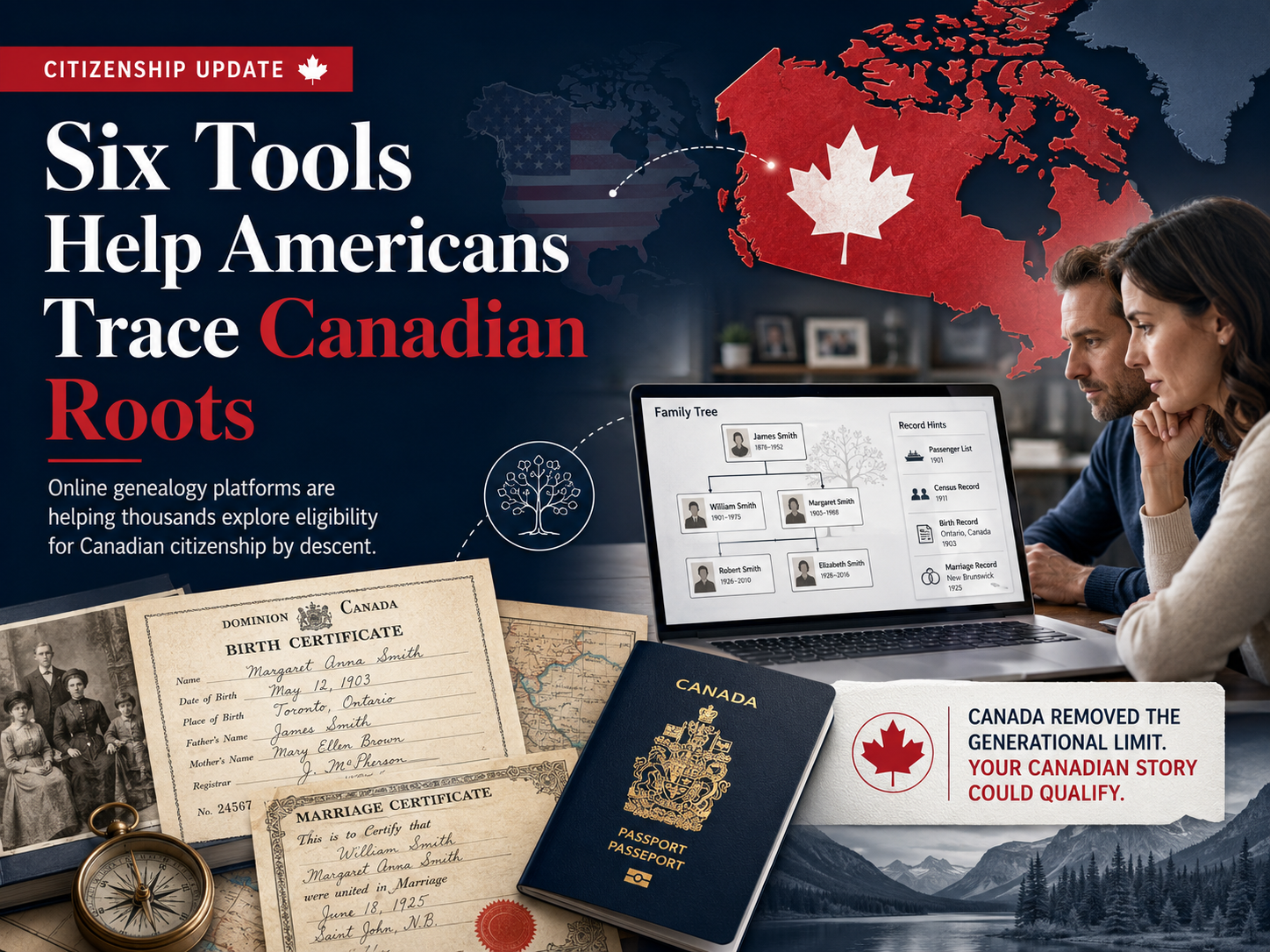
Immigration, Refugees and Citizenship Canada (IRCC) requires applicants to document each generation connecting them to their Canadian ancestor. Birth and marriage certificates can help establish these relationships and explain surname changes over several generations.
Since 1981, Quebec spouses have retained their birth surnames for legal purposes, meaning Canadian and American records may identify the same woman differently.
Historical laws can also complicate applications. Before 1947, women who married men from outside the British Empire could lose their British subject status. A 2015 amendment restored citizenship rights to many affected women, although evidence of a husband’s foreign nationality may be necessary.
Bill C-3 and earlier reforms removed discriminatory citizenship rules, but applicants must still establish their family connections through reliable documentation.
Anyone investigating Canadian ancestry should begin by gathering family records, checking alternative spellings and carefully tracing each generation. Those who establish eligibility can apply for a Canadian citizenship certificate as proof of their status before seeking a passport.









Having an ‘Identity Verified’ badge or being ‘Identity Verified’ simply indicates that an individual has submitted information to complete our identity verification process or we have conducted internal verification using various authorized websites. While this process includes safeguards, it does not guarantee that the person is who they claim to be.
If you encounter any issues with this profile, please report them here. While all consultants who are verified have RCIC ID, we may not have the latest data in terms of their renewal/cancellation/discontinuation of their RCIC ID.
╳The “Verified Consultants” profiles on Immiperts.com are independently compiled using publicly available information from multiple sources, including the official CICC Public Register, consultants’ own websites, other public directories, and social media.
Immiperts.com is a completely independent platform and is not affiliated with, endorsed by, or connected to the College of Immigration and Citizenship Consultants (CICC), IRCC, or any immigration consultant.
All information is collected manually and is for educational and informational purposes only. Consultants may claim, update, or request removal of their profile by contacting us at hello@immiperts.com.
Users are strongly advised to always verify the latest authorization status directly on the official CICC Public Register at college-ic.ca.