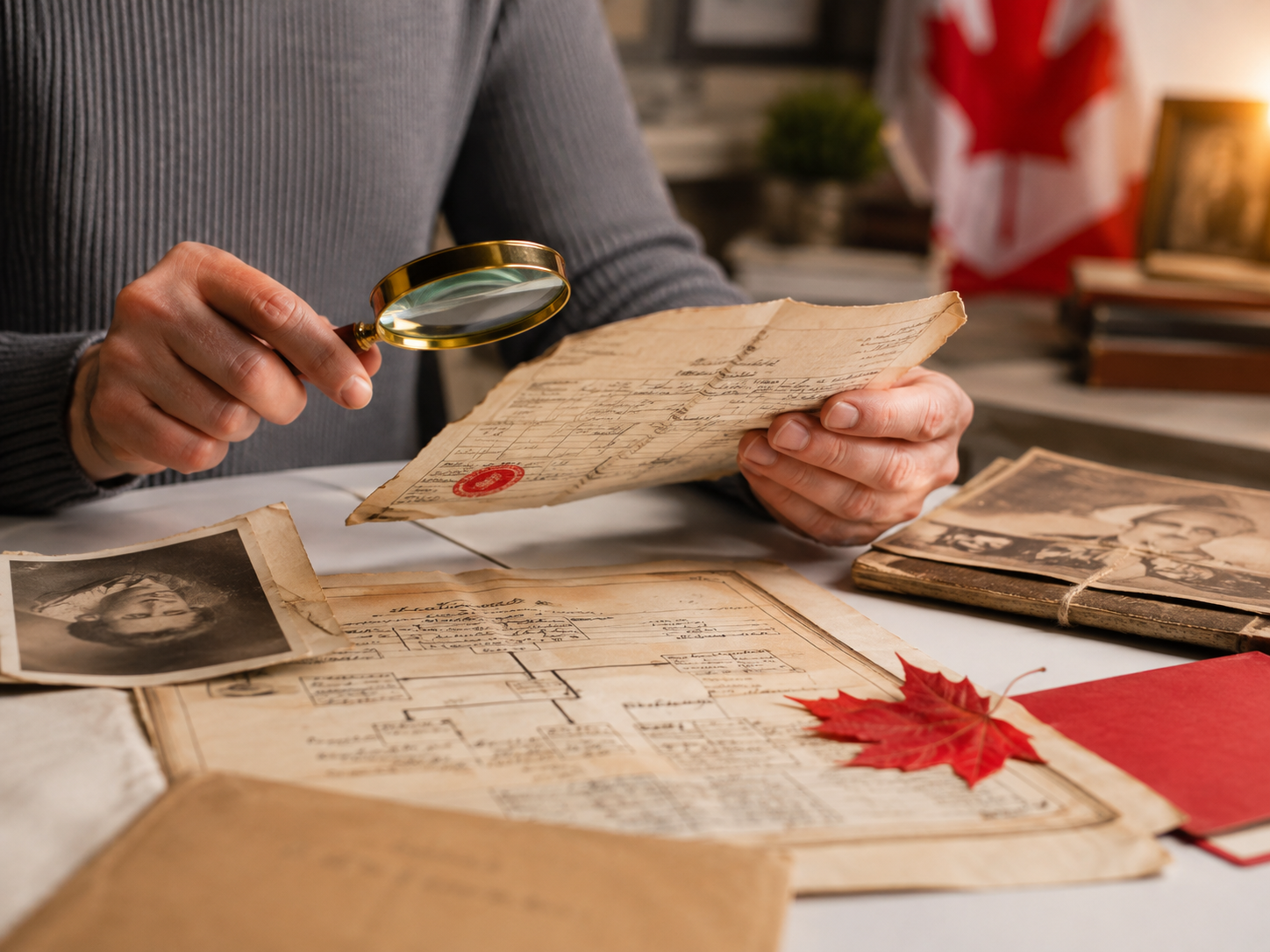


You find an old baptismal record or birth entry linking you to a Canadian ancestor, but it is only a copy. Now the worry starts: will IRCC reject it because it is not certified? That uncertainty can delay filing, waste money, or push applicants toward the wrong evidence.
Not always. IRCC’s current guidance focuses on whether documents are authentic, reliable, verifiable, and issued by the original authority that created or keeps the record.
An uncertified copy is not automatically useless. IRCC may still ask for more evidence if a record is doubtful, hard to read, or does not clearly prove a family link. The supplied source similarly notes that IRCC’s focus is primarily on the source of the document, rather than certification alone.
The main question is not whether a document has a stamp. It is whether the record can be trusted and whether it proves the chain from you to your Canadian ancestor.
IRCC asks paper applicants for clear colour copies and online applicants for high-quality colour images.
Common records include:
If a birth certificate is unavailable, IRCC may also accept hospital birth records, physician or midwife records, baptismal records, census records, or boat manifests from the original authority.
Genealogy websites are useful for research, but they should not form the whole application.
IRCC says a citizenship certificate application cannot be supported solely by third-party records. If you find a record on a genealogy website, use it to identify the archive, registry, diocese, or government office that holds the original record. Then request it from that authority.
Think of a genealogy printout as a clue, not the final proof.
A missing record does not automatically end the claim. IRCC says applicants who cannot provide an official record should explain why and show that they tried to obtain it.
This helps show that the gap is genuine.
Yes. Library and Archives Canada has naturalization lists covering 1915 to 1951. These can identify an ancestor who naturalized in Canada and may provide a certificate number.
Not everyone appears in these lists. Before 1947, people who were British subjects by birth did not necessarily need to naturalize. A missing name, therefore, does not prove that an ancestor lacked Canadian status.
Review the family line one generation at a time:
Canada changed its citizenship-by-descent rules on December 15, 2025. Eligibility and documentary proof are related but separate questions. A possible legal claim still needs enough records to prove the family connection.
An uncertified family record is not automatically a dead end. What matters more is whether it comes from a trustworthy source and helps prove an unbroken link to the Canadian ancestor.
Build the application around official, traceable records. Use other evidence to support missing links, document unsuccessful searches, and avoid relying only on genealogy-site printouts. Cases involving missing generations, adoption, conflicting identities, or older citizenship rules may benefit from advice from a qualified Canadian immigration professional.
Potentially. IRCC accepts baptismal records in some cases, especially when a birth record is unavailable, but the document should come from the authority that created or maintains it.
Not as the only proof. Use third-party records to locate the official source, then obtain the strongest available record from that source.
Contact the authority that should hold it and keep proof of the search. Explain the missing record and provide other reliable documents supporting the family link.
Yes. Their value depends on what they show, where they came from, and how well they fit with the rest of the file.
Yes, especially when a record is old, unclear, inconsistent, or central to the claim. Certification can reduce questions even though current IRCC guidance does not impose a blanket certification requirement on every supporting record.
Having an ‘Identity Verified’ badge or being ‘Identity Verified’ simply indicates that an individual has submitted information to complete our identity verification process or we have conducted internal verification using various authorized websites. While this process includes safeguards, it does not guarantee that the person is who they claim to be.
If you encounter any issues with this profile, please report them here. While all consultants who are verified have RCIC ID, we may not have the latest data in terms of their renewal/cancellation/discontinuation of their RCIC ID.
╳The “Verified Consultants” profiles on Immiperts.com are independently compiled using publicly available information from multiple sources, including the official CICC Public Register, consultants’ own websites, other public directories, and social media.
Immiperts.com is a completely independent platform and is not affiliated with, endorsed by, or connected to the College of Immigration and Citizenship Consultants (CICC), IRCC, or any immigration consultant.
All information is collected manually and is for educational and informational purposes only. Consultants may claim, update, or request removal of their profile by contacting us at hello@immiperts.com.
Users are strongly advised to always verify the latest authorization status directly on the official CICC Public Register at college-ic.ca.