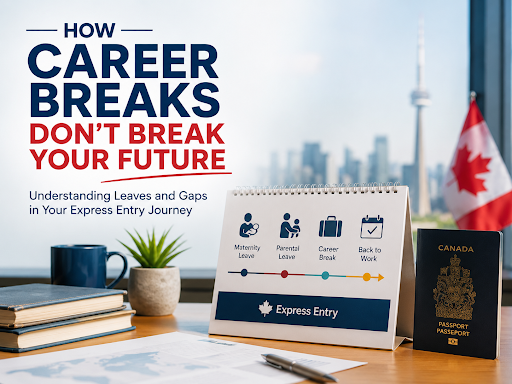


A few months away from work can change an Express Entry application more than many applicants expect. Express Entry work experience is not judged only by your job title or the dates on your employment letter. Maternity leave, parental leave, unpaid leave, or a career break can affect how many hours IRCC accepts, whether your work remains continuous, and whether you still meet the rules of your chosen program.
A work gap does not automatically make you ineligible. The timing, pay status, and program rules decide how it affects your application.
Express Entry programs do not all count work the same way.
The Canadian Experience Class usually requires one year, or 1,560 hours, of authorized paid skilled work in Canada during the three years before you apply. The work must normally be in TEER 0, 1, 2, or 3. IRCC counts a maximum of 30 hours per week, but the experience does not have to be continuous.
You may combine eligible work completed before and after a break if all counted hours remain within the three-year window.
The Federal Skilled Worker Program requires at least one year of continuous paid skilled work, equal to 1,560 hours, in your primary occupation during the previous 10 years.
If unpaid leave or a lengthy break falls inside the 12-month period you are using to qualify, it may break continuity. A break taken after you completed an eligible continuous year does not erase that earlier experience.
The Federal Skilled Trades Program generally requires two years, or 3,120 hours, of paid trade experience within the five years before applying.
IRCC’s published rules require paid work through wages or commission and calculate eligibility using qualifying hours. They do not provide a universal statement that every week of maternity or parental leave counts as work experience.
Remaining employed is not always the same as performing qualifying work. A careful approach is to count the weeks and hours you actually worked rather than automatically including time when you:
Get individual advice if you worked part-time or continued performing duties.
Unpaid leave normally adds no qualifying hours because Express Entry experience must be paid.
Stop counting when the leave begins and resume when you return. You must still reach 1,560 eligible hours within the three years before applying.
An unpaid break can interrupt the required continuous 12 months. You may need an earlier uninterrupted year or a new continuous year after returning.
A career break carries no separate Express Entry penalty. What matters is whether your earlier work remains inside the program’s time limit, matches the correct NOC and TEER, and can be proven.
For example, qualifying foreign work followed by a caregiving break may remain valid under the 10-year Federal Skilled Worker window. Under the Canadian Experience Class, later eligible work may be added if it remains within three years.
Never hide maternity leave, unemployment, caregiving, study, or another period away from work. IRCC warns that false information or omitted details can lead to refusal and may result in a five-year ban for misrepresentation.
Include claimed jobs in your work history and explain all remaining periods in your personal history without gaps.
Ask your employer for a reference letter showing:
If leave occurred, ask the employer to state its dates and your return date. Keep pay slips, tax records, contracts, leave approvals, and Records of Employment.
Maternity leave, parental leave, unpaid leave, and career breaks do not automatically end an Express Entry plan. Problems arise when non-working time is counted as work, a break interrupts the Federal Skilled Worker continuous year, or older experience falls outside the relevant window.
Calculate eligible hours, confirm your program, and disclose the leave clearly. If the disputed period is essential to eligibility or your CRS score, seek advice from an authorized Canadian immigration representative before applying.
Maternity leave does not create a direct CRS deduction. Your score may change only if excluding that period leaves you with fewer completed years of qualifying work.
Receiving EI benefits does not automatically mean you performed paid work for Express Entry. Count your actual eligible hours and seek advice if your employer continued paying regular wages.
No. Eligible Canadian work can generally be accumulated across different periods and jobs, provided you reach 1,560 hours within three years.
Yes, if it interrupts the only 12-month period used to meet the continuous-work requirement. An earlier completed continuous year may still qualify.
Usually yes under the Canadian Experience Class if both periods qualify and remain within three years. Under the Federal Skilled Worker Program, separated periods may not satisfy the initial continuous year.
Having an ‘Identity Verified’ badge or being ‘Identity Verified’ simply indicates that an individual has submitted information to complete our identity verification process or we have conducted internal verification using various authorized websites. While this process includes safeguards, it does not guarantee that the person is who they claim to be.
If you encounter any issues with this profile, please report them here. While all consultants who are verified have RCIC ID, we may not have the latest data in terms of their renewal/cancellation/discontinuation of their RCIC ID.
╳The “Verified Consultants” profiles on Immiperts.com are independently compiled using publicly available information from multiple sources, including the official CICC Public Register, consultants’ own websites, other public directories, and social media.
Immiperts.com is a completely independent platform and is not affiliated with, endorsed by, or connected to the College of Immigration and Citizenship Consultants (CICC), IRCC, or any immigration consultant.
All information is collected manually and is for educational and informational purposes only. Consultants may claim, update, or request removal of their profile by contacting us at hello@immiperts.com.
Users are strongly advised to always verify the latest authorization status directly on the official CICC Public Register at college-ic.ca.